Latest News

a, Arts & Entertainment, Music

Aloe Blacc—Lift your spirit

Products don’t always live up to their advertisements, but Aloe Blacc’s Lift Your Spirit holds true to its promise. Blacc’s innovative third album dips into multiple genres and realizes its promise of lifting listeners’ spirits through an upbeat mix of classic and novel sounds.

Tending towards simple and iconic subject matter, the tracks mainly focus on love, faith, and money, but ventures occasionally into political or existential territory, as “Ticking Bomb” does prominently. The album’s spirit never becomes downtrodden though, as Blacc explores all topics with the subtle emotion and grace that most will remember from his 2010 hit, “I Need a Dollar.”

The playful humour on Lift You Spirit’s most danceable tracks, “Can You Do This” and “The Man,” comes out on lines such as “I played my cards and I didn’t fold/Well it ain’t that hard when you got soul.” Interestingly, these tracks also show Blacc partake in hip hop’s conventional egotism, which he was previously stated he was “uncomfortable with” in a 2010 interview with the website HipHipDX. Perhaps he feels that his recent successes indeed warrant some measured bravado.

After all, the only blips on Lift Your Spirit are the country-infused “Here Today” and “Wake Me Up”—which Blacc originally performed vocals for on Avicii’s megahit—but Blacc’s luscious voice somewhat salvages even these. Considering Montreal’s brutal weather this March, it’s probably best for your spirit’s health and well-being to try a listen. You’ll get quality music, but more importantly, some of the advertised good vibes too.

a, News, SSMU

Tariq Khan’s presidency invalidated due to multiple bylaw infractions

Elections SSMU has invalidated Tariq Khan’s presidential win due to multiple bylaw infractions during the campaign period.

As a result of the invalidation, runner-up Courtney Ayukawa has been declared the president-elect for the Students’ Society of McGill University (SSMU). Ayukawa lost the presidential race to Khan by 78 votes on March 21.

Khan’s campaign period was marked by allegations of bylaw violations, including a public censure on March 21 for campaign activities carried out by individuals who were not members of Khan’s campaign team.

Chief Electoral Officer (CEO) Ben Fung said Elections SSMU received evidence that Khan violated more than this one bylaw during the campaign period.

“In the time following the elections we were made aware of several things, either through email, our own investigations, or requests for investigations of new information,” he said. “Part of our due diligence is to seek the testimony of all parties [….] We [took] all this information into consideration.”

According to Elections SSMU, Khan’s bylaw infractions include financial inconsistencies within his budget report, unsolicited messages regarding campaigning to SSMU members, and the “impingement of the spirit of a fair campaign and of the voting process.”

“We won’t go into more detail at this time because we want to respect the privacy of all the parties involved in this situation,” Fung said.

SSMU bylaws allow the CEO to invalidate an election if they deem “any grave violation of the Constitution, bylaws, or policies” to have “adversely affected the outcome of the election.”

According to Ayukawa, a petition to overturn the election was also submitted to the Judicial Board after Tariq’s election.

“The J-Board case was […] saying that Elections SSMU did not uphold the spirit of a fair campaign, which allowed Tariq to get the equivalent of at least 78 votes because he broke so many rules,” she said.

Incoming Vice-President University Affairs Claire Stewart-Kanigan said she was one of the students who communicated personal concerns about bylaw violations with Elections SSMU during the campaign period and following Tariq’s election. According to Stewart-Kanigan, the evidence from the petition will clarify the decision to students.

“There’ll be a lot of substantial evidence there,” she said. “Within the first day, I’d heard that Elections SSMU received 50 emails regarding concerns about campaign violations for Tariq’s team, so that’s really unprecedented.”

Now that Elections SSMU has invalidated the election, the Judicial Board case will not move forward. However, Ayukawa said the petition’s evidence may still be relevant if anyone contests the ruling made by Elections SSMU by filing a petition with the Judicial Board within five days.

Fung said the Judicial Board case did not have a significant impact on Elections SSMU’s decision.

“[The decision] wasn’t prompted by it,” he said. “We have been working on this for a very long time before the petition was submitted to the judicial board.”

According to Fung, Ayukawa was declared president-elect due to bylaws mandating that, in the case of an invalidation, the runner-up becomes the winner. In addition, there is not enough time left in the semester to run another election according to the by-laws.

Ayukawa expressed excitement at the news.

“I’m confident that I’ve established [trust] with a lot of the other candidates already,” she said. “I’m so incredibly excited and at a loss for words.”

Stewart-Kanigan said she supports the decision by Elections SSMU.

“SSMU faces a lot of criticism from students and it does face a lot of problems with student trust,” she said. “I think this is an important move for SSMU and for showing our dedication for upholding the spirit of fair transparent government grounded in integrity.”

At time of press, Khan could not be reached for comment.


a, Joke

April Fools Issue 2014

News


SciTech


Arts & Entertainment


Student Living


Sports


Other stories…

  • <3 this: a masterpost
  • No more cheese?!?!?!?!?!? – VP Hofmouseter forecasts cheddar deficit
  • My MSN history from 2004


a, News, SSMU

SSMU drafts budget with increased prices for Gerts, minicourses

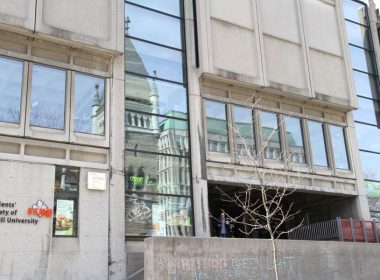
Increased prices for minicourses and Gerts are possible options for the Students’ Society of McGill University (SSMU) to balance their budget following the failure of the University Centre Building Fee referendum questions.

Executives originally intended to hold a special referendum period to re-run the same question. However, bylaw limitations mean they were unable to run another referendum until September.

“The fact of the matter is that clearly we were not bombastic enough with the way we were promoting [the Building Fee],” SSMU President Katie Larson said. “Could we have run a ‘yes’ campaign? Of course. But at the end of the day, I shouldn’t have to explain to students why they should find something important [….] It’s not just the executive’s fault—it’s everybody’s fault.”

In light of SSMU’s financial uncertainties heading into the 2014-2015 academic year, Vice-President Finance and Operations Tyler Hofmeister developed the first draft of a contingency budget in preparation for the possibility that the September referendum question also does not pass.

One change is that operations SSMU initially ran to break even could potentially be run with the goal of making a greater profit—for example, mini courses and Gerts.

“We believe that we could probably keep demand [for mini courses] fairly stable while still increasing [prices] to generate a revenue,” he said. “There [would also] be increases in price for Gerts, particularly for pitchers, pints of draft beer, and potentially the end of the drink specials—we’d probably increase the price by about 50 cents.”

Other proposed changes in the draft contingency budget include freezing salaries and hiring, eliminating the Club Fund and SSMU executive retreats, and reducing the SSMU Building’s operating hours.

Hofmeister noted that after-hours access to the building costs approximately $30,000 a year due to security staffing. According to Hofmeister, cuts to hours would likely include closing the building completely on weekends and closing Gerts significantly earlier.

WalksSafe Operations Coordinator David Olmstead urged SSMU to reconsider that possibility, saying that services like WalkSafe and DriveSafe rely on access to the building after 1 a.m.

“Cutting after-hour access would be devastating to our service,” Olmstead said. “During frosh, we had over 46 individual walks, [all of which were] entirely outside of operating hours.”

Another possibility that is not currently included in the contingency budget is to replace the Nest and room 108 with commercial tenants, which could generate approximately $75,000 in revenue.

“This is obviously not a scenario we’d like to pursue,” Hofmeister said. “That being said, it’s a possibility, and knowing the financial situation that we are in right now […] solutions like removing The Nest or renting out 108 for commercial space are much better solutions for keeping [SSMU] financially sustainable in the long run.”

Even after cutting costs in this draft of the budget, Hofmeister said that there would still be roughly $20,000 left to cut. Council will vote to approve a final draft of the contingency budget at the final Council meeting of the year on April 10.

Defending SSMU members’ right to vote

Council also approved a motion for SSMU to work alongside the university to support students interested in voting in the April 7 provincial elections. The motion was brought forth in the context of recent cases where students were allegedly denied their right to vote due to interpretations of the “domiciled” requirement for all registered voters.

“We’ve been going to the media [and] lawyers for help, but we haven’t gotten any help from our university or students’ society,” Arielle VanIderstine, U0 Arts and Science, said. “The motion [would] support those students […] as they exercise their democratic right to vote.”

The motion mandates SSMU to publicly defend its members’ right to vote through a press release, as well as to provide “support and resources” to students who have been denied the right to vote.

Dissolving the finance committee

Council also approved the elimination of the finance committee, which was previously run under the vice-president of finance and operations’ portfolio with the intension of allowing councillors and other SSMU members the opportunity to review the budget.

“A lot of these councillors […] didn’t have enough information going into these meetings,” Hofmeister said. “[There would be] very long meetings where the general manager and [VP Finance] would explain what was going on in the budget, only to do so again at Council to the exact same people [….] It hasn’t been very productive.”

Useful science gives summaries for recent studies
a, Science & Technology

Useful Science bridges communication gap in research

Science communication today is like a game of broken telephone. Data generated in the laboratory quickly spreads from one social media site to the next until ionized alkaline water boosts energy levels and eating ginger cures cancer.

“We’ve had the Stone Age, we’ve had the Bronze Age, we’ve had the Iron Age, and now we have the Information Age,” said the Director of McGill’s Office for Science and Society Joe Schwarcz. “Sometimes my feeling is that our ability to produce data through scientific experimentation has outstripped our ability to interpret what that data means.”

This rising concern within the realm of scientific communication is no stranger to researchers. As information travels frantically on the Internet, the public’s ability to determine its value and reliability struggles to keep pace.

“We need a filter system to show people what is worth reading,” Schwarcz said. “And then there’s the second aspect, which is to interpret it for them because most people are not adept at reading the tough language in scientific journals.”

This is exactly what McGill BSc. Graduate and current PhD Physics student at Princeton University Jaan Altosaar hoped to do when he launched the website Useful Science in January 2014.

“One of the questions we asked was, ‘What would a website look like if every fact was cited?’” Altosaar said. “Science reporting is becoming more quantitative now, but there is still a lot of work to be done. We are trying to be really conscious of the [lack of sourcing in scientific websites]. I haven’t seen any websites that do that well, so we are kind of trying to fill that gap in science reporting.”

With its one-sentence summaries of the most recent scientific discoveries, the site threatens the most seductive of pseudoscience pages available on the Internet. By linking each sentence directly to the study it summarizes, Useful Science provides readers with a reliable source of information.

“We are trying to make it really accessible,” Altosaar explained. “When the New York Times cites something, you can’t just click a link to see the study.”

The website also boasts another kind of accessibility, which is its translation of the language of scientific experiments into meaningful changes people can make to their lives. Altosaar recognizes that one of the leading causes of miscommunication between the laboratory and social media is the complexity of papers published in journals, and the difficulty the public may have in interpreting these studies. Therefore, each 25-word sentence published on the website is aimed at anyone with a basic high school education.

“I like to think of contributing to Useful Science as using my superpowers for good,” said McGill Neuroscience PhD student and Useful Science writer Maryse Thomas. “My superpowers being the ability and patience to read and understand scientific articles.”

Currently, Useful Science is run by a group of 25 writers who aim to post collectively at least one summary each day. The site has received 77,000 visits to date, where the average duration of a visit is two and a half minutes. Considering most users spend less than a minute per website, Altosaar counts this as a huge success towards readers actually taking the time to learn something about science.

“I want to know what science can tell us,” Altosaar said. “I have always tried to live my life in a scientific way. I read studies and I try to apply it to my life. You know how in Montreal it’s really depressing in the winter? Well, I read studies about seasonal affective disorder, and I learned about one of those light therapy lamps. This all involved a lot of research personally, but there was no website I could use as a single resource for scientific discoveries. So this is something that I have been thinking about for years now.”

In many respects, the success of the Useful Science is no surprise. Its sentences are short and sweet, and they fit right in with the fast bursts of information we have become accustomed to in this Information Age. It’s a space that translates studies such as “Exploring the effects of ambient noise on creative cognition” into accessible blurbs like “The optimal noise level for carrying out abstract thinking and creative tasks is 70 dB, which is the average noise level of a coffee shop,” resembling a scientific cross between Reddit and Twitter.

“The real challenge is to take reputable scientific information, put it into short segments without trivializing it but making it digestible,” Schwarcz said. “And if you can add a bit of entertainment to it, even better.”

While Useful Science is currently non-profit, Altosaar is looking for funding opportunities so that the site can expand and in the future act as a solid resource that people could use to keep up with the latest discoveries in science.


For more on Useful Science, check out their tumblr: http://http://usefulscience.tumblr.com/, and twitter feed: https://twitter.com/usefulsci

Full disclosure: Maryse Thomas is a design editor at the McGill Tribune

a, Opinion

SSMU showcases continued incompetence, contempt for students on building fee

On March 21, 2014, students voted 53.6 per cent and 60.8 per cent, respectively, against both parts of the proposed SSMU building fee. Students’ Society of McGill University (SSMU) President Katie Larson, in a recent interview with the Tribune, condescendingly accused students of ignorance, saying students “did not do their part.” During last week’s SSMU Council, Larson continued to place the blame on students.

“I shouldn’t have to explain to students why they should find something important,” Larson said. “It’s not just my fault, it’s not just the executive’s fault—it’s everybody’s fault.”

The blame does, in fact, lie with Katie Larson and the SSMU executive, and not with the undergraduate student body. The former were the ones who did not do their part. Why should someone run to become a student politician? To represent students, advocate for them, and provide leadership. If the SSMU executives were truly fulfilling this role, they would not be chastising students for the student society’s imminent financial self-destruction. As former and current elected representatives of students in this university, we find the buck-passing of blame to students unacceptable. When you are the president of SSMU and responsible for representing and leading over 20, 000 undergraduates, the buck stops at your office, Katie Larson. We condemn you for your remarks towards students.

Furthermore, the lease of the University Centre itself is shrouded in mystery. The SSMU executives made no attempt to explain it while it was being negotiated or after it had been negotiated. All that students were told was that it had been finalized after several years of negotiations. There was no mention of specifics. Most civil society organizations, such as labour unions, would set public demands during a negotiation, even if the negotiations were confidential. If the negotiating conditions themselves were unjust, they might even run a public campaign. People might disagree about tactics, but no one can deny the results that these methods would yield. Except SSMU, as the executive clearly thinks its members can’t handle the information. As a result of SSMU’s screw-up, there will either be massive budget cuts to essential services or an eviction from the University Centre building. This could mean life or death for SSMU. Shouldn’t they think that this is worth fighting for? The SSMU Council remains indecisive to the whole issue, preferring to merely present options at their last (March 27) meeting instead of taking action.

Third, there was no effort made during the campaign period by SSMU to provide a strong voice for the “Yes” vote. The SSMU executives have no right to blame students for not understanding the importance of this issue. As Larson says, “People clearly didn’t read the context of the question.” We ask, how are students supposed to understand the context of a question if their elected representatives didn’t bother to inform them of its importance? No doubt the vast majority of students do not want student services, especially ones such as Gerts and the Student-Run Cafe (SRC), to disappear or be cut back. Nevertheless, student leaders are entrusted with the duty of informing the student body of these issues in advance. There should have been more of an effort to disseminate information and push for a “Yes” vote.

Fourth, it’s offensive that the SSMU executive expects students to simply vote “Yes” to everything posed during a referendum period just because they deem it to be important. Instead, demonstrate the importance of the issues and advocate for the path that is deemed to be the most beneficial to all students. If SSMU is a democratic civil society organization then, like any democratic civil society organization, it is the leadership’s responsibility to explain what is going on. SSMU members pay the salaries of the SSMU executives; these executives therefore have a duty to inform us. In this case they did not fulfill that aspect of their mandate.

It is our belief that the SSMU executive should first and foremost formally apologize for attempting to place the blame on students for the result of this referendum. Second, they should more clearly inform students of the importance of this issue as it continues to develop throughout the rest of the semester—and possibly longer. This brings us to our third point: the SSMU executives need to rectify this problem immediately. As students who use—and enjoy—the services provided by SSMU, we cannot imagine a year without them. What will happen to our beloved student bar, Gerts? Will the newly-opened Student-Run-Café close down within a year of its opening? What will happen to the children who spend their days in the SSMU Daycare? Will there be another referendum? Will SSMU proceed with the drastic cuts in costs that were talked about at last week’s council meetings? A decision must be made; the time for debate is over.

James Gutman is a U3 History student and former Arts senator, Matthew Eidinger is a U3 Political Science student and current president of the McGill Political Science Students Association. Their views are their own and do not represent those of their respective organizations.

a, News

Continuing education students seek improved access to mental health services

Continuing education students are seeking to improve their access to McGill’s mental health services due to a lack of access to the university’s resources for part-time students.

The issue is currently under review by the Student Services Office, in collaboration with the dean of Continuing Studies at McGill and the McGill Association of Continuing Studies (MACES).

Mental health services at McGill are currently run under the university’s Student Services unit, funded by an automatic fee for all except continuing education students. These students qualify to opt-in if they are taking at least nine credits; otherwise, they do not have the option of using the university’s mental health resources.

Jana Luker, executive director of Student Services, said students taking fewer credits do not have the option of opting-in because they often have access to other resources outside the university.

“Our services aren’t set up for continuing studies,” she said. “People who are taking one continuing education course, say in the evening, they probably have their own setup in Montreal. I’m assuming most students are working, and therefore have their own infrastructure and access to services.”

However, Amine Arezki, the continuing education studies representative to Senate, said this is not necessarily the case.

“Psychologists are not reimbursed by the government nor by private insurances, so the services that McGill could offer could be the only chance for those students to have access to [mental health] services,” he continued.

The Student Services fee for continuing education students is $141.50 per term.  The full-time undergraduate student fee totals the same amount, although graduate, part-time, medical students and residents, and post-doctoral fellows pay less, as they utilize student services less.

Arezki said that mental health issues are prevalent in continuing education students due to the stresses of school work and day-to-day life.

“[Continuing education] can be challenging, with international students, single mothers [or] fathers, and students juggling school with work, studies, and personal life,” Arezki said. “In a place like McGill where everybody is expected to perform at high level, mental health can easily become an issue.”

According to Luker, a possible solution is the development of a different fee infrastructure to meet the needs of this unique demographic of students.

Luker argued that allowing opt-ins for all continuing education students might not be compatible with their specific needs, because the Student Services fee includes many other resources—such as First People’s House and Career Planning Services—that they may not use.

“Some students in continuing studies wanted to get just access to the mental health services, and not all the services,” Luker said.  “Would their needs be fulfilled under the structure we have?”

Luker also argued that the cost associated with the fee would be unreasonable for students taking fewer courses.

“Continuing studies courses can be less expensive, which is very attractive, especially if you’re only taking one or two courses,” she said. “To put another $140 fee per term, that’s a real difference.”

Arezki proposed a separation of mental health from the other fees.

“I believe that mental health is an essential service,” he said.  “For continuing education students, it should not be put in a package with other non-essential services.”

According to Luker, another potential solution involves creating different services for continuing education students.

“I’ve been trying to assist continuing studies students to set up their own services, so they can sculpt them to what the needs are in a framework they would feel would be useful for them,” Luker said.  “[The Office of Student Services] is there to assist or follow through, whatever they would want.”

Judith Potter, dean of the School of Continuing Studies, asserted her willingness to support review current policies.

“I am, of course, in favour of improvements that would help continuing studies students,” she said. “I would very much like to sit down with MACES and Student Services to discuss the issue and to come up with a solution that works for all.”

a, Arts & Entertainment

Pop rhetoric: Keeping it real at concerts

It’s hard to explain why you do it. Why, at some point during a concert, you will feel the need to pull out your phone—with its lackluster picture and video-taking ability—and snap a picture or a 30-second video that doesn’t do the artist any justice whatsoever. Sure, part of it is some notion of preserving the moment for nostalgia’s sake, but the more likely reality is that you’re just going to upload it onto whatever form of social media you partake in, hoping to get a few likes. Live music is a uniquely enriching experience, but when half the people at a show are busy coming up with a sweet caption to accompany their next Instagram upload, a lot of its value gets derailed.

Technological advancements such as mp3 files and YouTube have revolutionized the ways in which the average person listens to music. There is so much access to free music through the internet that the process of physically going to the store and buying a CD has become the exception, not the norm. Amid the rapid changes brought on by technology, concerts have been perceived as being safe from going obsolete. There remains nothing quite like immersing yourself completely in live music and soaking up the intimate experience of a concert—it’s something that technology can’t replace.

Although concerts remain as popular as ever, they are being compromised by the very thing from which they seemed to be immune, and the all-engrossing experience they offer is getting harder and harder to achieve. I challenge you to think of one concert you’ve been to recently at which you were not bombarded by a plethora of smart-phones throughout the performance. Now I’m not saying that I’m 100 per cent guilt-free on this, but I do think there is a way to go about it with a little bit of decorum.

Here’s how not to do it. I was recently at Kodaline’s show at the Corona Theatre, and I ended up standing behind a girl who watched the entire two hour show through the three inch screen of her iPhone. Aside from the fact that she kept her arm up for the entire time, I was astounded that she made the conscious decision to alienate herself from the musicians onstage for the whole performance. Not only did she—and everyone behind her—have a worse visual experience, but when you place a barrier between yourself and the stage, it’s pretty damn hard to connect.

It’s not just audience members who get irked by an obnoxious use of cell phones at shows—musicians have been speaking up about it, too. While on tour last year, bands like The Lumineers and the Yeah Yeah Yeah’s both made announcements during their shows in response to their plugged-in audiences. In one instance, Lumineers front man Wesley Schultz stopped mid-“Ho Hey” to ask fans to quit filming the concert on their phones—a bit of an abrasive tactic, in my opinion. The Yeah Yeah Yeah’s on the other hand, posted a sign that read: “PLEASE DO NOT WATCH THE SHOW THROUGH A SCREEN ON YOUR SMART DEVICE/CAMERA. PUT THAT S— AWAY as a courtesy to the person behind you and to Nick, Karen and Brian. MUCH LOVE AND MANY THANKS! YEAH YEAH YEAHS.” The message was then reiterated when vocalist Karen O gave a photo-op during one song and then asked that phones get put away. I think that’s a happy medium.

There’s no doubt that a rapt audience vastly improves any performance. The more you keep your phone out of sight, the more freedom you have to truly connect with the music in whatever way is meaningful to you. Putting your phone away will enhance the experience of everyone around you. As is the case with any human interaction, the best ones occur when you are fully engaged, and live music is no exception. Allow yourself to disconnect from your phone, and by extension, fully connect with the moment.

Student of the Week
a, Student Life

Student of the Week: Michaela Hirsh

When Michaela Hirsh was in grade 10, her teacher told her she wasn’t cut out to pursue a career that involved math. Six years later, she’s in the math-heavy finance program in the Desautels Faculty of Management, with a job at J.P Morgan lined up for this summer.

“When people tell me not to do something, it makes me want to do it,” Hirsh says. “So I said, ‘You know what, I’m going to do it anyway.’ In grade 12, something just shifted and I just started to get math [….] I found a passion for it.”

Hirsh studies honours investment management, where she finds a passion for both the critical thinking and risk-laden aspects of finance.

“In class, if you’re given a problem, you can solve it […] but in practical finance like investing, you never know what the right answer is until you invest in something and it either goes well or it doesn’t […] it’s exhilarating,” she says. “[But] when you dig into a company and you get to know everything about it, it’s not so much of a gamble anymore […] so I also like the analytical aspect of it.”

Her interest in finance extends to various executive positions on campus. Hirsh is vice-president sponsorship of the McGill Investment Club, a financial markets columnist for the Bull and Bear, and a participant in various case competitions. She also co-started a series of workshops that helps students around McGill learn the basics of networking, interviews, and analyzing stocks.

Hirsh is particularly driven to increase respect for women in the male-dominated field of finance.

“There are all of these hurdles that women face, and people don’t necessarily realize it,” she says. “I’ve been really trying to [encourage] women in finance—especially younger ones I’ve met in the faculty—to […] apply for the jobs they want and to never say, ‘I don’t want to apply because I don’t want to get rejected.’ It’s always better to go for things.”

Hirsh recently spoke at the National Women in Business Conference and was awarded the 2013 HSBC Women in Business Leadership Award.

Hirsh’s adventurous and outgoing spirit drives her to pursue and experiment in many different outlets outside of business. For example, she was vice-president events for McGill’s Make-a-Wish foundation in her first year, is currently involved with the Commerce Administration Student Charity Organization (CASCO), and participates in intramural sports.

As Hirsh looks forward to her up-and-coming future as a graduate of McGill, she notes her excitement but admits her fear of leaving the place she’s called home for the past four years.

“I’ve been realizing that my friends at McGill mean the world to me, and I’m so afraid that once we leave this amazing environment it’s just not going to be the same,” Hirsh says. “I think that’s the hardest part—[leaving] the lifestyle [where] I’m able to get involved in such a diverse array of things.”

McGill Tribune: If you could go back to any time in history, when would it be?

Michaela Hirsh: One hundred per cent the dinosaur [era]. They are so cool.

MT: Who would you like to shake hands with if you could go back in time?

MH: Margaret Thatcher [….] She actually didn’t even want to run for prime minister; someone convinced her and said, “you are the most capable person for this” so she stepped up and did it. I think she’s pretty awesome […] I’d also like to talk to Frank Sinatra.

MT: What’s your guilty pleasure?

MH: Definitely binge watching Law and Order SVU.

MT: What is your favourite sport to watch?

MH: To watch, I’m a huge hockey fan. [My favourite team] is the Leafs […] it’s hard to love them sometimes, but it’s like a boyfriend—you go through ups and downs.

MT: Who is your favourite musician at the moment?

MH: I think Pitbull is just so funny, anything by Pitbull gets me going.

a, Joke

President Obama reacts to “Barnan-gate”

WASHINGTON, D.C and McBill/Milton-Parc, MONTREAL QC


After weeks of speculation, United States President Barack Obama made his first public comments on the campus political scandal that has divided partisans worldwide. Opining on the incident that has come to be known as “Barnan-gate,” Obama called the situation a “total gong-show.” 

The incident which prompted Obama’s statement was an apology that Ryan Barnan, Vice-President Listserv and Fro$h of the Students’ Society of McBill’s Offensive Overlords (SSMOO), was forced to give in the wake of an equity complaint which alleged that a .GIF image he had sent of President Obama kicking down a door constituted a microaggression. The decision was met with much ridicule on the McBill campus, but the story seemed to have run its course before being picked up by several American right-wing blogs, bringing the story to international prominence.

“It’s always interesting to hear the news from up North,” Obama said at the press conference. “As you know, my staff is generally swamped with more important international news, which freed me up to keep a close eye on this situation as it unfolded.”

“At first I thought that SSMOO Council was just cramping [Barnan’s] style by making him apologize,” the president continued. “I mean, it was really just a classic case of Barnan being Barnan. Although I later totally sympathized with students who felt—what’s the phrase—‘micro-aggressed’ by the image. But then it blew up online and I couldn’t believe the amount of [crap] that Barnan was taking for it. And now I’m just upset that they retracted the apology. It’s been a real roller-coaster ride.”

“I’m just glad I wasn’t calling the shots in that situation. Yikes,” Obama concluded before being called into the Situation Room for an emergency meeting of the National Security Council.

In response to a follow-up question, Obama revealed his next steps; a trip to Canada to meet with the members of the SSMOO executive.

“I really feel that with this unfortunate situation finally being put to rest, the time is right to directly involve myself in it,” the president said.

After making an appearance at the next scheduled Students’ Society of Offensive Overlords (SSMOO) Council session, Obama will give an exclusive interview on TVM, continuing his apparent strategy of appearing in unconventional venues to promote his policy initiatives.

The president brushed off accusations that this itinerary was a waste of his time.

“As the leader of the free world, I take personal responsibility for democracy at all levels, worldwide,” Obama pointed out. “Besides, the alternative would have been another meeting about pipelines or something with Prime Minister Harper; and let me tell you, those are quite a bore.”

Reaction on the McBill campus was mixed.

“Yaaa know, this whole Barnan thing…was, like, embarrassing to the university…but if we get a visit from Obama out of it, I guess that’s chill,” said Rhys Inding, a first-year Management student, between shots of Jägermeister.

“I really can’t support the idea of someone who has deported so many undocumented migrants and ordered so many drone strikes being on our campus,” said Damian Maastricht, a political theory student and columnist for the self-described “underground” campus publication the McBill Occasional. “The only just response to such a symbol of the status quo appearing on this racist, colonial campus is to resist.”

Meanwhile, literature student Steven Novich was unimpressed with the whole controversy.

“You know, I find the whole thing a bit distasteful,” he said, while calmly sipping an espresso and staring pensively into the distance. “Don’t we all have better things to worry about?”

A. Pierre D’Ville reported from Washington D.C.


Additional reporting by Stephanie Lamprey and Carter Whitby in Toronto.

 This story is a work of satire and appeared as part of our April Fools Issue 2014.

Read the latest issue

Read the latest issue