When Michaela Hirsh was in grade 10, her teacher told her she wasn’t cut out to pursue a career that involved math. Six years later, she’s in the math-heavy finance program in the Desautels Faculty of Management, with a job at J.P Morgan lined up for this summer.
“When people tell me not to do something, it makes me want to do it,” Hirsh says. “So I said, ‘You know what, I’m going to do it anyway.’ In grade 12, something just shifted and I just started to get math [….] I found a passion for it.”
Hirsh studies honours investment management, where she finds a passion for both the critical thinking and risk-laden aspects of finance.
“In class, if you’re given a problem, you can solve it […] but in practical finance like investing, you never know what the right answer is until you invest in something and it either goes well or it doesn’t […] it’s exhilarating,” she says. “[But] when you dig into a company and you get to know everything about it, it’s not so much of a gamble anymore […] so I also like the analytical aspect of it.”
Her interest in finance extends to various executive positions on campus. Hirsh is vice-president sponsorship of the McGill Investment Club, a financial markets columnist for the Bull and Bear, and a participant in various case competitions. She also co-started a series of workshops that helps students around McGill learn the basics of networking, interviews, and analyzing stocks.
Hirsh is particularly driven to increase respect for women in the male-dominated field of finance.
“There are all of these hurdles that women face, and people don’t necessarily realize it,” she says. “I’ve been really trying to [encourage] women in finance—especially younger ones I’ve met in the faculty—to […] apply for the jobs they want and to never say, ‘I don’t want to apply because I don’t want to get rejected.’ It’s always better to go for things.”
Hirsh recently spoke at the National Women in Business Conference and was awarded the 2013 HSBC Women in Business Leadership Award.
Hirsh’s adventurous and outgoing spirit drives her to pursue and experiment in many different outlets outside of business. For example, she was vice-president events for McGill’s Make-a-Wish foundation in her first year, is currently involved with the Commerce Administration Student Charity Organization (CASCO), and participates in intramural sports.
As Hirsh looks forward to her up-and-coming future as a graduate of McGill, she notes her excitement but admits her fear of leaving the place she’s called home for the past four years.
“I’ve been realizing that my friends at McGill mean the world to me, and I’m so afraid that once we leave this amazing environment it’s just not going to be the same,” Hirsh says. “I think that’s the hardest part—[leaving] the lifestyle [where] I’m able to get involved in such a diverse array of things.”
McGill Tribune: If you could go back to any time in history, when would it be?
Michaela Hirsh: One hundred per cent the dinosaur [era]. They are so cool.
MT: Who would you like to shake hands with if you could go back in time?
MH: Margaret Thatcher [….] She actually didn’t even want to run for prime minister; someone convinced her and said, “you are the most capable person for this” so she stepped up and did it. I think she’s pretty awesome […] I’d also like to talk to Frank Sinatra.
MT: What’s your guilty pleasure?
MH: Definitely binge watching Law and Order SVU.
MT: What is your favourite sport to watch?
MH: To watch, I’m a huge hockey fan. [My favourite team] is the Leafs […] it’s hard to love them sometimes, but it’s like a boyfriend—you go through ups and downs.
MT: Who is your favourite musician at the moment?
MH: I think Pitbull is just so funny, anything by Pitbull gets me going.
WASHINGTON, D.C and McBill/Milton-Parc, MONTREAL QC
After weeks of speculation, United States President Barack Obama made his first public comments on the campus political scandal that has divided partisans worldwide. Opining on the incident that has come to be known as “Barnan-gate,” Obama called the situation a “total gong-show.”
The incident which prompted Obama’s statement was an apology that Ryan Barnan, Vice-President Listserv and Fro$h of the Students’ Society of McBill’s Offensive Overlords (SSMOO), was forced to give in the wake of an equity complaint which alleged that a .GIF image he had sent of President Obama kicking down a door constituted a microaggression. The decision was met with much ridicule on the McBill campus, but the story seemed to have run its course before being picked up by several American right-wing blogs, bringing the story to international prominence.
“It’s always interesting to hear the news from up North,” Obama said at the press conference. “As you know, my staff is generally swamped with more important international news, which freed me up to keep a close eye on this situation as it unfolded.”
“At first I thought that SSMOO Council was just cramping [Barnan’s] style by making him apologize,” the president continued. “I mean, it was really just a classic case of Barnan being Barnan. Although I later totally sympathized with students who felt—what’s the phrase—‘micro-aggressed’ by the image. But then it blew up online and I couldn’t believe the amount of [crap] that Barnan was taking for it. And now I’m just upset that they retracted the apology. It’s been a real roller-coaster ride.”
“I’m just glad I wasn’t calling the shots in that situation. Yikes,” Obama concluded before being called into the Situation Room for an emergency meeting of the National Security Council.
In response to a follow-up question, Obama revealed his next steps; a trip to Canada to meet with the members of the SSMOO executive.
“I really feel that with this unfortunate situation finally being put to rest, the time is right to directly involve myself in it,” the president said.
After making an appearance at the next scheduled Students’ Society of Offensive Overlords (SSMOO) Council session, Obama will give an exclusive interview on TVM, continuing his apparent strategy of appearing in unconventional venues to promote his policy initiatives.
The president brushed off accusations that this itinerary was a waste of his time.
“As the leader of the free world, I take personal responsibility for democracy at all levels, worldwide,” Obama pointed out. “Besides, the alternative would have been another meeting about pipelines or something with Prime Minister Harper; and let me tell you, those are quite a bore.”
Reaction on the McBill campus was mixed.
“Yaaa know, this whole Barnan thing…was, like, embarrassing to the university…but if we get a visit from Obama out of it, I guess that’s chill,” said Rhys Inding, a first-year Management student, between shots of Jägermeister.
“I really can’t support the idea of someone who has deported so many undocumented migrants and ordered so many drone strikes being on our campus,” said Damian Maastricht, a political theory student and columnist for the self-described “underground” campus publication the McBill Occasional. “The only just response to such a symbol of the status quo appearing on this racist, colonial campus is to resist.”
Meanwhile, literature student Steven Novich was unimpressed with the whole controversy.
“You know, I find the whole thing a bit distasteful,” he said, while calmly sipping an espresso and staring pensively into the distance. “Don’t we all have better things to worry about?”
A. Pierre D’Ville reported from Washington D.C.
— Additional reporting by Stephanie Lamprey and Carter Whitby in Toronto.
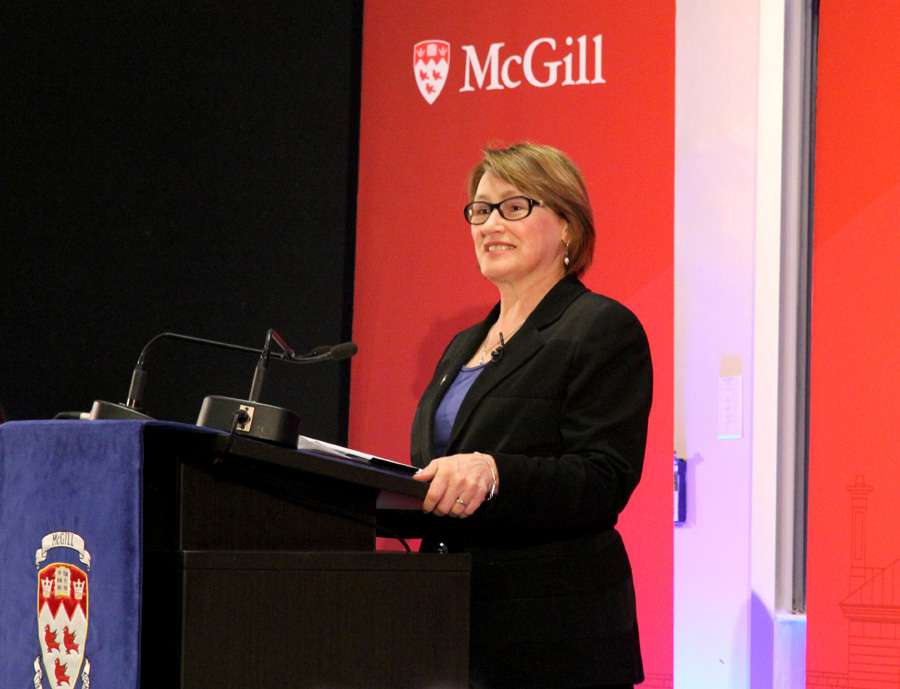
Strengthening research, learning environments, and the university’s connection to society is at the forefront of McGill’s priorities for the next five years, according to a March 28 address by Principal Suzanne Fortier.
In front of 180 members of the McGill community, Fortier touched on improvements that are necessary in the areas of student life and learning, research, engagement, and learning organization in addition to space.
“The vision for our university is an expression of how we see our mission today at McGill, building on our strengths and identity and in the context of the 21st century,” she said.
Fortier explained that her priorities developed through her discussions with people and groups from across the university since she began her term as McGill’s 17th principal last September.
“Since arriving on campus, I have had the opportunity to meet with many of you and participate in many activities,” she said “This has helped me crystallize the hopes, the goals and the ambitions of this community.”
Nicolas Magnien, executive co-coordinator at McGill’s Indigenous Studies Community KANATA, applauded Fortier for her engagement with the McGill community.
“As far as I know, no other principal has really ever tried from the beginning of their mandate to learn about indigenous issues, and [Fortier] has,” Magnien said. “She is the only principal that I’ve heard of [who] came up with this [consultation] initiative.”
On the priority of a learning organization, Fortier said she seeks to build a more effective professional environment and improve the university’s physical and virtual campuses.
“Our vision is for a transformed environment, for teaching and learning and for conducting research and scholarship, an environment that is sustainable, accessible, state-of-the-art and healthy,” she said.
The principal also said McGill is exploring the possibility of acquiring the Royal Victoria Hospital in the coming years as a means to address the university’s space deficit of 65,000 square meters.
“Our vision of the Royal [Victoria Hospital] is as a carrefour—a meeting place that connects Quebec and the world,” Fortier said.
Fortier’s address faced criticism from Demilitarize McGill, a student-run group aimed at ending McGill’s alleged connections to military research. Members of Demilitarize McGill protested outside Fortier’s presentation, accusing the administration of lacking transparency.
“[Fortier] says that [the administration] is going to be open and connected and purposeful,” demonstrator Cadence O’Neal, U1 Arts, said. “We question how open McGill really is. We question the purposefulness of the weapons that McGill is trying to develop.”
The protesters accused the administration of receiving over $1.2 million in funds for military research.
In her address, Fortier emphasized the complexity of relationships between the university and its governmental and industrial research partners.
“As we know from our history, [much] of the research that has been done in the past have created improvements, advanced knowledge, and benefited society,” she said. “It is important to make sure that you stay true to your values and principles and it is important as you engage in these collaborations to test and ask yourself the question of whether they do or not.”
On the topic of future challenges, Fortier acknowledged that the university continues to face financial strain.
“We cannot ignore our financial challenges, but we cannot let them define us,” she said. “We will need to evolve while preserving what makes McGill, McGill. Our openness to change, I believe, will determine our future success.”
Members of Demilitarize McGill protests outside Fortier’s address. (Laurie Anne Benoit)
For 10 months, scientists from the Institute of Molecular Biotechnology (IMBA) at the Austrian Academy of Sciences (OeAW) fed and cared for a tiny cluster of cells. With the correct mixture of nutrients, chemical environment, and appropriate coaxing, the researchers successfully cultured miniature brains that are still functioning today—10 months later.
The brains were grown from human stem cells derived from the skin. Researchers identified growth conditions that helped the stem cells differentiate into several types of brain tissues. They grew the stem cells on a synthetic gel that resembled natural connective tissues found in the brain and elsewhere in the body before placing these clumps of cells in a spinning vessel, known as a bioreactor, in order to enhance nutrient absorption and infuse them with oxygen.
The purpose of this research was to develop a model by which to study developmental brain disorders, including microcephaly, a condition that results in stunted brain growth and cognitive impairment.
Microcephaly is difficult to replicate in rodents due to species-specific differences in brain development. These miniature brains provided a resource the team could harness in order to grow and study human organs affected with the disorder.
According to developmental neurobiologist at the University of California, Arnold Kriefstein, in an interview with Nature, the study confirmed many prevailing theories about microcephaly. The brains grew to a smaller size than expected, but replicating the disorder in these model tissues allowed scientists to discover other potential causes for microcephaly than previously discussed.
Although the miniature brains do not function as a cohesive unit—normal brain maturation requires growth signals from other parts of the body—scientists may be able to develop larger and more complex neural-tissue clumps in the future. These tissues could be used to model other disorders besides microcephaly, especially if researchers can learn more about controlling cell growth reliably.
“This whole approach is really in its early stages,” Kriefstein told Nature. “The jury may still be out in terms of how robust this [technique] is.”
These miniature brains are not the only model organ currently being grown. Scientists at a variety of prestigious institutes around the globe have recently announced success in steps towards engineering functioning organs from stem cells. Researchers in Japan have developed functional human liver tissue in a petri dish from reprogrammed skin cells, while several teams have reported progress on developing kidney tissue in a similar fashion.
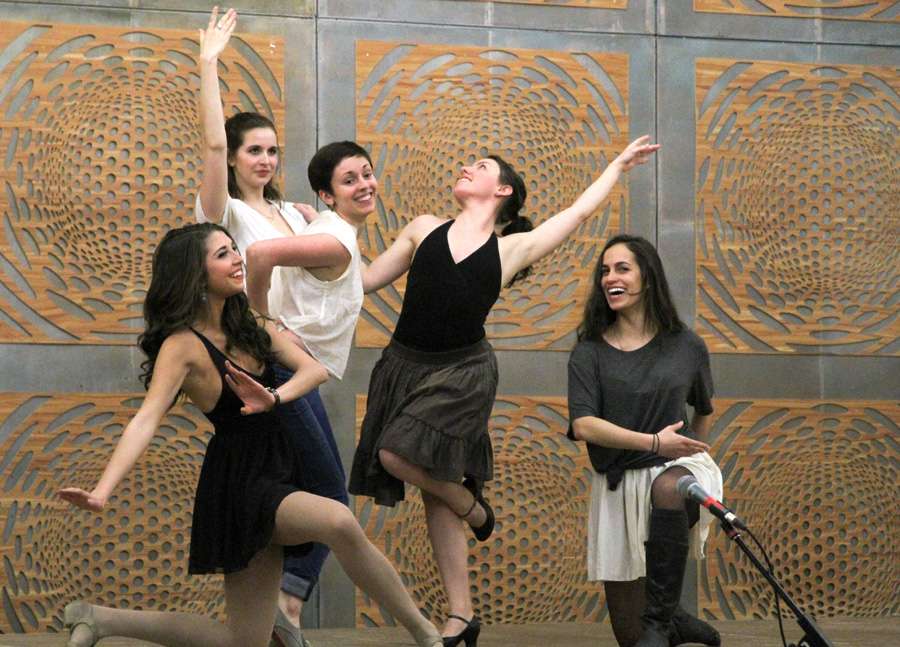
There aren’t many places—the Tribune’s Arts & Entertainment section being excepted—where one can find visual art, performance art, interactive art, and live music all together at McGill. In order to reconcile the lack of a formal fine arts program at the school, each year the Arts Undergraduate Society’s (AUS) Fine Arts Council hosts Nuit Blanche, an events showcase featuring different student artists and performers from the McGill community. This year’s theme was Tableau Vivant: “a silent and motionless group of people arranged to represent a scene or incident.”
I began my night in Room 108 of Shatner—the building where Nuit Blanche took place—and immediately noticed Roland Selinger’s interactive art presentation. A screen and projector were set up, allowing artists to free form or just trace along with the images that were displayed. from. This was a fun concept that allowed for visitors to immediately immerse themselves in the artistic mood that dominated the night. The room featured a handful of photographs by Andrew Kittredge and Lucy Ava Liu; the latter’s work caught my eye for its club-pink tint that added an otherworldly effect to a simple photo of a girl standing on the side of the road.
Working upwards through the building, the next stop was the Madeline Parent Room, which housed Fridge Door Gallery’s (FDG) winter vernissage. There were photographs, paintings, drawings, collages, and a projector running a series of pieces against the main wall—not to mention complimentary wine and cheese. FDG’s showing felt like a true art exhibition and was particularly interesting because of the disjointed harmony of all the pieces displayed. While I appreciated the more refined aspect of the vernissage, the setup as a whole seemed oddly removed from the rest of the event, almost as if it had been designed as its own event, only happening to coincide with Nuit Blanche’s exhibition.
Next door to the vernissage was a participatory art exhibit, Liu’s second display of the night. The concept was simple: put two strangers in a room and have them act out a pose for the camera. I decided to participate; I went into the empty room where Liu and another photographer waited and was instructed to chat with my partner while they chose the photo we would be replicating. Though slightly awkward, it was still a fun experience, and afterwards, I spoke with Liu about her inspiration for the project.
“You saw that viral first kiss video that was going around?” asked Liu. “What I didn’t like about it was that it seemed so staged, you could tell each montage was edited to make that element of closeness. I wanted something that was a more real representation of two strangers put into an intimate setting.”
Liu’s approach was to have strangers recreate intimate photos, such as the ones famously taken of David Bowie and Elizabeth Taylor. Even though the poses were staged, they still captured the real performance element of the photo subjects—as long as the subjects didn’t treat it like a joke.
“People take it seriously,” Liu said. “Of course, some people less so than others, and it depends on who the people are and what picture they’re recreating. It’s interesting though, I’ve seen a lot of different reactions.”
There was also a lot of action going on upstairs in the ballroom. I listened as Montreal’s Blank Bullets gave an acoustic performance of songs from their latest EP while simultaneously looking at the works by artists from McGill’s Market Cooperative, an organization which was created to help support local artists from the Montreal area—including designers, jewellery-makers, painters, and bakers.
Nuit Blanche offered a fantastic display of McGill artists working in multiple mediums, and this variety ensured everyone found something they liked. However, Nuit Blanche would have benefited from consolidating the works into fewer rooms. For instance, having more of the visual art displayed in the back of the ballroom where the live music was playing would have allowed for a more inclusive feel, as it seemed that while many styles of art were featured, they were categorized and separated—thus causing an overall fragmented feeling. It was also frustrating that not all of the artists were clearly identified. I find one of the best parts of an exhibition is being able to easily identify and meet the person who painted the portrait that immediately caught your eye.
Despite these minor shortcomings, I can’t deny that just being at the event seemed to be inspiring people to let a little more creativity into their lives. I noticed a few seated people doodling into journals, others were mesmerized by some of the projections in the Madeline Parent Room. When I ended my night in the SSMU lounge watching McGill Improv, I got to see friends and strangers laughing together. Ultimately, it’s always a pleasure to view artwork; and among the rooms full of musicians, craftsmen, painters, poets, photographers, and designers, you were bound to see something you loved.
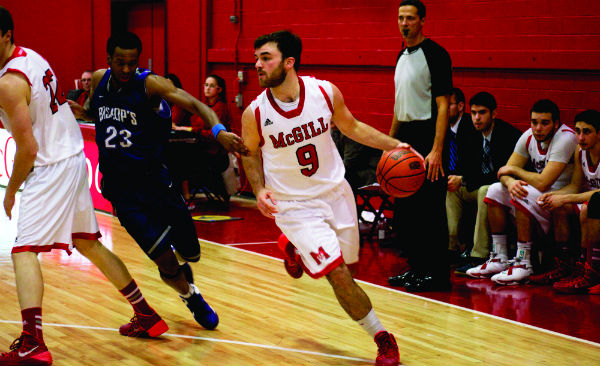
The ball clanks off the back iron and falls into Sebastian Beckett’s hands. The seconds tick off the clock but the cheering has already started. The 2013-2014 McGill Redmen assembled across the foul line to accept their RSEQ Championship medals. Redmen Head Coach David DeAveiro cuts down the final strand from the net for the second time in as many years. But this season is different. This RSEQ Championship marks the end of the team’s gruelling eight-month journey. For 10 of these young men, the journey started when they first stepped onto a collegiate basketball court seven months earlier.
It’s the middle of August, frosh is still weeks away, and last-minute cramming for finals is a thing of the distant future. For most people, it’s baseball season, but not for these 10 freshmen. While fathers and sons play pitch and catch in front yards, the athletes sweat in stuffy gymnasiums while running suicides, breaking only after exhaustion has set in completely. Their tongues hang out of their mouths and sweat beads down their foreheads as DeAveiro separates the boys from the men. It’s time for them to make the jump.
Though their journeys are all different, these Redmen have all found collective success. For starting swingman Michael Peterkin, the transition to the collegiate game was difficult, but he received ample playing time as a starter. Other athletes, such as redshirt freshman Thomas Lacy, spend their entire first season on the sidelines watching from afar.
(Photo courtesy of Jenning Leung)
However, few people understand the magnitude of this transition better than point guard Jenning Leung. Leung, a native of the Philippines, was by far the best player on his team in Manila, and almost always the most skilled player on the court. As a point guard, the biggest challenge for Leung was the speed and timing of the CIS game.
“That was the major adjustment,” Leung said. “Just how much faster you have to think.”
The fast pace of the CIS game has left Leung watching from the bench for the majority of the season as he works behind Simon Bibeau and Ave Bross, the team’s two veteran point guards. This was tough for the freshman, who was used to being in the limelight for his high school team.
“At the start of the season, my confidence was low,” Leung explained, after a 63-56 victory over Concordia in which he posted double digit points for the first time. “I just had to find the perfect [balance] between knowing [that] I wasn’t going to be ‘the guy’, but also knowing I have to go out there and prove myself.”
Ari Hunter, basketball coach at Crescent High School in Toronto and former McGill Redmen (1997-2000), believes this balance between overconfidence and lack of confidence is the hardest concept for new student athletes to grasp.
“If you’re going to be an elite athlete […] you have to have an edge on you [and] you have to believe that you’re the best,” Hunter said. “So you can’t lose that ‘I can do this, I’m a badass’ attitude, because then you lose that little extra [edge] that makes you excellent.”
While seeing limited playing time might not have been what Leung had in mind when he committed to McGill, he now understands his role within the team.
“During practice, I have to go at [Bibeau and Bross],” Leung explained. “It’s nothing personal [….] I’m pushing them […] because they don’t want to lose their minutes […] but at the same time, I know I’m getting better.”
(Photo courtesy of Michael Peterkin)
The transition to the collegiate level has been much different for Peterkin. He was thrown into the fire from day one and was asked to respond.
“I was pretty surprised when coach put my name in the starting five in the NCAA game against Sacred Heart,” Peterkin said. “I’ll always remember that moment [.…] I’m glad [DeAveiro] believes and sees something in me for this year, and hopefully the future.”
While Peterkin doesn’t deal with a lack of playing time, at times competing against bigger and better players has been overwhelming.
“It’s crazy thinking that a year ago I was the oldest guy [on the court],” he said. “[Now] I’m battling against guys who have played basketball longer, who are older than me, and guys who have developed more than me. It’s been tough at times.”
Peterkin quickly realized that he couldn’t rely purely on athleticism to succeed at the collegiate level.
“In high school, if I didn’t play at my best, I was still […] at another level compared to some guys. But here, I have to play at my best and compete,” he explained.
While Peterkin has struggled to score this year, his strong defensive abilities have made him a regular in the Redmen lineup. The same cannot be said for Lacy, who never saw the court in his first year at McGill. Coming from Vermont—a state that only produces a handful of college basketball players each year—Lacy was a regular in his high school team’s starting lineup, and was named captain of the varsity team in grade 10. Not seeing game time was tough, but being left out of practice was harder.
“There were days when I didn’t even get to touch the ball at practice,” Lacy said. “That was the hardest part for me – sitting and watching. I couldn’t handle the thought of being the worst player in the gym, because I knew I could change that with time.”
After countless hours in the gym last year working to improve his game, Lacy earned the chance to play this season.
"There were days when I’d show up at the gym at 6 a.m. for practice and wouldn’t leave until after noon,” Lacy said. “One of our assistant coaches last year, [Daniel McCue], really took me under his wing. He put me through drills and workouts for hours after official practice was over [.…] Having put in so much work last year to improve my game, it felt amazing to finally get minutes this year.”
With the support of his teammates, Lacy found his way onto the court, even scoring a career-high 30 points in a game at Laval earlier this year. Despite having a stellar season this past year, Lacy knows that he needs to continue to get better if he wants to hold onto his playing time next season.
“I earned a role this year, but every year is different,” Lacy said. “Each new season is a new story. I know my spot can be taken at any moment if I don’t continue to improve.”
The same goes for the rest of the freshmen. With Bibeau leaving this year, Leung expects to take on a bigger role next season. Lacy understands that he will have to wrok hard and fight for playing time next year, while Peterkin hopes to take his game to the next level in his sophomore year.
Making the jump is about adapting to an increased intensity. CIS basketball demands a higher level of preparation, focus, and effort than these athletes have ever seen before.
“There is a reason the Olympic motto is citius, altius, fortius – faster, higher, stronger,” Hunter said. At the university level everything is faster, higher, and stronger than high school, and together, the increased speed, size, and skill creates a more intense level of play. The ability of this year’s crop of freshmen to adapt played a key part in the Redmen winning the RSEQ Championship. Despite their collective success this year, immediate achievement is not guaranteed in the slightest.
The transition from high school to university is one that student-athletes struggle with and must adapt to. Every minute must be earned, and every moment must be cherished. For these 10 freshmen, the first part of the journey is over. But for countless others in gyms, courts, fields, and rinks across the country, it will will begin anew in the Fall.
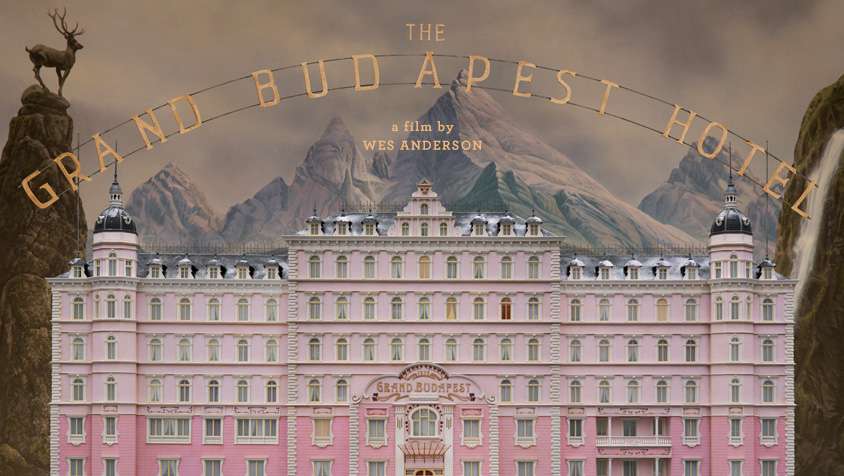
The central characters in Wes Anderson’s films have always had a deep and inextricable connection to the places they love: Max Fischer had Rushmore; Royal Tenenbaum had the house on Archer Avenue; Steve Zissou had his ship, the Belafonte. Despite their usually roguish natures, these connections hint at some kind of deep sadness and longing beneath their charismatic façades. For them, these places are more than houses and boats and boarding schools—they represent something friendly and welcoming. They know that the world can be a cruel, cruel place and all they can really ask for from life is somewhere to call home—a sanctuary. For M. Gustave (Ralph Fiennes) of Anderson’s remarkable new film, the titular location of The Grand Budapest Hotel is just that.
Largely set in the fictional Eastern European country of Zubrowka, the film uses four distinct timelines, each filmed in a different aspect ratio and colour palate precisely layered together. The first takes place in present day, and features a young girl walking through a garden to reach the tomb of an accomplished writer. Next is a flashback, in which the the writer talks directly to the audience about a time in the past when he visited the hotel. The third follows him in the 1960s, a young man at the time, through the hotel—a fading relic of a once vibrant and glorious past. There, he meets owner Zero Moustafa (F. Murray Abraham), who tells him of the hotel’s history and the hyper-competent concierge, Gustave, who is its main attraction. The final and longest timeline picks up in 1932 and follows Gustave and Zero, now an inexperienced lobby boy, as Gustave inherits a priceless renaissance-era painting after an elderly socialite with whom he was sleeping is murdered under mysterious circumstances. What follows is a deft blend of genres—caper, murder mystery, prison break, and screwball comedy being the most recognizable.
At the centre of the story is M. Gustave, a typical Andersonian hero. He’s witty, gregarious, and empathetic. He is also, for lack of a better word, quirky: he recites romantic poetry to his employees, wears a liberal amount of perfume, and has a near god-like ability to anticipate the needs of his guests. What sets him apart from other Anderson characters, however, is his edge: he drinks, gets into fights, and relishes in the use of well-delivered profanity. In turn, this makes his sympathetic qualities stand out much more. He, above all else, understands that the unkindness of people comes from fear or institutional obligation rather than hatred. He is portrayed brilliantly by Fiennes, who attaches a human sadness to this incredibly touching role, while seeming to have the most fun of his career.
Filling out the rest of the cast is the usual cavalcade of Anderson actors—Bill Murray, Jason Schwartzman, and Owen Wilson all get minor roles—and seemingly every established character actor alive, including Willem Dafoe, Jeff Goldblum, Tilda Swinton—in spectacular old-age makeup—and Tom Wilkinson to name just a few. Deserving special attention is newcomer Tony Revolori as Zero. He brings a nervous energy to the film that works as a counterpoint to Gustave’s ever-composed nature.
The film also features some of Anderson’s most experimental camera-work. He moves the camera beyond his usual whip-pans and tracking shots to create some of the most dazzling, empathetic filmmaking I’ve seen in recent memory. One particular standout shot features Zero’s love interest, Agatha, looking directly at the camera with swirling lights around her head, representing the dizzying high of young love. He also uses his common techniques to great effect: every shot is beautifully and meticulously composed, and the script supplies a steady stream of locations for him to showcase his talent – a museum, a mansion, a prison, and especially, the hotel—all rendered in a high level of minute detail and shot in a distinct cinematographic style.
The Grand Budapest Hotel is a fun romp with a complex, emotional centre and is not to be missed.
The Grand Budapest Hotel is running at Cinema du Parc (3575 Parc) between 1-9 p.m. until April 3. Student tickets are $8.50.
Reggie Bibeau and Cheryl Bibeau: Bibeau wonder-siblings decide to open up a fashion parlour due to their sick flow.
Laurent Pro-Jour: Choosing to follow his beard rather than his heart, Pro-Jour decides to forgo his NFL career and promising medical career to lead the McGill Woodsmen to a four decade stranglehold on the Woodsmen Championship.
Harmony Daoust: Having acquired a taste for gold, Daoust decides to pursue a career in mining investments, specifically avoiding companies that mine silver or bronze.
Ossie Short: Lax slang enthusiast Ossie Short announces plans to stop using words in the english dictionary by 2015.
Coach Dennis Parrot: Taking matters into his own hands, Parrot enrolls in a PhD program and joins the McGill cross-country team after a lacklustre recruiting season.
The Students’ Society of McBill’s Offensive Overlords (SSMOO) has been forced to relocate to President Caty Arson’s apartment following the failure of a fee referendum which left the organization unable to pay rent on the Kirk Building.
“We thought we would at least be given a room to operate from, but McBill said that we couldn’t get any space because we are operating at a deficit,” Arson said. “On top of everything else, we’re not sure if we’re going to get our finder’s fee back, and I mean, between you and me, we could really use that money.”
The relocation, according to Arson, could not have come at a worse time, as one of her roommates has friends visiting from Queen’s, and the other—after taking an economic statistics class last semester—has recently taken up the bagpipes.
“It’s thrown off the whole team dynamic,” Arson said. “Disputes have already broken out over equitable refrigerator space allocation, and two of the execs won’t stop rearranging my furniture.”
McBill University Director of Internal Propaganda Don Sour confirmed that administration is looking into other leasing possibilities, but won’t confirm or deny widespread rumors that Liquid Sustenance is hoping to expand their operations to take up the entirety of the Kirk Building.
“McBill has to do what makes the most fiscal sense, after all, at this point, we don’t expect to see any reinvestment from the PQ,” Sour said. “If smoothies are the direction we need to go in right now, then we will explore those options.”
Showings have been arranged with other potential lessees, which has been a cause of great confusion for students who still believe they are scheduled to table in the Kirk lobby. Some a capella group members were verbally attacked for not being able to answer questions about internet rates, while other visitors have been strong-armed into buying tickets for year-end hip hop dance performances.
The failure of the referendum question also has implications on how Gerts will operate in the coming year. There has been general unease throughout the student body, not only regarding the fate of sangria Wednesdays and throwback Thursdays, but also of forget-about-your-GPA Fridays, try-this-new-shot-I-just-invented Tuesdays, and maybe-you-shouldn’t-be-drinking-tonight Mondays.
“No reGerts [sic], right?” U4 philosophy major Your Mom said. “But this time, there are reGerts [sic]. Who knew the results of the referendum would actually affect people? I’m reGerting [still sic] it already!”
One student suggested the transition might actually improve accessibility to SSMOO.
“I mean, I never even knew where the SSMOO office was in the Kirk building, but [Arson] threw a party last year when she got elected, so I feel like a lot of people would have an easier time finding her [at her apartment],” former SSMOO executive Matt Spzjzjzdja said.
SSMOO president-elect Guy Without-Hat said he’s eagerly awaiting his chance to run operations out of his apartment next year, and welcomes more than just SMOO employees into his home.
“Inclusivity and accessibility are extremely important to me,” Without-Hat said. “Any student who feels they have input they would like to share with the exec or myself is more than welcome to stop by for coffee, any time, day or night. But it’s bring-your-own-coffee. And I would never say no to a double-double.”
With summer ahead, it’s the perfect time to start planning your applications to graduate school in science and engineering. Whether or not you’ve decided that you’re ready to apply, read on to learn more about what the application process entails and what you can do to improve your chances of getting in.
Before applying:
Seek out research experience:
The number one thing you can do to show grad schools that you are ready to undertake a graduate program is to get some research experience. While there are different types of graduate programs, most of them are research-based with just a few required courses. Having previous experience demonstrates that you are capable of doing research and that you know what it entails. It’s also the best way of finding out whether or not you will actually like graduate school.
If you don’t have any research experience yet, start now! Ask professors if they need volunteers in their labs, find a job as a research assistant this summer, or do a semester-long research project to fulfill requirements for your major. If you have the option to apply to an honours program, this is also an excellent opportunity to spend a year working in the lab. In any case, having some experience is a must if you want your graduate school application to be successful.
Decide where to apply:
While undergrad programs are relatively broad, graduate programs are more specialized, and the research that you undertake will be extremely specific. For this reason, you should begin your search by deciding what research topics you are interested in and then look for schools that have professors doing research on those topics. Instead of trudging through a maze of university websites, ask professors and graduate students what the best institutions and programs are for your field.
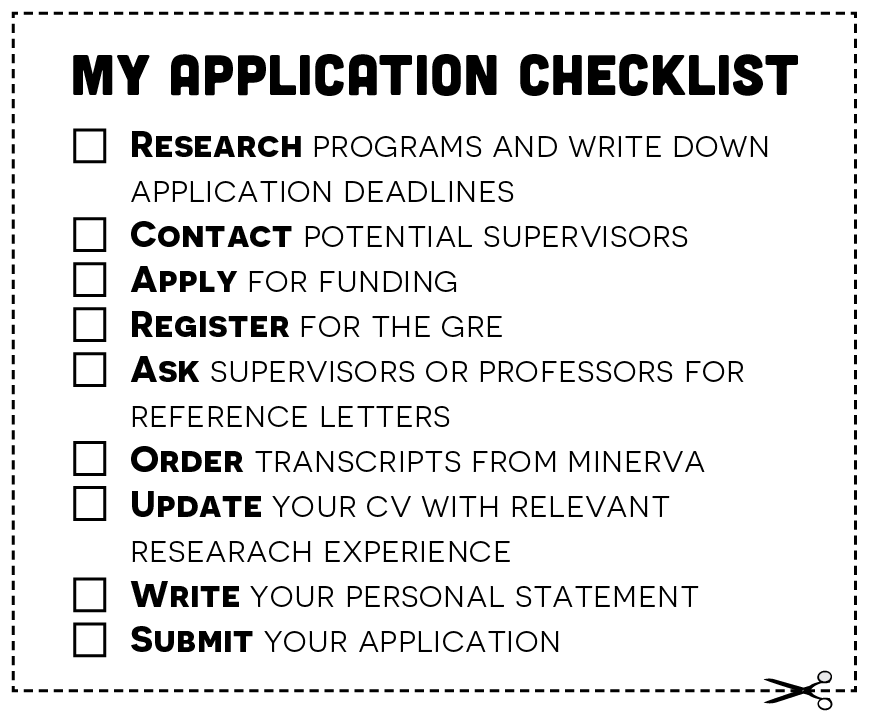
Once you’ve decided on several programs to apply for, write down all the deadlines and all the requirements for each school. Do this early in May so that you won’t be caught by surprise by application deadlines that can fall as early as September.
Find a supervisor:
A supervisor is the head of a lab or research group who mentors graduate students throughout their degree. Some programs will require you to find a supervisor before you are accepted, while others will only ask you to list supervisors that you would be interested in working with. Finding a supervisor you work well with is important because you will be working with them for several years depending on the length of your degree, and their research interests will dictate the type of work you end up doing.
The best way to find a supervisor is to ask for recommendations from professors you already know, and then to read several of their most recent papers. If you can see yourself working on projects similar to those already published, then it’s a sign that you may enjoy research in the lab. If there is more than one professor that you are interested in working with at a university, don’t be afraid to suggest a co-supervision. This type of collaboration can result in really unique research projects, and provide the opportunity to work on a close basis with multiple researchers.
Although having a great supervisor is important, it’s not the only thing that will determine whether or not you will enjoy your graduate student experience. You will be spending most of your time in the lab or students’ office, so try to meet other students in the program and get a feel for the environment before you make your final decision.
Apply for funding:
The best part about pursuing a graduate degree in the natural sciences, health, or engineering is that you can often receive funding to support you financially as you complete your studies. Funding can come from internal or external sources. Internal sources of funding are your program and your supervisor, who may pay you an annual stipend in addition to covering or subsidizing the cost of tuition. External sources of funding include scholarships, fellowships, and grants, which must be applied for separately from graduate applications.
(Maryse Thomas / McGill Tribune)
While it may sound easier to rely on finding a program that guarantees internal funding to all of its students, it is always better to obtain your own, external funding. Doing so makes you extremely attractive to application reviewers because it saves them money, it makes it easier to get more funding later, and it shows that you are capable of writing a successful research grant.
Deadlines for external funding are often much earlier than deadlines for graduate schools (September to October), so make sure you plan early and add these dates to your master list. Funding applications usually ask for a one-page research proposal, copies of your transcript, and a short description of your research experience. If you haven’t decided on what grad programs to apply for yet, apply with your undergraduate research supervisor or professor. If your application is successful, you can always transfer the money to your new project. Well-known funding agencies in Canada are the Natural Sciences and Engineering Research Council (NSERC), Canadian Institutes of Health Research (CIHR), and Social Sciences and Humanities Research Council (SSHRC).
Completing the application:
Although graduate programs will differ in their individual application requirements, nearly all programs will require the following basic components.
Transcripts:
Most schools require an official transcript sent directly from the registrar’s office, so order these from Minerva early and make sure that they are received. You don’t want your application to be rejected because your transcript was late or never arrived.
GRE and subject GRE:
The Graduate Record Examination (GRE) is a standardized test used by graduate schools to compare students from different universities on a normalized scale. This is the grad school equivalent of the MCAT or LSAT. Most programs only require the general GRE, which tests students on quantitative reasoning (math), verbal reasoning (vocabulary and passage understanding) and analytical writing (essay writing). However, some programs may also ask for the subject GRE, such as the Physics, Psychology, or Biology GRE. A test centre in Montreal offers the general GRE twice a month, but subject tests are only offered once in September. In both cases, it’s best to register early because test dates will sell out.
The best way to prepare for the GRE is not necessarily to learn the material, but to learn how to take the test. The same types of questions will come up very often on the GRE, so if you learn how to do those questions, you will be more at ease on test day. Workbooks or preparatory courses are highly recommended to help you prepare.
Curriculum Vitae:
Adapt your CV to highlight your research experience. Separate “Research Experience” from “Work Experience” and put research at the top. Include any information that would show your interest in research like conferences you have attended, presentations you have given, and publications you may have. Don’t forget to list any funding or awards you have received.
Letters of recommendation:
Graduate schools usually require two or three letters of recommendation. The best people to ask for a reference are those who are familiar with your capabilities as a researcher, namely previous supervisors. Make sure that you ask for letters at least a month in advance, and don’t hesitate to send a reminder email when the deadline is two weeks away.
Personal statement:
The personal statement, also called the statement of purpose, is the most important part of your application. This is where you can demonstrate to reviewers that you weren’t just entering data that summer you worked in a lab. The personal statement asks you to describe your background, research experience, and your reason for applying to graduate school in one to two pages. Focus on your research experience and elaborate on specific things that you did to move a research project forward. Link this experience and your future goals to your background in order to create a cohesive statement. Finally, mention specifically why you chose to apply to the program in question and which supervisors you are interested in working with or plan to work with. Once you have written one personal statement, it will be easy to modify this section for subsequent applications.
Resources:
Visit McGill’s Career Planning Service (CAPS) website for more resources about applying to graduate school: mcgill.ca/caps/students/gradschool