Latest News

a, Opinion

Eliminating ethnocentric tuition policies

Quebec has always made the preservation of the French language and culture within the province a priority.  In many areas of Quebec, speaking French is not only encouraged, but necessary. This custom of preserving Quebec’s French roots merits praise; however, it should not come at the cost of alienating people of different backgrounds. The bilateral agreement between France and Quebec which allows French students to receive Quebec tuition while studying in the province is one such example of an exclusive policy whose terms disadvantage other international or out-of-province students without French citizenship.

The agreement, signed in 1965, incentivizes native French speakers to come to Quebec to receive their university education. The policy has certainly succeeded in attracting French students, thereby promoting the use of French within the province. It also gives French students the ability to experience university abroad at an even lower price than they would pay in France. Despite the benefits of this agreement, its exclusion of non-French citizens is tinged with the ethnocentric tendencies that Quebec has been known to display in its relations with France.

At a public Canadian university such as McGill, it doesn’t seem entirely right that French students should have a lower tuition than others, especially when some of those excluded from the tuition agreement also speak French. There are, indeed, other French-speaking countries whose students may receive exemptions on their tuitions. However, the list is brief and restricts the number of students from each country who may receive lowered tuition. If Quebec is truly concerned about promoting the use of French, all francophones should be given equal advantage, regardless of their citizenship. Such a change would encourage even more French-speaking students to come to Quebec, and it would promote greater equality among students whose tuition rates are widely disparate.

There is no easy way to level tuition prices in order to treat all students equally.  One option would be to raise the tuition for French students in order to decrease the margin of difference. However, in order to attract enough French students to Quebec, tuition rates in the province must be low enough to compete with the low prices of education in France. If the McGill tuition rate for French citizens were to be raised too high, French students would lose their incentive to come to Quebec to receive their education, which would be detrimental to the preservation of Quebec’s culture and language. There are also, of course, budgetary concerns. One must acknowledge that the province simply cannot afford to lower the tuition equally for all students. Therefore, a more inclusive policy to give advantage to all fluent French speakers, regardless of nationality, would be a good first step.

A language test to determine proficiency for all students claiming French as a first language would allow all francophones to receive the same benefits. While such a policy would still exclude non-French speakers from the lowered tuition, it would, in theory, be a more equitable policy than the current agreement, which excludes many francophone students from the same tuition exemptions as their French counterparts.  If this change were to be implemented, Quebec’s defensive preservation of French language and culture, historically characterized by its ethnocentric, colonial relationship with France, would be replaced by a more inclusive promotion of French that would include people of all backgrounds, which would be a step in the right direction.

a, Arts & Entertainment, Film and TV

Wrong answers are blowing in The Wind Rises

How much responsibility does a filmmaker working from non-fictional material have to accurately represent his subject? It’s a complicated question, and one which muddles the The Wind Rises, an animated biopic that writer-director Hayao Miyazaki re-released with an English cast of voices that replace those in the original Japanese version. The film follows the life of Japanese military airplane designer Jiro Horikoshi (voiced by Joseph Gordon-Levitt), whose planes were incredibly effective killing machines and an asset to the Japanese military efforts during the Second World War, assisting with the slaughter of soldiers around the world. But The Wind Rises is not about the destruction that Horikoshi’s efforts wrought; rather, Miyazaki uses the film to emphasize the engineer’s identity as a dreamer, a lover, and an artist.

Airplanes fascinate young Jiro (voiced by Zach Callison), and he hopes to one day become a pilot. He looks up to the Italian aeronautical designer Giovanni Caproßni (voiced by Stanley Tucci), who inspires him to turn his aspirations into his life’s work. Though Jiro is discouraged when he realizes his poor eyesight prevents him from ever becoming a pilot, he revives his joie de vivre by learning that he can still design airplanes, even if he can’t fly them.

Jiro’s ambition leads him to study at a university. As he takes a train there, he meets a young girl named Nahoko (voiced by Emily Blunt), who catches his hat as it flies through the air. Jiro quickly repays her kindness when an earthquake hits and her caretaker Kinu (voiced by Mae Whitman) is unable to evacuate due to her broken leg. Jiro creates a makeshift splint for her and fetches water for both girls. Although, he leaves them abruptly and continues his trip to the university, Miyazaki leaves little room for doubt that Jiro and Nahoko will be reunited somewhere along the designer’s journey.

The scene on the train indicates one of the film’s major flaws: Miyazaki’s awkward attempt to merge straightforward realism with fantastical elements that feel lifted from the bizarre universes of his earlier films. As Nahoko attempts to catch the hat, it flies just out of her reach for a while before conveniently hanging in the air right in the range of her grasp. Touches of magical realism like these—which permeate The Wind Rises—are cute and add a touch of whimsicality to the mostly somber tone which Miyazaki strikes throughout the film, but they undermine our ability to take the narrative seriously. It’s hard to treat the film as a sober depiction of Jiro’s life when these elements continuously reappear to remind us that it takes place in a world fundamentally different from our own.

Miyazaki further undermines the gravity of the story through the simplistic depictions of his characters and the banal platitudes with which they speak. The short temper and rash judgements of Jiro’s boss Kurokawa (voiced by Martin Short) make for brief moments of comic relief, but they fail to lay the foundation for a substantive or believable character. Likewise, the German Castorp (voiced by Werner Herzog) comes off as little more than a bland manifestation of the “wise old man” archetype frequently found in Hollywood films. While the generic advice he provides Jiro helps to solidify his status as a father figure to the confused youngster, it also makes him seem more like a fortune cookie than a fully-realized human being.

This all would be less of a problem if Miyazaki wasn’t depicting real events, but he’s dealing with someone whose actions had an undeniably violent impact on the course of history. The portrayal of someone who created formidably destructive machinery deserves more gravitas than Miyazaki’s fanciful touches and paper-thin characters allow for. His focus on Jiro’s genius and artistry rather than the death it caused provides too narrow of a historical view to be taken seriously. I can’t help but wonder how audiences would have reacted if a filmmaker had used this approach to tell the story of the makers of Zyklon B or the atomic bomb. I don’t imagine viewers would have too much patience for such a film, and The Wind Rises is no more deserving of their attentions.

a, Student Life

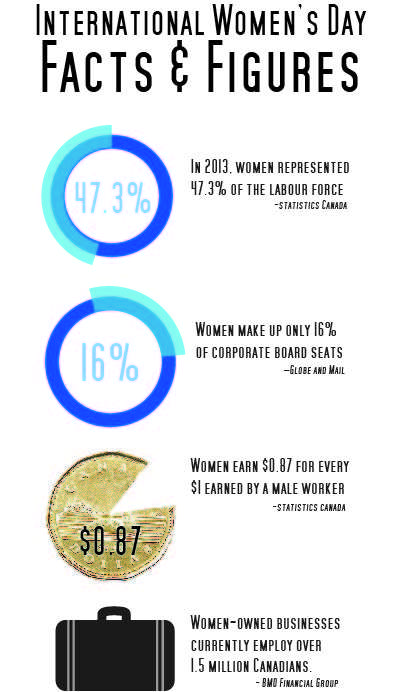
International Women’s Day: facts & figures

This past Saturday marked the 103rd annual International Women’s Day (IWD). On March 8, people across the globe celebrated women and recognized the steps taken on the path toward gender equality.

At McGill, women have come a long way in the last century. The first female students were admitted in 1884, 41 years after the first male students. Today, women make up 56 per cent of the student body.

However, IWD also highlights the challenges that women continue to face. Each year, Canada picks a theme for IWD, included ending violence against women, women’s rights, and women in leadership. This year, the theme for Canada’s IWD was “Canadian Women—Creating Jobs One Business at a Time,” to acknowledge women’s contributions in shaping the Canadian economy.

a, Science & Technology, Student Research

This Month in Student Research: Finding the art in developmental biology

Known for its excellence in research, McGill University is home to a host of professors and scientists whose work contributes to scientific innovation. In tribute to the amazing work conducted within McGill’s walls, each month, Science and Technology features a student researcher who has helped further the cutting-edge science conducted at the laboratories. 

Di Hu stands a mere 5’2”, but what she lacks in height she makes up for in passion and her bubbly demeanor. Over the past four years at McGill, the U3 Anatomy and Cell Biology major has worked in six different laboratories, created three different posters, discovered a novel gene, and became involved in four papers—one of which she recently submitted to the Journal of Biomedical Sciences as first author.

Hu’s gateway into scientific research is unique from most undergraduate students at McGill. Hu actually attended an arts middle school, where she explored music and visual arts before pursuing more science-based courses in high school, and ultimately at McGill.

“In that time in my life in middle school, [I realized] how important creativity is, and that I always want to make something new,” Hu said. “I took that to McGill—I don’t want to just learn from a textbook for the rest of my life, I want to make advancements. My favourite aspect of [research] is the creativity.”

Hu was unsure at first as to what type of research she was interested in pursuing—or whether that was even in her future at all—but she knew that she wanted the experience. She recalled her first lab position where she performed data analysis in electron microscopy.

“It was very simple work. I didn’t know much about electron microscopy at the time, but I could delete blurry pictures.”

As Hu progressed in her U1 courses that semester, the picture quickly unfolded as to what she was passionate about.

“I was sitting in BIOL 200, and that was the class that really changed my life,” Hu said. “I realized how much I loved molecular biology, the questions involved, and the implications that fundamental research has in human health and disease.”

From this point forward, Hu’s advancements in the realm of research seemed to flow naturally. She took inspiration from each lab she worked in and looked forward to other laboratories that she could explore.

“I learned in Dr. Richard Roy’s lab that I really like development [….] However, I realized that ‘Yes, I like development, but I wanted to work with mammals,’” said Hu. “Dr. Maxine Bouchard was giving us a lecture about kidney development the next semester in BIOC 212. That was when I realized, ‘Wow, understanding the process of kidney development can help us understand congenital disease as well as cancers [….] I asked him if I could join his lab after class and he let me.”

However, it was Hu’s experience as a summer student at SickKids hospital that opened her eyes to the career she is currently pursuing. Unlike her other lab experiences, her work with Dr. Norman Rosenbloom pulled her away from the lab bench and into the clinic.

“[Because Rosenbloom] is both a researcher and a physician, I got to see the patient-driven motivation behind [his research] and it was so cool,” Hu explained. “That was when I realized that I want to be a physician scientist. It just made so much sense for me. I want to be at the bedside and I want to talk to patients and help them on a one-on-one basis and also use that to inspire questions at the lab.”

Although Hu initially applied to PhD-MD programs, throughout the application process she noticed how much more fluidly she could write the PhD aspect of the application. While Hu traveled to Oxford for the holidays over Christmas break, she decided to apply to the school’s graduate program. Taking a chance, she wrote the application on the plane back to Canada—little did she know she would be accepted into this five-person program.

“I felt like there was just a natural flow in what I did, and I was really just pursuing what I like to do,” said Hu.

As a pre-med Science student, Hu never would have imagined that after four years of undergraduate studies at McGill she would be jetting off to Oxford in the Fall to start her PhD. Yet, it was these unexpected experiences in the lab that have proved invaluable, both in terms of her class work and her own professional development.

“It definitely helps put what I’m doing in class into deeper context,” Hu said. “Memorization, you know, I don’t think I do that anymore at all. I understand it and can picture it. It also makes you realize what is important and what is not.”

“I think one of the most important things I have learned in research is to embrace failure,” Hu said. “It really changed my life to be calmer and say, ‘Yes, I may fail,’ because you are always failing at research. Be open-minded and learn from failure and recognize it and improve. It kind of made my life better.”

McGill Tribune: If you could describe yourself in three words, what would you say?

Di Hu: “Passionate, natural, and creative.”


MT: What is your favourite part of developmental biology?

DH: “I think [one] aspect is that it is so funny and weird that all of the processes in developmental biology do the exact same things in cancer. The only difference is that the embryonic environment is very sterile, but the adult environment is very toxic. The same processes in different environments lead to very different things. To study development is to study cancer, and I think it is a very powerful tool.”


MT: If you could have one superpower what would it be?

DH: “To know what others are feeling—emotions. I try to be aware, but sometimes, you don’t know.”


MT: Do you have a favourite article of clothing?

DH: “Definitely like a head thing—it is like a hair accessory. I feel like head accessories are the future. I love these, they are so much fun.”

a, Editorial, Opinion

Recent rhetoric highlights need for linguistic tolerance

The issue of the flight of anglophones from Quebec returned to the forefront following the release of a study that found that over half of Quebec’s anglophone and allophone (those with a mother tongue that is neither English nor French) population has considered leaving Quebec in the past year. The study, commissioned by the CBC and released Feb. 25, found that political uncertainty was the major reason for the doubts, citing the language divide as one of the main sources of contention. In thinking about language issues this election, we must ensure that policies encourage the vitality of the French language without exercising vindictively punitive measures on the use of English.

With about 50 per cent of McGill’s population declaring English as their first language and 32 per cent declaring a language other than English or French as their mother tongue, this issue certainly touches McGill students. For those approaching graduation, the consideration of whether to leave or stay in Quebec after McGill is not a new one, especially considering that 47 per cent of McGill students officially declare residency as outside of Quebec, according to statistics from Fall 2013. After three or four years of growing to love the vibrant Montreal city life, with its multitude of cultural offerings and opportunities, many of us would like to stay in the city past the conclusion of our McGill degree. However, the dire job outlook for anglophones poses a major challenge for those hoping to stay, as the law requires that French be the official workplace language of businesses with more than 50 people, a number that the provincial government has expressed interest in further lowering.

While we recognize that as outsiders, much of the burden falls on English-speaking students to learn French and educate ourselves more deeply about the province, the reality is that the provincial government is increasingly and worryingly encroaching on the English language. The same week that the CBC study was released, the Quebec minister responsible for the charter of the French language, Diane De Courcy, spoke strongly against institutional bilingualism in Quebec, using the common bilingual greeting “Bonjour-hi” as an example of the “unacceptable slide” towards bilingualism in commercial spaces and across the province. This statement is indicative of a larger trend, particularly with the current Parti Québécois (PQ) government, and one that has the potential of continuing to push away people who would otherwise be strongly inclined to stay and contribute to the province.

One of the issues that De Courcy’s statement highlights is the rising animosity in the way language issues in the province are addressed. This polarizing rhetoric often spreads to students’ interactions in the city, for example, with vendors downtown refusing to speak in French to students with an accent, thus limiting their opportunities to practice the language. There appears to be a disconnect between the idea that newcomers should learn French and the supports provided to them. While the onus remains on the students to learn the language, the provincial government should play a role in promoting integration by working towards removing the obstacles—legal or social—that often prevent them from truly integrating with Quebec.

While Quebec has only French as its official language, English has certainly shaped important aspects of the province, including Montreal itself, well-regarded as one of the largest bilingual cities in the world. Current French language policies stem from longstanding tensions and historical concerns for the survival of francophone culture in the province, but English cannot be dissociated from the province’s cultural wealth.  As Quebecers head to the polls on April 7, the tensions that accompany the language divide are bound to continue at the forefront of provincial discussion. With this in mind, it will be important to remember the value of mutual respect in these debates.

a, Men's Varsity, Sports

Basketball: Redmen repeat as RSEQ champions

After taking down the Laval Rouge et Or with a 80-62 victory in Saturday’s RSEQ semifinal game, the McGill Redmen moved on to face the conference pre-season favourite Bishop’s Gaiters in the RSEQ Championship for the second consecutive season. Contrary to last season, which came down to late game heroics from now-graduated guard Adrian Hynes-Guery, the Redmen started the game hot and didn’t let up as they trounced the Gaiters 73-47.

Fresh off of winning RSEQ Player-of-the-Year honours, third-year shooting guard Vincent Dufort refused to let an injured ankle slow him down, dropping a game-high 18 points. The 6’4” physical education major nailed four-of-five three-pointers en route to capturing Player-of-the-Game honours.

“[When we face] Bishop’s I have the advantage on the perimeter against their big post players,” Dufort said. “They take chances on leaving me open at the three-point line, and today I was fortunate enough to be able to make [the shots].”

Dufort’s co-captain Simon Bibeau finished his spectacular RSEQ career as a two-time champion. Though Bibeau’s  time is coming to a close, the Redmen program revival that he initiated is in full swing. With an astonishing nine freshmen having played a role in the squad’s great season, the future looks bright.

“Playoff games are [very] different than regular season games in terms of intensity,” Dufort said. “For the freshmen to come in and play the way they did in that type of atmosphere is amazing. We have a very special group of guys. Every single guy stepped up and played a big part this weekend.”

Freshman forward Francois Bourque finished his RSEQ season with his sixth double-double as he registered 10 points and a game-high 12 rebounds. Bourque has dominated all season, often operating as the team’s lone interior threat. However, it was his teammate Dele Ogundokun who took home the RSEQ Rookie-of-the-Year award before the tournament.

“It is an honour to win the award, but none of it could have been possible without my teammates and coaching staff,” Ogundokun said. “As a team, we are always pushing each other to get better and strive for greatness.”

While the Redmen offence showed no mercy against Laval or Bishop’s by scoring 82 and 73 points respectively, it was McGill’s defence that sealed the team’s championship.

Redmen Head Coach David DeAveiro has emphasized defensive intensity all season, with the game against the Gaiters serving as the culmination of the team’s hard work throughout the year. Bishop’s scored a season-low 47 points, including two quarters in whch the Redmen held their opponents under double-digits.

“We have our defensive principles that we stick to, but what it really came down to was trust, effort, and who wanted it more,” Dufort said. “It took an entire team effort as opposed to just a couple of guys playing good defence.”

The team now heads out to Ottawa for the CIS National Championship tournament, which the hometown Gee-Gees enter as the no. 1 seed having upset the Carleton Ravens in the OUA Finals. McGill will take on a tough Victoria Vikesteam in the first round, who will be looking to bounce back after a close loss to Alberta in the Canada West Finals.

The Redmen took down the Vikings 80-68 in last season’s CIS tournament to capture fifth place, but are looking to improve upon last year’s finish. Coach DeAveiro lost seven players from that squad—including three starters; but his Redmen have not missed a beat. The team now has its eyes set on bringing home McGill’s first national championship.

“This weekend, our goal is to win the national title,” Dufort said. “Anything short of that will be a disappointment.”

a, Science & Technology

Science from Science Fiction: Gravity

From invisibility cloaks to light sabres, many recent scientific advancements have made it possible for researchers to get a little bit closer to reproducing some of our favourite technologies portrayed in films. However, while science inches towards science fiction, science fiction can still take a lesson in recreating science. One of this year’s most popular science fiction films Gravity made a concerted attempt to correctly reproduce astronauts’ experience in space, but ultimately faced some bumps in accuracy along the way.

This Academy Award winning film turned out to be a stunning display of the cosmos and the dangers lurking thousands of miles above us on earth. The film’s beautiful graphics and bird’s-eye view of the globe, distracts from the inaccuracies of the film.

Neil deGrasse Tyson, the director of the Hayden Planetarium in New York’s American Museum of Natural History, posted a series of tweets highlighting technical errors in Gravity (along with much positive praise) after the film’s release. One of Tyson’s qualms was the plausibility of the physics at work when the characters struggled in the vacuum in space.

According to Tyson, when two people are floating in zero gravity, even a small tug can bring their bodies together. Therefore, when Bullock catches Clooney’s tether as he tumbles past her, this tug would be enough to save him from having to sacrifice himself and drift off into space. Unfortunately, if Clooney’s trajectory were to have obeyed the rules of physics, there would not have been much of a film.

The debris shown to be orbiting the Earth also violates natural physics laws. Nearly all satellites orbit Earth west to east; however, in Gravity, the satellite debris were depicted moving east to west.

In addition to physics, the astronaut’s outerwear was tailored more to the Hollywood appeal than to an astronaut’s actual gear in space. Bullock should not have been able to strip down so easily to her undergarments after taking off her suit—she should have been equipped with a liquid cooling and ventilation garment beneath the space suit she wore on screen.

Furthermore, the actual fate of the protagonists would likely have been different had they been wearing their Simplified Aid for Extra-Vehicular activity (EVA) Rescue (SAFER). This small backpack is required for astronauts working on EVA missions, as it acts as a backup plan in case the tether breaks and the spacewalkers are in danger of drifting away.

Despite its inaccuracies, Gravity has been praised for its representations of space. Former NASA Astronaut Garrett Reisman applauded the film’s depiction of spacewalking, where the actors realistically portray the ease of starting a motion and difficulty of stopping one. For Reisman, director Alfonso Cuaron’s artistic licence and creative vision adds to the excitement of Bullock and Clooney’s journey into space, even if the same can’t be said for its plausibility.

Politics

Obama and Leaders Reach Debt Deal

Image Source: Center for American Progress Action Fund

This is some dummy copy. You’re not really supposed to read this dummy copy, it is just a place holder for people who need some type to visualize what the actual copy might look like if it were real content.

If you want to read, I might suggest a good book, perhaps Hemingway or Melville. That’s why they call it, the dummy copy. This, of course, is not the real copy for this entry. Rest assured, the words will expand the concept. With clarity. Conviction. And a little wit.

In today’s competitive market environment, the body copy of your entry must lead the reader through a series of disarmingly simple thoughts.

All your supporting arguments must be communicated with simplicity and charm. And in such a way that the reader will read on. (After all, that’s a reader’s job: to read, isn’t it?) And by the time your readers have reached this point in the finished copy, you will have convinced them that you not only respect their intelligence, but you also understand their needs as consumers. (more…)

a, Arts & Entertainment, Music

Kanye can’t touch the sky with his ego weighing him down

“I am the next Walt Disney. I am the next Steve Jobs.”

When you bring up Kanye West in conversation, you’re likely to be greeted with two very distinct opinions. On one hand, we have the adamant defenders, die hard ‘Yeezies’ who can spend hours attesting to West’s creative brilliance; opponents can be seen rolling their eyes, mumbling about the egotistical media junkie who had the audacity to compare himself to Jesus on the cover of Rolling Stone.

All this being said, why is it that Kanye West—a man who has clearly secured his place in hip-hop history through his outspoken tirades and lyrical antics—has failed to move past his defined role as fanatic producer/rapper into the business world like his peers Jay-Z and Pharrell Williams? Contrary to what West might have you believe, it all comes down to his ego.

“There are only two types of people in this world: haters and dreamers. The only difference between them is that haters let go of their dreams.”

Just the other week, West performed at the Bell Center, making up for the previously planned November show that was cancelled due to technical difficulties. West took 22 minutes out of his performance to give what some news outlets have dubbed a “quality of life” speech. He spoke to the crowd on a large array of topics; ranging from his potential, his hopes, his dreams, and most importantly, his legacy. Public opinion, West claimed, is what has been holding him back from reaching his greatest potential. In the speech, he acknowledged his egotistical ways and his borderline manic outbursts in the past year—but he largely dismissed them, calling them the ideals of a genius, not the ravings of a lunatic.

“It ain’t about me. It’s about y’all, and it’s about us.”

Perhaps West is exaggerating how harshly the industry has stifled his potential. His performance was nothing short of mesmerizing, exactly what you’d expect from a man who’s referred to himself as both a “pop enigma” and “this generation’s greatest rapper.” There were explosions, women dressed in what can only be described as nude pantyhose  suits, an imitation Jesus, and Yeezus wearing a variety of bejewelled masks. The bass reverberated with every note and the crowd was electric. They knew every line, bounced to each individual beat; any minor change that took place on stage was noted and greeted with boisterous cheers and high-pitched squeals. West was a god among his worshippers.

“I’m a celebrity… I am God’s vessel.”

However, Kanye West is not doing himself any favours to counter the stereotypes being thrown at him by his detractors. His view that the media wants to stifle him because he is a black man from a low socio-economic upbringing is interesting when you consider that his net worth is $100 million, making him one of the most successful college dropouts in the business. West claimed during his monologue that the walls he was hitting in his efforts to produce his own clothing line were a result of corporations’ greed and unwillingness to break away from what was expected of them. Public opinion is holding him and all of the other innovators back. As he described in what was my favorite line of the night: “Someone wants to walk over here [to the Bell Center] without a coat on because they’re naturally hot inside or some shit and they tryna walk over here and public opinion be like ‘motherfucker, put a coat on!’”

 “All of y’all gave my voice the power and I never take that for granted. And since you gave my voice the power, I will have the courage to use my voice whenever necessary.”

Is public opinion holding Kanye West back? Does he have a point when he says that racism and class stratification are not only alive in America but also thriving? Well, yes and no. No one can reasonably doubt that things like racism and class discrimination still exist—not just in America but also throughout the world. Public opinion too does play a large role in how we as consumers perceive people, events, and products, and West’s outbursts have arguably been overplayed to stir up a widespread opinion that he is nothing more than a self-absorbed lunatic. But West is lying if he claims he doesn’t play the media game just as hard as it plays him. Standing in a crowd full of adoring fans asking them to cheer if they agree with him is not a difficult task.

“Let’s see if they print anything I said tonight. That would be surprising.”

Ultimately, it isn’t the media, big business, or corporations holding West back—it’s his ego. I have been a fan of West for years because of his larger-than-life personality and his steadfast belief that he can do anything; but when you constantly aim for unreachable heights, one day, you have to face that even “god” has his limits.

a, News

EUS VP Communications sanctioned for mocking Farnan apology

An executive in the Engineering Undergraduate Society (EUS) has apologized to the Students’ Society of McGill University (SSMU) for mocking an apology issued earlier this month by SSMU Vice-President Internal Brian Farnan.

On Feb. 9, Vice-President Communications Luis Pombo sent a satirical apology through the EUS listserv, which mimicked the format and nature of Farnan’s Jan. 27 apology for racial insensitivity.

Pombo’s joke triggered an EUS equity complaint. In response, the EUS executive team, in consultation with the EUS equity commissioner, imposed a number of sanctions on Pombo. In addition to Pombo’s apology to SSMU, these include equity sensitivity training and the revocation of EUS listserv and publications responsibilities, which will now fall under the president’s portfolio.

EUS President Carlos Marin said the problem stemmed from Pombo conveying personal opinions from his position as an executive.

“[He] as an individual may disagree with SSMU’s Equity Policy […] but [he] cannot, as a representative of the EUS, make a joke out of that; that’s completely unacceptable,” Marin said. “[He] cannot send an official e-mail from an official communication channel of the EUS making fun of the concept of equity.”

Pombo accepted full responsibility, noting that his mock apology was part of his initiation into the Plumbers’ Philharmonic Orchestra (PPO), an Engineering student group.

“As part of my PPO initiation I was given a set of tasks,” Pombo told SSMU Council on Thursday. “One of these tasks, however, was to send out a fake apology to all engineering students. In what can only be described as a lazy attempt at comedy, I decided to satirize Brian Farnan’s apology.”

Without the listserv and work on publications, Pombo will continue to manage the EUS web developing team and the yearbook, among other tasks.

Some students, such as Alex Grant, U2 Engineering, said the response was appropriate.

“I think [the sanctions] are probably a good middle between taking him out totally and leaving him how he is,” Grant said. “There’s absolutely no way that he could just be let off the hook for that.”

Other students such as Morgan Grobin, U3 Engineering and a chief of the PPO, said the response to Pombo’s mock apology was too harsh.

“I think anyone who is mildly intelligent realizes that [the e-mail is] mocking the SSMU equity process itself, and not mocking equity or Brian Farnan personally,” Grobin said. “What Luis did was a mistake [… but] I don’t think he should be stripped of all of his powers [….] Maybe something that would have been more productive would have been an open forum with Engineering students to talk about equity.”

Grobin also criticized the process by which the sanctions were decided.

“The [executive team] is only eight people; they’re elected representatives, but they only represent the interests of the EUS executive, and there wasn’t consultation from year representatives who represent all the students in the Engineering body,” Grobin said. “That’s why Council exists—so that no decision gets pushed through that’s inappropriate or unfair.”

However, Marin argued that the executives abided by EUS Equity Policy.

“That’s how our process of the Equity Policy works […] and the fact that [the complaint was about] someone from our team made it more appropriate,” he said.

Marin also said that despite negative reaction surrounding the incident, increased discussion about equity among students was a positive outcome.

“There’s this stereotype that in Engineering we don’t care about these things,” he said. “As leaders of the [Engineering students’] community, [we] have to make sure that this discussion happens. And I think it’s happening.”

Read the latest issue

Read the latest issue