Latest News

a, News, SSMU

SSMU research suggests Equity Policy compares favourably with other schools’

SSMU’s Equity Policy measures favourably against other universities, according to a report presented at the Students’ Society of McGill University (SSMU) Council meeting on Feb. 20.

Equity researcher Chelsea Barnett presented on the SSMU equity research study. Structure, finance, and complaints were the factors observed in the study, which compared data from SSMU to that of the University of Toronto, the University of Virginia, the University of British Columbia, Concordia University, and Cornell University at both administration and student-union levels.

According to Barnett, SSMU was the only student organization among the universities that had its own equity policy, independent from university policy.

She also mentioned that the policy is more progressive in terms of its coverage of issues.

“It includes things not mentioned in other university policies such as fatphobia [and] sizeism,” Barnett said. “However, on the flipside of that, the jurisdiction of SSMU’s policy is much smaller. If we didn’t have our own policy, we could be putting pressure on the university policy to include [these] things.”

Barnett noted the low number of discrimination complaints on campus.

“There are three possible hypotheses: students overlook the SSMU policy because they don’t think it applies to them [or] they want to [go] to McGill for bigger consequences; they don’t feel SSMU’s jurisdiction would even include them; [or] students don’t know the policy exists,” she said.

Arts Representative Ben Reedijk offered an alternative possibility.

“If you look on the website when it talks about how people make an equity complaint, the first thing it says is to read the Equity Policy,” he said. “But if you read the Equity Policy, it’s filled with typos and grammatical errors, which I don’t think inspire confidence.”

Barnett responded that while a copy-edit of errors could be beneficial, her research did not address syntactical details.

“A project to professionalize the Equity Policy—I think that would be a useful way to spend some time and energy around equity as well,” Barnett said.

In terms of suggestions for the future, Barnett said SSMU would benefit from having an executive in charge of overseeing equity affairs on campus. While equity is currently under the portfolio of the vice-president university affairs, Barnett said equity deserves an executive position.

“For U of T, the notable feature is their executive position [VP Human Resources and Equity],” Barnett said. “ I’m advocating for [also having] an executive commissioner who would be in charge of overseeing equity. It’s becoming a large issue [….] Equity is in the forefront.”

New mental health policy adopted unanimously

Councillors voted in favour of adopting a new Mental Health Policy, which will aim to promote mental health support on campus. Joey Shea, SSMU vice-president university affairs, worked closely on the policy’s development.

“[The Mental Health Policy Committee] started by just discussing what we thought SSMU’s approach to mental health should be, and then from those very broad objectives, we narrowed it down to a very tangible five-year-plan which is reflected in the policy,” Shea said.

David Benrimoh, medicine representative, presented an overview of the policy.

“This is going to be a network of services, of listservs, websites, and events that are going to together improve access for students for mental health care and promote mental health wellness,” he said.

Benrimoh also emphasized the renewability of the new policy.

“This is a living document,” he said. “This document is going to keep changing, keep improving over the years, and it will serve as a foundation for a new mental health network.”

Sue Jeong, Arts representative, asked what set the new Mental Health Policy apart compared to other mental health services available at McGill.

“We want to encourage overall wellness,” Shea said. “A large part of our approach [is to] facilitate the growth of these other groups to perpetuate a culture of wellness and overall well-being at the university.”

a, Opinion

Mockery trivializes North Korean misery

I have never met my grandparents. This isn’t because of family division or irreconcilable differences, but due to an act of terrorism. On Nov. 29, 1987, Korean Airlines flight 858—en route to Seoul from Baghdad—exploded over the Andaman Sea. Two North Korean agents, acting on personal orders from Kim Jong-Il, had planted explosive devices in the cabin that detonated during the flight. My grandparents and all 113 passengers and crew were killed.

However, today the media and the audience views North Korea and its leader Kim Jong-Un as nothing more than comic relief, dismissing him as a pudgy-faced joke.

On the Internet, blogs like “Kim Jong-Un Looking at Things” and “Kim Jong-Un is Hungry” play up the comical side of the regime. Numerous photos of Kim Jong-Il and his son Kim Jong-Un have been utilized for a multitude of Internet memes. The Economist has printed a pseudo-satirical cover of Kim Jong-Il with the title “Greetings, earthlings,” ridiculing the leader’s sense of self-importance. Even Hollywood has gotten in on the fun, with films such as Team America showcasing the Great Leader’s vocal talents, where he croons about his own loneliness.

It’s hard to deny that the North Korean regime is ridiculous enough that it can be considered comical. Our society here is so far removed from the antics of someone like Kim Jong-Un that he may as well be a character from a work of fiction. But that same joked-about leader is also the head of a state responsible for numerous human rights abuses. On Feb. 17, the United Nations Human Rights Council (UNHRC) released a 400-page report after interviewing over 320 defectors from North Korea. The report contained detailed accounts of mass starvation, political executions, and labour camps reminiscent of Soviet-era gulags.

The Korean War (1950-1953) changed the lives of my family in irrevocable ways, both during and after the conflict. My grand-uncle defected to North Korea in the early stages of the Korean War as a young communist sympathizer. It wasn’t until the North Korean government allowed for family reunions in 2000, that we discovered he was still alive and had spent 50 years living in the North. And of course, my grandparents were casualties of a decades-old geopolitical conflict, directly caused by a ruler whose oppressive regime quashes the right to a legitimate political process for millions of people.

It’s difficult for me to see the humour in blogs, videos, and films that ridicule North Korea. It’s even more difficult for me to see why the common reaction to such material isn’t disgust and anger, but laughter.

Nonetheless, I do accept that humour can be a tool to shed light on unexamined issues. For example, Jon Stewart criticizing American policy towards military veterans in a humorous way still recognizes the incompetence of the policy behind the veil of comedy. However, memes and songs about Kim Jong-Un fail to address the suffering of human beings on an informative level, but simply dismiss him as a kooky dictator. If we cannot bridge the cognitive disconnect between the satire and the reality that is being satirized, we lessen our understanding and awareness of the atrocities being committed daily.

As I read the UNHRC report, I grimace to think of what those living in the camps would think of our memes, videos, and films about their leader who condemned them. Would they be laughing along with us?

a, Behind the Bench, Sports

No end in sight for women’s hockey

On Thursday, the Canadian Women’ s hockey team won its fourth consecutive gold medal after an exhilarating comeback win over the United States. Although the squad is surely still celebrating, its joy may be dampened by the disconcerting whispers that the female edition of Olympic hockey may be axed in the future due to a lack of parity beyond the two North American powers.

These whispers started in Vancouver 2010, when then International Olympic Committee (IOC) president Jacques Rogge ominously stated, “We cannot continue without improvement [of non-established hockey playing nations],” in reaction to Canada’s string of absurd blowouts against the European competition. In reality, women’s hockey has nothing to fear for the foreseeable future despite the Canadian stranglehold on the gold medal; the sport’s Winter Olympic position is secure.

While Rogge might throw around coded threats, he knows that the Winter Olympics cannot afford to lose too many female athletes, especially those in one of its most exciting sports. The number of female events has increased to 38 this year, only seven fewer than the number of male events. Future Games will be looking to further this gender equality, and the IOC, after its efforts to increase the number of female events, cannot justify getting rid of a sport that contributes 168 athletes to the Olympics.

Parity still does not exist, but progress is being made. Those who are still frustrated by the large gap in development should be reminded that in men’s hockey, it took Sweden nearly 60 years to beat Canada; and yet, the two nations just squared off in the men’s final, and are the two most recent countries to have won Olympic Gold. Sochi brought with it the needed green shoots of improvement that Rogge called for, as no team was beaten by more than 10 goals—a drastic contrast to the Vancouver Games where Canada and the U.S. combined for five double-digit blowouts. This visible improvement will no doubt spark more interest in women’s hockey among youth in the competing European nations that already have strong hockey cultures.

In some eyes, the fact that the two best nations are in North America hurts ice hockey’s legitimacy as an Olympic sport. These arguments are unfounded. The Winter Olympics themselves are not global. Only 43 per cent of nations participate in the Games, and of those examples, there are countries such as Ethiopia who send only one athlete—which does not affect the medal tables. The same arguments for hockey being excluded for a lack of genuine competition can also be extended to the legitimacy of other sports that exhibit dominance among a handful of completing nations. For example, the Netherlands won 24 medals in Sochi over the past two weeks, and all 24 were in speed skating. If the IOC is really pondering getting rid of women’s hockey, why not do away with speed skating as well?

Look no further than softball at the Summer Olympics to see where the arguments for removing ice hockey are founded. Softball was voted to be removed for the 2012 games because the same four nations had made the semifinals in four straight Olympics. Ultimately, the IOC will understand that the women’s game must remain in the Olympics. Five-point-six million Canadians tuned into the gold medal game, a TV rating which will serve to bring in sponsorship and revenue through advertising for the Games.

Simply put, getting rid of women’s ice hockey at the Olympics would be financially unwise, and stunt the progress that is being made. No longer would spectators be watching the best in the world competing to see who can go faster, higher, and stronger. Rather, they would be stripped of the chance to see the best rivalry and the best drama of the entire Olympic spectacle.

a, Arts & Entertainment, Film and TV

Oscar Predictions

The A&E team takes on four of the prominent categories at next week’s Academy Awards by offering probable predictions and wild card scenarios for each.

Best Actor:

Bruce Dern — Nebraska

Leonardo  Di Caprio — The Wolf of Wall Street

Chiwetel Ejiofor — 12 Years a Slave

Matthew McConaughey — Dallas Buyers Club

Christian Bale — American Hustle

It seems like this year’s battle for Best Actor is coming down to who brandishes the most compelling story—in real life. Following three high-profile wins at previous awards shows, Matthew McConaughey is coming out with guns blazing. At this point, his pull isn’t necessarily a result of outperforming the other nominees; rather his success at the Oscar forerunners has helped him build momentum. McConaughey’s performance in Dallas Buyers Club commands the screen with a kind of intimacy and nuance we’re not used to seeing from him. With his transformation from rom-com party boy to serious actor over the last couple of years, an Oscar win seems like the appropriate confirmation of his metamorphosis.

Wild Card: Christian Bale will win for American  Hustle but no one will notice because Jennifer Lawrence will steal the show with a photo bomb.

— Kia Pouliot


Best Actress:

Amy Adams — American Hustle

Cate Blanchett — Blue Jasmine

Sandra Bullock — Gravity

Judi Dench — Philomena

Meryl Streep — August: Osage County

Look for Cate Blanchett to give a repeat  performance, and take home the hardware for her role in Blue Jasmine, just as she did a few weeks ago at the Golden Globes—only this time, hopefully, with less vodka under her belt. The five-time Oscar nominee won in 2005 for her supporting role in The Aviator, and has once again secured herself in the company of other Hollywood heavyweights like Meryl Streep and Judi Dench. Blanchett’s nuanced portrayal of fallen New York socialite Jasmine French evokes sympathy for a sadly troubled yet nonetheless grating character, adding a depth and vulnerability upon which the entire film hinges.

Wild Card: Judi Dench will win but Meryl Streep will catch the snitch.

— Jacqueline Galbraith


Best Picture:

American Hustle

Captain Phillips

Dallas Buyers Club

Gravity

Her

Nebraska

Philomena

12 Years a Slave

The Wolf of Wall Street

Oscar pundits have been predicting a Best Picture victory for 12 Years a Slave since international festivals first screened it, and the film still looks to be in good shape. The stark treatment of its disturbing subject matter has won it a steady stream of plaudits since its premiere, and all signs appear to point towards Oscar voters affirming the praise and awarding the film top prize. However, no film this year aims for as high a degree of difficulty or achieves as much as The Wolf of Wall Street. The scathing satire entertains to a remarkable degree while simultaneously shedding light on the absurdities of modern capitalism. The film won’t win Best Picture, but Martin Scorsese and the rest of the team behind it can go home knowing that they’ve created a masterpiece.

Wild Card: Her wins Best Picture. Technosexual activists around the world claim the victory as a turning point in the fight to broaden the definition of marriage to include “one man and one computer.”

— Max Bledstein

Best Director:

Alfonso Cuarón — Gravity

Steve McQueen —12 Years a Slave

David O. Russell — American Hustle

Alexander Payne — Nebraska

Martin Scorsese — The Wolf of Wall Street

In a category that features three seasoned nominees (Russell, Payne, and Scorsese have 14 Best Director nods between them), it’s the newcomers that have turned it into a two-man race. It’ll be a monumental upset if one of the first-time nominees, Steve McQueen or Alfonso Cuarón, don’t go home with a statue. Cuarón has taken on frontrunner status between the two; with Gravity’s ethereal visuals and seamlessly woven intricacies, Cuarón has leap-frogged his veteran peers to take us to a new cinematic frontier altogether. It’s a testament to McQueen’s agonizingly excellent film that we can even talk ourselves into picking an upset here, but choosing Cuarón should be an easy call for the Academy.

Wild Card: McQueen’s name is in the envelope, but after it’s announced, Steve is beaten to the stage by a speedy and confused attendee: the real-life  CGI incarnation of Cars’ Lightning McQueen.

— Max Berger


a, Martlets, Sports

Basketball: Martlets win nail-biter in final home game

Five years ago, Hélène Bibeau and Françoise Charest walked onto the floor of Love Competition Hall for the first time. One-year later, Valérie L’Ecuyer joined the team. Now seniors, the three have presided over the transformation of the McGill Martlets into perennial playoff contenders, with the team winning the RSEQ banner three seasons in a row. Thursday’s contest against the UQAM Citadins held a mixed bag of emotions; although McGillpulled off a close 63-62 victory, the evening also marked the last home game in the Martlet careers of Bibeau, Charest, and L’Ecuyer.

McGill started the game with tenacious play and focus—the players’ tight-hustle and crisp ball movement opening up the game for the home team. Despite the tough full-court pressure by UQAM, McGill posted an easy 38-27 advantage to end the first half.

“[The Citadins] pressured a lot,” Martlet Head Coach Ryan Thorne said. “And they didn’t give us a lot of area to see passes [….] But I think [we] came out ready. Twenty-five points in a quarter is the highest scoring quarter we’ve had [this season].”

However, the second half was a different story for McGill as the home team saw its lead gradually disappear. An inability to end defensive possessions on the glass by the Martlets gave UQAM numerous second-chance opportunities, allowing the Citadins to slowly chip away at McGill’s advantage.

With four minutes left in the game, a three-pointer by UQAM’s Juliette Delaune cut the Martlet lead to just one point. The Citadins’ defence continued to stifle McGill, halting the Martlets’ offence and forcing a number of shot clock violations late in the game. Two free-throws by UQAM’s Valerie Gauvin put the visiting team up by one point with one minute to go. However, Bibeau refused to leave her home court with a loss, nailing a jumper with 53 seconds left in the game to clinch the win.

A teary and emotional celebration took place after the game on the same court where their careers began. Their jersey numbers—Charest’s 8, Bibeau’s 21, and L’Ecuyer’s 22—were honoured of the graduating players as their friends and family looked on.

Charest, one of the first Martlet basketball players out of Quebec City, has been the floor general for the team ever since her arrival. Her trailblazing effort has encouraged other athletes to leave Quebec City for McGill—which has set a precedent for the recruitment of great players.

“Right now, we have a really good squad,” Charest said. “People want to come to McGill.”

For L’Ecuyer, joining the Martlets was a tough task as a bench player out of CEGEP. However, in recent years she has been a key figure in the Martlet locker room, helping the other forwards develop their skills and playing a big role off the bench.

“Basketball brings me lots of things that I can carry on in my personal life,” she said. “Just finishing off with those girls—I’ve been playing with them for four years, so it’s a big family.”

Echoing the sentiments of the other graduates, moving on will be tough for Bibeau after the years of memories.

“[I’ll miss] the game itself; but when you play five years at the same school, you [also] miss the environment and the friends,” Bibeau said. “It becomes a family when you spend so much time here.”

Next up for the Martlets are the RSEQ playoffs, where they will face the Laval Rouge et Or (6-10) in the semifinals. Laval holds the last playoff spot, and while not necessarily impressive in the win-loss column, may prove to be troublesome for the reigning conference champions—particularly on the Rouge et Or’s home court. McGill’s quest for a fourth-straight RSEQ banner begins this Friday, Feb. 28 at 8:00 p.m. at Centre PEPS, Quebec City.

a, Science & Technology

Sloths hold untapped resource for novel antibodies

Hanging from the canopy of trees in Soberania National Park, Panama, the coat of the world’s slowest mammal may become the medical community’s newest “bioprospect.” Fungi isolated from the hair of the Bradypus variegatus Three-toed sloths have been found to have anti-parasitic, anti-cancer, and anti-bacterial activity by a study published this past January in PloS one Journal.

Amid the matted-grime of the three-toed sloth lies a richly biodiverse environment. While the inner layer of the two-tiered coat consists of fine, soft hair, the outer layer is made up of courser, cracked hair. These fractured hairs serve as the home for an entire ecosystem; camouflaging green alga grows on this coat among a host of other micro- and macro-organisms.

Researchers have identified 84 fungal species from samples collected from nine sloths, including three new ones. All samples were of the phylum ascomycota, the same phylum of the mold that produces the antibiotic penicillin and the fungus that secretes the immunosuppressor Ciclosporin—an important drug in organ transplantation as well as rheumatoid arthritis and psoriasis.

The fungi were cultured on agar plates and tested for their bioactivity in vitro by the team of researchers from the Smithsonian Tropical Research Institute, UC Santa Cruz, and the University of Arizona.

The relationship between the fungi and sloths has yet to be explored, but the potential benefits to humans are promising. Using a BioMAP (antibiotic mode of action profile) antibiotic profile screen, out of 50 or so fungal extracts, 20 were active against at least one of 15 human bacterial strains. Furthermore, 15 fungi also showed bioactivity against the MCF-7 breast cancer cell line. The anti-parasitic applications include parasites Plasmodium falciparum that causes malaria and the parasite responsible for Chagas disease, Trypanosoma cruzi. New therapeutic solutions are needed to counter T. cruzi, since the side effects of current agents, nitrofurane and benznidazole, are fairly strong.

Also of significance is the action of the Lasiodplodia fungal species, which showed “potent and specific activity against Gram-negative bacteria.” Gram-negative bacteria contribute to the growing problem of drug resistance that is largely attributed to the overuse and misuse of antibiotics.

Although the results of the study are preliminary and may not amount to any substantive results during in vivo animal studies or in humans, it sheds a glimmer of hope for an untapped resource for tackling some of today’s most demanding clinical challenges.

“The pressing need for new medications continues to represent one of humanity’s greatest challenges,” the study reads.

“The high abundance and diversity of fungi associated with sloth hair, coupled with their bioactivity, may speak to a biological importance to sloths that is yet unexplored.”

With five other extant species across the neotropics, who knows what other medical applications might exist from this adorable beacon of laziness, as well as the vast diversity of Panama that is currently threatened by deforestation.

Ensuring the viability of ecosystems is a worthy goal, not only for the sake of the environment in itself, but for their broader social benefits, as Executive Director of the UN Environment Program Achim Steiner has expressed.

“We must help society understand how much we already depend on diversity of life to run our economies, our lives; but more importantly, what we are losing in terms of future potential,” he said in an interview with the CBC.

a, Student Life, Student of the Week

Student of the week: Clovis Rigout

Does spinach, oyster mushrooms, and feta raviolis with a red pepper coulis sound better than your normal frozen pizza with a side of Kraft Dinner? Of course it does—but those types of dinners only exist for most students in the realm of parent visits and graduation dinners. For Clovis Rigout, however, these meals are much more common.

Rigout—along with two other McGill students, Priscilla Wang and Taegu Frank Kim—finished in second place at the inaugural inter-university Iron Chef competition on Feb. 8. Teams from the University of Massachusetts, the University of Toronto, and the University of Ottawa gathered at McGill to show off their culinary expertise.

Born just outside of Paris, France, where he lived until he was 10 years old, Rigout cites his French background and his childhood experiences there as major influences on his culinary preferences.

“I grew up in a family where we always cooked nicely,” he said. “Cooking just reminded me of some childhood memories—watching my mom cook food, or trying to finish off the chocolate batter when we made brownies.”

After living in the United States for six years, Rigout moved to Montreal and finished high school in Outremont. Rigout said Montreal is where he really started to enjoy cooking for himself.

“Living in my studio, that’s where I really picked it up,” he said. “You’re forced to do it every day, and that’s where I really appreciated it.”

Rigout has been able to sharpen his skills in the kitchen this year while living in Varcity515, where students cook for themselves rather than relying on meal plans. He enjoys the residence experience because it has allowed him to meet others in the  McGill community and share his experience with people of different backgrounds. The cooking competition, which started as an inter-residence competition, combined both of these aspects of residence life.

“What I liked about the Iron Chef [was that] I was able to get involved with the school, represent McGill, and do something I really enjoy,” Rigout said.

Fans of Iron Chef and Chopped know these competitions are not for your average chef.  The teams were given five “secret ingredients”—all either organic or fair trade—which had to be incorporated into their dishes.

“They gave us tons of ingredients to choose from and then said you have to use [other] secret ingredients,” he said. “Then it was just a quick brainstorm about what to do.”

The McGill team earned their second-place finish with the above mentioned raviolis and a pork dish. Rigout noted that the team’s diverse culinary expertise—his preference for French cuisine and his teammate’s interest in Asian-style cooking—played a role in their success.

“What was interesting about our team […] was we had prepared different textures for the judges,” he explained. “We had the fried, the cold, [and] the crunchy. It was quite versatile and it worked out well.”

Though the competition is quite demanding, Rigout noted that there is a certain gratification attached to thinking on the spot to make a meal.

“The cooking itself can be quite stressful,” he said. “Once you actually make it, and it’s on the plate dressed nicely for the judges [… there’s] a certain satisfaction. You really create things from scratch and you see the final product right away [….] It was an amazing experience I won’t forget.”

McGIll Tribune: Describe yourself in three words:

Clovis Rigout: Energetic, happy, multicultural.

MT: Favourite mathematician or theorem?

CR: Other than my professors— no, not really.

MT: If you had the opportunity to do anything you wanted what would it be?

CR: Understand my math courses better[….] Probably travel quite a lot more, go to Asia and go backpacking for six months.

MT: If you could make your own cake, what would it be?

CR: A cake with raspberries and chocolate would suit me well. Any cake really, even a cheesecake, as long as it had raspberries and chocolate. 

MT: What was the last book you read?

CR: Dances with Wolves [by Michael Blake]

MT: What is your favourite article of clothing?

CR: A big sweater that keeps me warm in the winter that my brother bought me over winter vacation. It’s a big warm sweater that just feels good when its -20oC.

a, News, SSMU

TaCEQ executive resigns citing “degrading situation“

The resignation of an executive from the Quebec Student Roundtable (TaCEQ) last Friday marks the continued disintegration of the student federation.

Guillaume Fortin, vice-general secretary of communications and internal affairs, announced his departure from the organization, which currently represents the Students’ Society of McGill University (SSMU) and two associations from Université Laval.

Fortin cited several problems within the organization as reasons for his resignation, including the failure to organize a congress to reform TaCEQ and difficulties in translating the organization’s documents into English.

“A severe lack of communication between the student associations […] made coordination worse,” Fortin wrote in his letter of resignation. “I thought I could still work in this degrading situation but I can’t anymore. It’s putting too much stress on me.”

Fortin’s resignation comes after Université de Sherbrooke’s graduate association (REMDUS) voted to leave TaCEQ in a January referendum. TaCEQ  has two remaining executives—Secretary General Paul-Antoine Cardin and Deputy Secretary General for Administrative and Financial Affairs Xavier Laberge.

According to SSMU Vice-President External Sam Harris, the resignation will have little effect on SSMU’s representation in TaCEQ, since SSMU is already running a referendum question to leave the association.

“At this point, it looks like everyone has given up and is ready to move on,” Harris said. “[But] we’re mandated to continue with TaCEQ until our electorate says otherwise.”

The SSMU referendum question points to similar concerns to those Fortin expressed.

“SSMU members and elected representatives have raised many concerns in regards to the inaccessibility of TaCEQ documents, the cancellation of a congress for reform, and the lack of return on cost of membership dues,” the referendum question reads.

This year, SSMU contributed $17,000 to TaCEQ in membership fees.

In addition to SSMU’s referendum, Harris said Université Laval’s postgraduate student association (AELIÉS) will also discuss the possibility of leaving the association during a general assembly on Tuesday.

SSMU’s referendum to leave TaCEQ will take place March 14 to 21.

—Additional  reporting by Sam Pinto

a, Martlets, Sports

Hockey: Martlets swarm past Stingers and into RSEQ Finals

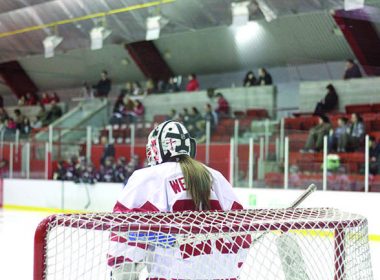
Like so many times before, senior centre Katia Clement-Heydra stepped up when her team needed it the most. She tallied two goals and added an assist on rookie forward Jordan McDonnell’s game-winning goal, as the McGill Martlets squeaked by the Concordia Stingers 3-2 on Friday night.

In what has been a recurring theme throughout the season, the Martlets did an excellent job of getting pucks on net and limiting their opponent’s ability to do the same, outshooting the Stingers 42-16. Despite the barrage of shots, McGill was only able to convert on three of its chances, a recurring issue for the team this season. However, with Clement-Heydra generating scoring chances seemingly out of thin air, the squad will be primed for a successful post-season.

“She’s come a long way,” Martlet Head Coach Peter Smith said in regards to Clement-Heydra. “From her first year to her fourth year, she’s gained a lot of in terms of experience [and] her skills have vastly improved. But the number one thing that has made her a better player this year is how hard she worked this summer on her fitness and conditioning.”

On Sunday, the Martlets opted to avoid the late-game theatrics that characterised their first win of the series by demolishing the Stingers at Ed Meagher Arena with a score of 10-2.  Clement-Heydra once again added three points to the score sheet, but was not alone in her efforts as 11 different players found their way onto the box score. Gabrielle Davidson, the sophomore standout who tied the CIS regular season record for goals with 28, bounced back with two goals and two assists after being held off the scoresheet in her previous two games.

The win means that McGill has earned a berth in the RSEQ Finals as well as the CIS Championships—the RSEQ claims the wildcard berth following the Carabins’ CIS title last year. With a national championship bid secured, the squad can take a bit of respite knowing that the shock of last year’s surprise playoff exit will not be repeated. They will get their chance to shine on the brightest stage soon.

In the meantime, there is still work to be done; and standing in their way once again is their bitter rival, the Carabins. McGill won its first three games against Montreal this year before dropping the last two at home, signalling that something different needs to be done to secure an RSEQ banner.

“I think the last couple weeks, not sure why, but we got away from playing the Martlet brand of hockey, [which is] a high-tempo, structured kind of game.” Smith explained. “I thought the game [Sunday] at Concordia—we had flashes of that back. Now it’s just a matter of playing with tempo and structure for a full 60 minutes.”

The entire best-of-three series takes place during McGill’s reading week. The first game will be held in McConnell Arena on Sunday, March 2 at 3:00 p.m., while the return leg is slated for Thursday, March 6 at Arena CEPSUM. If required, the rubber match will be played at McConnell Arena on March 8.

a, Men's Varsity, Sports

Basketball: Bibeau bows out in style in narrow Redmen victory

A winning culture. This is the phrase that motivates athletes to play their hearts out, and the three words that athletic departments live and die for. Simon Bibeau has been the physical manifestation of that culture for the McGill Redmen the last four years, having led the team to three straight playoff appearances—bringing the school back to relevance again in a tough conference. Bibeau’s last home game for McGill took place this past Thursday at Love Competition Hall in a 69-67 victory over the UQAM Citadins, where he led the team in a signature performance with 19 points.

Bibeau wasted no time getting involved, nailing two quick three-pointers and masterfully orchestrating the offence to a 21-13 first-quarter advantage. Rookies Francois Bourque, Thomas Lacy, and Dele Ogundokun played key roles as well, posting six, five, and five points respectively by the end of the first half. McGill looked to be playing at its finest, moving the ball with purpose and penetrating the paint with ease to enter halftime with a 37-31 advantage.

“I thought we did a lot of good things,” Head Coach David DeAveiro said. “We were rebounding well [….] I think we’re the best three-point shooting team in our conference. So that helps us—when we need a bucket, sometimes we can knock a three down.”

A scrappy third-quarter carried into the last frame, with UQAM fighting back thanks to the play of Richard Addai and Alexandre Bernard. Addai, who finished the game with 24 points, nearly ruined the night’s send-off for Bibeau, as he nailed a three-pointer with 4:48 left in the game to help UQAM take the lead at 62-61. With the crowd of over 200 on its feet, Bourque nailed a jumper with 1:48 remaining to give McGill a three point lead. However, Bernard silenced the stands with a jumper seconds later, trimming the lead to just one point.

With just 13 seconds remaining in the game, Bernard fouled Bibeau, sending the Redmen’s marquee player to the free-throw line. In the last home game of his career, Bibeau sealed his legacy by netting the game-winning free-throw.

“The one thing about [Bibeau] that I’ve learned is that in situations like this, he shows up—he’s at his best,” DeAveiro said. “He loves the stage; he loves the spotlight.”

Four years ago, DeAveiro and Bibeau both joined the Redmen in the hopes of bringing a winning culture to McGill’s basketball program. It is clear that they have succeeded. Bibeau has been the key to that turnaround, with his presence attracting further top-recruits to the program.

“When you come in and you take over a program, you try and find that one guy who’s going to give your program an identity,” DeAveiro said. “Getting [Bibeau] coming out of CEGEP—you were getting the best player in Quebec. And that was a statement, that [said,] ‘Hey, the best players in Quebec want to come play at McGill.’ So getting [Bibeau] was big for us in terms of establishing some credibility in our program and for the rest of the kids in Quebec.”

The senior point guard’s time at McGill has created lifelong memories and unparalleled experiences.

“[McGill has] meant a huge development for me as an athlete, as a person, as a student,” Bibeau said. “It’s been beyond what I had expected. A lot of obstacles, roadblocks, challenges, but I could not have asked for a better university experience.”

Next up for the Redmen are the Laval Rouge et Or in the RSEQ semifinals. Despite Laval’s lethargic six wins, McGill will have to be at the top of its game in the sudden death format of the playoffs, as the Rouge et Or have the luxury of hosting the game. McGill begins their quest for back-to-back RSEQ Championships on Mar. 1 at 7:00 p.m. at Centre PEPS in Quebec City.

Read the latest issue

Read the latest issue