Latest News

a, Arts & Entertainment, Theatre

Savoy Society turns 50

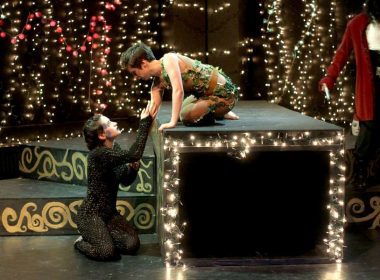
Fifty years ago this month, the Savoy Society was born as it graced the stage at McGill with its debut performance: Gilbert and Sullivan’s The Mikado. Today’s Savoy Society is honouring its golden anniversary by presenting the same whimsical, timeless operetta with which it first premiered so many years ago.

Any Gilbert and Sullivan piece is bound to keep you on your toes and craning your neck to see every inch of the stage, and this riveting rendition is no exception. Set in rural Japan, the operetta follows the chaotic story of Nanki-Poo (John Cook), who is the son of the emperor known as the Mikado. He has disguised himself as a travelling musician to escape an arranged marriage to a cruel older woman. On his journey, Nanki-Poo falls in love with Yum-Yum (Dallas Chorley), a village schoolgirl, who is inconveniently betrothed to the town’s appointed High Executioner, Ko-Ko (Nathaniel Hanula-James). After two love triangles and almost five attempted executions, Nanki-Poo and Yum-Yum try their best to dance around the Mikado’s system of justice while keeping their love—and themselves—alive.

The eclectic cast of characters provides constant enjoyment. One such figure is Poobar (Jonah Spungin), the bumbling, jack-of-all-trades assistant to the Executioner whose perfectly delivered one-liners provide comic relief during any emotionally charged scene. Claire Rollan’s portrayal of Katisha, the estranged fiancée of Nanki-Poo, is both bone chilling and hilarious.

The original show, meant to satirize Victorian-era England’s fascination with Japan, incorporates Gilbert and Sullivan’s usual pokes at British politics. This production, however, adds some unexpected relevance by appropriately taking a few stabs at Montreal government and other current events; Nanki-Poo even threatens to leave Japan and “transfer to McGill!”

The Savoy Society’s vocals are noteworthy as well. The smooth, swelling tones of the male chorus practically dominate act one and the captivating vibrato of Cook’s tenor perfectly complements Chorley’s stunning, strong soprano during their tender love duets. Finally, the female choir’s bright, succulent harmonies practically soar to the back of the auditorium as the tension builds in this crazy operetta. Musically, The Mikado does much to impress, especially considering that many of the cast and crew are not music or performance majors.

For all those who appreciate the visual aspects of a production, the artistry of the show is fantastic. Award-winning set designer Jean-Claude Olivier is part of the Savoy team—his talent and expertise shines through in the vibrant colours of The Mikado’s stage, hand painted to look like a mystical, oriental garden. The costumes are the pinnacle of Japanese expression in the show, and create a vivacious feast for audience eyes.

Steeped in tradition, Savoy is one of the longest standing and most established student groups on campus. They are a well-coalesced team, which is certainly evident in their performance.

“We really came together,” says Stage Director Cameron MacLeod.  “Kind of like a family.”

From the peppy, upbeat orchestra pit to the fine-tuned lighting crew, there seems to be some sort of overall sense that they truly are all friends who love working together, creating a production that’s greater than the sum of its parts.

The Mikado mixes the topsy-turvy style of Gilbert and Sullivan with enough intelligent human emotion and sharp wit to keep the audience engaged till the curtain falls. The Savoy Society’s grand, fifty-year legacy brilliantly carries on this classic Anglo-tradition to a modern generation of McGill theatre-goers.


The Mikado will be performed at 7:30 p.m. from Feb. 20-22 and at 2 p.m. on Feb. 22 at Moyse Hall. Student tickets are $12.

a, News

AUS to launch laptop lending program in March

The Arts Undergraduate Society (AUS) will unveil a new laptop lending program this March.

The new initiative comes in response to the termination of a similar program run by the university in the beginning of the academic year due to budget cuts.

“Given that some funds had accumulated since Winter 2010, we had the opportunity to make a large impact by creating a laptop lending program,” said AUS President Justin Fletcher

Funding for the program—a total of $120,000—will derive from the Arts Computer Lab Fund, created in Winter 2010, to which all Arts students pay an opt-outable $9.80 fee per semester. The program will be administered by the Ferrier Computer Lab, which is managed by McGill staff members.

Funding was ratified at last Wednesday’s AUS Council meeting, following approval of the program’s budget by the fund’s committee earlier the same day. The committee is comprised of the AUS president, the AUS vice president finance, the dean of Arts, and the associate dean (academic administration and oversight) of Arts, and two student representatives.

After months of consultation by the committee, the program’s budget will be allocated towards the purchase of 20 Apple laptops, 20 Lenovo laptops, anti-theft software, and assorted computer programs.

According to Erin Sobat, a student representative of the committee, development of the program began when the university library system ended its laptop lending program in September.

“Once it was established that the library would not be able to reintroduce a sustainable lending program […] it was decided that the best course of action was to move to a faculty-specific model—such as those that already exist for Education and Management,” he said.

According to Fletcher, who also serves as Chair of the committee, the development of the program underwent extensive research before approval.

“We’ve worked closely to build this budget to make sure that we have a solid program,” he said. “We did research by talking to [representatives at] the Sandiford Lab in the Bronfman Building, and we spoke to [representatives] at the Education Building on their laptop lending program, and we also spoke with the […] people at the library who worked on the laptop lending program, so that way, we could have a program that had the best features of all three to best support the needs of our students.”

Fletcher said that the project proposal did not face criticism.

“There were concerns about lost or stolen laptops, [but] we have a really good warranty to protect the laptops in case there’s any damage,” he said. “There have been concerns about liability, but knowing how well others have worked, that’s given us a good model on how to construct this program.”

Fletcher emphasized the usefulness of the program for students.

“Having access to laptops is an urgent need for students,” Fletcher said. “I’ve been in a situation where my laptop stops working and I need something, or I want to use a laptop for a presentation. So I’m really glad that we’re able to provide a service through the Faculty of Arts.”

Some students, such as Mary Guay, U2 Arts, also expressed support for the announcement of the new program.

“I think it’s great that a faculty is stepping in for it,” Guay said. “I think most people don’t realize it’s utilized, but for the select few, it is very useful.”

a, Behind the Bench, Football, Sports

Forget the narrative, focus on football

SEC Player-of-the-Year, consensus All-American, and controversial draft prospect. No, this isn’t Tim Tebow. This is Michael Sam, a defensive end from the University of Missouri who, last week, announced that he is gay—a momentous milestone for the macho world of the National Football League. Despite the trepidation surrounding being the first openly gay player committing to the NFL draft, Michael Sam and his supporters should be optimistic that come draft time in May, the only thing being assessed will be Sam’s ability on the field—because he is doing everything he can to make that the case.

But first, cue the lazy, tired narratives propagated by the media and others within the NFL. Sports Illustrated (SI)—who interviewed eight NFL executives and coaches on the issue—ran reports that focused on his draft stock plummeting. According to a personal player assistant interviewed by SI, “Football is [not] ready for an openly gay player,” because it is a “man’s-man game.”

These views reveal little about the reality of the present-day NFL. Former NFL star Jerome Bettis has said that 90 or 95 per cent of NFL players do not care about Sam’s sexual orientation. A former Missouri teammate mentioned that “98 per cent in the NFL could care less about someone being gay, and that it’s the two per cent that will make us look bad.” Furthermore, there has been little talk about how NFL commissioner Roger Goodell—who has a gay brother—has handled the issue. The NFL’s most important man has shown support for Michael Sam and promised further training to help the NFL deal with its first openly gay player.

It goes without saying that the NFL is an imperfect league. Michael Sam and his sexual orientation is the least of the NFL’s problems. Just take a look at former New England Patriots tight end Aaron Hernandez, who is currently in prison on murder charges; or recently retired safety, Darren Sharper, who was arrested last week for felony drug and sexual assault charges.

Beyond this, Sam is doing all he can to put himself in the best position to thrive once he makes it to the NFL. He wisely heeded the advice of Tyrion Lannister: “Never forget who you are; the rest of the world will not. Wear it like armour and it can never be used to hurt you.” Sam’s announcement has given him control over the narrative surrounding the story, giving teams ample time before the draft to address the issue. The NFL hates surprises, and Sam has done his best to control the media firestorm. This will help shift the media focus onto the only thing that matters: his ability to play football. Sam himself has been quiet since his announcement, only breaking the silence to reassert his commitment to training for the 2014 NFL Combine later this month.

The 24-year-old has also highlighted his qualities that appeal to the modern NFL. He is the first member of his family to go to college, and has overcome the death, disappearance, or incarceration of many of his siblings. He showed the ability to lead a locker room during his senior season at Missouri, where the team posted a 12-2 season while being fully aware of his sexual orientation. Sam is demonstrating that he is a dedicated learner who can overcome challenges, which is what forward-thinking NFL teams look for.

Sam is now a modern-day example of courage in the face of adversity. His announcement has flown in the face of the Richie Incognito-esque locker room culture that demonstrates the shortcomings of the league. Following his announcement, the narrative has changed on Sam’s story, as the media is becoming less concerned about his personal life and more concerned about what matters most: his on-field talents. The scouting report now reads that he is a courageous, high-motor pass-rusher, and someone who is clear about his intentions to succeed in the NFL.

a, Men's Varsity, Sports

Hockey: Redmen rally from four-goal deficit in thrilling overtime win

Although the stands were not quite full Friday night at McConnell Arena, it certainly sounded as though they were by the game’s end. After a rough start, the McGill Redmen pulled out a thrilling 7-6 come-from-behind overtime win over the Nipissing Lakers in their final regular-season game in the OUA.

McGill trailed for nearly the entire game, but managed to erase a four-goal deficit with just over 11 minutes to play to send the game into overtime. The extra period saw second-year centre Mathieu Pompei seal the win with his ninth goal of the year. The victory marked the largest comeback effort in Redmen hockey history. The outcome seemed improbable as the outlook appeared grim for the majority of the game

“Not a lot went well for us tonight, and it was looking like it was going to be one of those nights,” said Redmen Coach Kelly Nobes. “If you look at almost everything, top to bottom through the first 50 minutes, it was going their way.”

Despite outshooting Nipissing 27-24 through the first two periods, McGill looked out of sync. Things were so dire that a few unlucky fans made their exit early, missing out on the exciting finish.

The late rally was sparked by a strong individual effort from alternate captain Ryan McKiernan that resulted in a shorthanded goal. The goal was one of five points on the night for McKiernan, a defenceman from White Plains, New York, who will finish the season as the OUA’s leading scorer among defencemen with 13 goals and 37 points overall.

Fellow assistant captain Patrick Delisle-Houde potted McGill’s fifth and sixth goals, bringing his season total to 14. After tapping in his first goal on the power play at 17:21 of the third period, Delisle-Houde managed to put home his second just 52 seconds later after a heated scramble in front of the Nipissing net. As important as the efforts from McKiernan and Delisle-Houde were, however, this was most certainly a team win.

“I just told the guys, credit to your character,” Nobes said. “[They] could have packed it in with eight or nine minutes to go. It was just a character win.”

Perhaps almost as impressive as the comeback itself was McGill’s ability to stay composed despite being plagued by penalty troubles the whole game. The two teams combined for 68 penalty minutes, including two 10-minute misconducts­­—one for each side.

The Redmen goaltending—although stellar throughout the season—was less impressive Friday night. McGill starter Jacob Gervais-Chouinard was pulled after allowing four goals on 16 shots in the first period. Karel St. Laurent managed to fare better, stopping 17 of 19 shots he faced on the way to his fourth win. Gervais-Chouinard looked uncharacteristically shaky, but will finish the season with a team-best .917 save percentage despite Friday’s effort. When asked about his playoff starter, Nobes declined to comment, but Gervais-Chouinard would seem to be the likely choice.

The win wraps up the regular season for McGill, with the team now looking ahead to the playoffs. The Redmen, who led the OUA East division for the majority of the season, now sit in third despite finishing 9-0-1 in their last 10 games. Next on the docket is a first round match up against the rival Concordia Stingers. If the Redmen hope to replicate their National Championship-winning success of 2012, they will need to show the mental toughness and resilience they did on Friday.

“Nothing was going right for us, and to pull it out like that is certainly exciting for the fans,” Nobes said. “But just to show this kind of character also gives us a bit of momentum going into the playoffs.”

McGill’s three-game series against Concordia will begin Feb. 19 at 7:00 p.m. at McConnell Arena.

a, Opinion

Sochi problems: our laughs, their expense

Recent images of unfinished hotel rooms, broken plumbing, and other flaws noticed at the Sochi Games have been the source of much online amusement. However, these @Sochiproblems, a Twitter account started by Canadian journalist Alex Broad, might be more than just silly flaws to poke fun at.  In mocking these issues, we ignore that they are the result of widespread corruption. The Sochi Games cost over $50 billion, making them the most expensive Olympic games ever held. Yet, organizers can’t even build stalls to separate toilets. And while the pictures on Twitter of skiiers taking side-by-side bathroom breaks are admittedly funny, Russian taxpayers probably aren’t laughing.

The mis-allocation of funds in the construction industry is not a new phenomenon, especially in Russia, which continues to have a reputation of corruption in business dealings.  The Sochi Olympics, which required many massive building projects, provided a perfect opportunity for Russian construction tycoons to capitalize off of the government’s need for new infrastructure. When such corruption is present, accountability is eliminated, working conditions deteriorate, and construction work becomes erratic. Thus, the games end up with poorly built ski-jumps, broken sewage pipes, and exorbitantly-priced stadiums.

While such descriptions of construction procedures at Sochi may seem like classic “only in Russia” absurdities, the truth is that corruption in the construction industry is a much broader issue. As New Yorker financial  columnist James Surowiecki recently wrote, “Transparency International has long cited the construction industry as the world’s most corrupt, pointing to the prevalence of bribery, bid rigging, and bill padding.” Whenever large-scale infrastructure is built—even in liberal democracies with relatively transparent business practices, such as Canada—the risk for corruption and backdoor dealings is high.

Indeed, residents of Montreal are keenly aware of the crooked nature of the construction industry, which has been implicated in dealings with criminal elements, and is renowned for cronyism and corruption. Delays in construction, inflated prices, bribes, and kickbacks are all commonplace. This city’s  own preparations for the 1976 Winter Olympics were riddled with corruption. The Olympic Stadium was unfinished at the time of the Olympics, and its roof subsequently caved in twice over the years.  A piece of the tower also fell onto the field during a Montreal Expos game in 1986. To top it all off, the City of Montreal only finished paying off all of the debt from the stadium’s costs in 2006.

So the next time you come across a picture of a Sochi hotel lobby looking like a war zone, remember that the only people you’re sharing a laugh with are the Russian construction magnates who are om their way to the bank.  Maybe then we will be able to sympathize with the Russian taxpayers who are the ones shouldering the costs of our amusement.

a, News

PGSS Council approves four questions on fees for March referendum

Fees regarding graduate applications, the restructuring of Rutherford Park, the Midnight Kitchen, and the Health and Dental Plan will be voted on by graduate students during the upcoming Winter Referendum period for the Post-Graduate Students Society of McGill University (PGSS).

The four referendum questions were approved in PGSS Council last Wednesday. Students will be able to vote on them between March 13 and 21.

Midnight Kitchen fee

The first referendum question approved by Council regards the introduction of an opt-outable $0.50 Midnight Kitchen fee for PGSS members.

The Midnight Kitchen is a non-profit organization that provides by-donation lunches to students during the week. It is currently listed as a Students’ Society of McGill University (SSMU) student service and runs off donations and fees from SSMU members only.

“Undergraduates pay a fee every semester—which is currently $3.25—which goes to support this service,” Lorenzo Daieff, political science councillor and the mover of the motion, said. “Graduates do occasionally enjoy the service, but we don’t contribute in any way.”

However, PGSS Secretary-General Jonathan Mooney said graduate students do contribute financially to the service. He argued that the current Memorandum of Agreement (MoA) between PGSS and SSMU provides PGSS members access to the SSMU Building and its services for $4,152 per year.

“I’m reluctant to go forward with this given we’re already paying SSMU for access to its services and it’s not clear that there’s a pressing need amongst graduate students,” Mooney said.

According to Urooj Nizami, Finance & Administrative Coordinator at the Midnight Kitchen, the fees stipulated in the MoA do not actually go towards Midnight Kitchen.

“It seems to me there is confusion as to the fees everyone pays towards SSMU, and that is an important question that should be looked into,” she said. “But that seems to be a separate question to this referendum question.”

The motion ultimately passed.

Changes to graduate applications

(Hayley Lim / McGill Tribune)

McGill’s graduate applications process faces reforms, including updates to the uApply system and a potential application fee increase.

Graduate students will vote on an increased graduate application fee during referendum period. The proposed increase, which will raise the application fee from $102.60 to $120.00, would be implemented gradually over the course of five years beginning June 2014.

“The increase in the application fee payable by all new applicants to graduate studies is necessary to allow the University to properly maintain and support the system,” the motion reads.

The graduate uApply application procedure will also undergo technical changes for the Fall 2014 application period. Updates for the system include increased avenues for communication with the applicants such as a built-in chat system, more updates to guide applicants through the process, electronic document submission, and a general streamlining of the process.

“We revamped the entire system, not only for the graduate applicants, but also for the back office who are doing admissions,” Mark Quinsey, a member of the project management team, told Council. “We weren’t being very competitive at McGill with some of our peers. Not only do we want to help the applicants with a better experience, but it also allows us to actually get better students.”

According to Martin Kreiswirth, Associate Provost (Graduate Education), a survey of applicants who declined McGill’s offer in 2008-2009 showed that one of the main reasons was the long enrollment process, during which many applicants accepted other offers.

Kreiswirth said the new system would also provide economic benefits to applicants who now only have to fill out one form.

“One financial advantage is applicants now don’t have to pay two application fees to apply to two separate programs,” he said.

Restructuring Rutherford Park

A non-opt-outable fee of $3 per semester for the Athletics Building Improvement Fund was the subject of another referendum question that passed in Council.

The fee would affect every full- and part-time PGSS member from Fall 2014 to the Winter 2019 semester, going towards the development of Rutherford Park, currently an undesignated grassy area north of campus.

“For the past two and a half years, McGill Athletics has been working with Ville Marie and Montreal, negotiating about what they can do to restructure that space [in the park],” PGSS Academic Affairs Officer Adam Bouchard said. “What they’ve proposed is an artificial turf, with a soccer and softball setup.”

In the event that the project on the Rutherford Park does not go through due to citizen concerns about the lighting on the mountain, the fund would go towards improving buildings on the recreation side of McGill Athletics, as a greater proportion of PGSS members utilize those services compared to their participation in varsity sports.

Renewing the Health and Dental Plan

The renewal of the current PGSS Health and Dental Insurance Plan was the final referendum question approved by Council.

If passed in the referendum, the plan will be renewed for a period of three years—a change from previous one-year renewal referendum questions. According to PGSS Member Services Officer Elizabeth Cawley, having a three-year term gives ASEQ (Alliance pour la santé étudiante au Québec) more time to collect claims information and therefore provide a better estimate of the insurance price.

“This gives us more negotiating power in terms of setting a better premium, because we have a better understanding of the claims that are being made in the current year,” she said.

a, Arts & Entertainment, Music

John Butler Trio—Flesh and Blood

Fans accustomed to John Butler Trio’s (JBT) organic, funky, and sometimes folky sound might find themselves a bit taken aback after listening to the Australian roots band’s newest album, Flesh and Blood. JBT’s previous albums have packed musical variety, ranging from sassy, upbeat songs like “Used to Get High” (Grand National), to instrumental delicacies such as “Ocean” (John Butler), all the way to potently emotional ballads like “Peaches and Cream” (Sunrise Over Sea). The trio, which formed in 1998, have mastered the art of diversity in their sound as they have evolved—however, this journey of steady versatility seems to have been interrupted.

Flesh and Blood, while in no way an ear-sore of an album, lacks the entertaining assortment of sound JBT is known for. The name of the album denotes a sense of raw simplicity; maybe this was what John and the crew were going for when recording, as songs like “Only One” and “Young and Wild” are extremely simple not only instrumentally, but also lyrically. There are certain moments while listening where one could simply read the name of the song in order to know the majority of the lyrics and general ‘point’ of the song. A lot of the tracks run into each other and lack the liveliness JBT is known for.

This being said, the album is still packed with John Butler’s buttery voice and simple but skillful instrumental accompaniment—there were only two main guitar solos throughout the 11 tracks. JBT is known for making passionate music, and this isn’t fully lost, as demonstrated through the provocative story lines of “Bullet Girl” and “Wings Are Wide.”

Given that it has taken the group four years to release a new album, the work obviously merits a listen. However, approach with no sort of high expectation: find the one or two tracks you connect with, and re-shelf Flesh and Blood behind JBT’s much more impressive compilations.

a, Arts & Entertainment, Music

The Jezabels—The Brink

Every now and again, an artist—or band—crops up out of nowhere and absolutely stuns with one listen of their debut album. Following a string of EP’s released between 2009 and 2010, this alternative rock band from Sydney, Australia, released their first full-length effort, Prisoner, in 2011 to much critical acclaim, cementing their place in both Australian and international music industries. Since then, The Jezabels have performed at countless music festivals around the world and enjoyed international success.

So it was surprising, really, when their second album, The Brink, was released rather quietly, with no major promotion or chart-topper hit that reached the audiences like its predecessors did. It was equally surprising that, upon first listen, the band has somewhat muted their outrageously loud and gushing sound that had critics falling head-over-heels for on their debut, and have made a more tightly-knit album; the band had refined their work.

However, in the case of The Jezabels, who possess Hayley McGlone—a lead singer capable of powering her way through songs with a vocal range comparable to even Florence Welch of Florence + the Machine—refinement hasn’t translated very well, and has left her with little musical support behind her massive vocals.

Not only are the songs somewhat underwhelming—there is not one track on the record that is an immediate, brilliant slap-in-the-face of genius—lyrically, they are rather… dated. McGlone was quoted as saying this album is more personal, and it is fairly clear as the majority of the songs deal with love and issues closer-to-home than their globally-thematic work of Prisoner.

Don’t get me wrong, this is not a bad album; however, it’s hardly a step in the right direction for the band’s sound—possibly even a step backwards for them. The Brink represents an unquestionable sophomore slump, and although there is not one necessarily ‘bad’ song on the album, there isn’t one that grabs you immediately.

a, Martlets, Sports

Basketball: Silver and Sylla lay the smackdown on Laval

The McGill Martlets (12-2) cruised to a 72-51 victory over the Laval Rouge et Or at Love Competition Hall Thursday evening. The team’s penultimate home game was McGill’s sixth straight victory in the RSEQ, and marked the fourth time this year that the Martlets defeated the Rouge et Or.

The reigning RSEQ champs stormed the court from the starting tip with their zone defence, going on a 13-2 run in the first three minutes. Laval bounced back by attacking the Martlet zone defence with crisp ball movement, and focused on getting the ball into the paint. In the second half of the game, McGill switched up their game-plan by moving away from the zone and playing a more man-to-man defence, thus forcing Laval into poor passes and even worse shots.

On the offensive side, the Martlets relied on the interior combo of freshman Jennifer Silver and sophomore Mariam Sylla. McGill had shooters spread around the three-point arc to ensure enough spacing for the dynamic duo to operate.  Although the home team had just an eight point lead at half, the Martlets ran away with the game in the third quarter by emphasizing defensive stops coupled with quick outlet passes, ultimately leading to easy transition buckets.

“That was our best four quarters we played all season,” Martlet Head Coach Ryan Thorne said. “That was the best game we have played so far.”

Silver, a reserve forward, was key for the squad Thursday, as she dominated the paint for easy lay-ups and offensive rebounds. Silver finished with a team-high 15 points.  Laval had no answer for the rookie all game, as Silver racked up rebounds and easy jump-shots. Sylla used her athleticism and face-up game throughout the match, chipping in 13 points in the victory. Fifth-year forward Hélène Bibeau, and third-year guard Dianna Ros both played vital roles as well in the McGill win, dropping 10 points apiece.

“We put people in positions to be more successful,” Thorne said. “We tweaked a few things, and the girls benefited from that. Overall, everyone played well.”

McGill shot an outstanding 42.6 per cent from the field and 87.5 per cent from the charity strike, while Laval recorded a measly 28.4 per cent from the field. With the playoffs on the horizon, Thorne insists that there is still progress to be made.

“We have a couple more things to do better,” Thorne said. “It’s just about preparation for us. We have to make sure we are better than the other team in the playoffs.”

McGill’s week did not end with Thursday night’s matchup, as they traveled to Lennoxville to face the Bishop Gaiters on Friday night. The team came out on top with a 52-37 victory that saw Silver and Sylla once again leading the way with 14 and 12 points respectively. Sylla was a force to be reckoned with on the boards once more, as she tallied 11 rebounds for her ninth double-double of the year. The Martlets’ next game will be against UQAM on Thursday, Feb. 20 at Love Competition Hall. The match will begin at 6:00 p.m. and will be McGill’s final home game of the season before the RSEQ playoffs.

a, Opinion

Why McGill needs ECOLE

Speaking to students beyond McGill’s tight-knit environmental community, there is one question I encounter often: “Whatever happened to sustainability at McGill?” Awareness around campus of environmental initiatives comes down to three things: space, community outreach, and education—and particularly, the lack of all three. What can be done to improve this situation? Enter the Educational Community Living Environment (ECOLE)—the perfect blend of collective student living, learning, and community building—something like “the Real World: Montreal (Green Edition).”

Set in a soon-to-be converted MORE house residence that will open its doors in September, ECOLE seeks to revitalize the concept of sustainability at McGill. The house, as a student-run space, will not only provide a hub for the sustainability enthusiasts, but also be a model for sustainable change in the eyes of the greater McGill and Milton-Parc communities. It will house up to 12 residents—or “facilitators”—who will experiment with materially and socially responsible living, and  undertake individual applied research projects based around their collective living experience. Facilitators will come from a diversity of academic, cultural, and social backgrounds to promote the awareness of sustainability as a universal concept applicable to all aspects of life—not merely environmentally-based ones.

As an accessible space, ECOLE will also be open to all members of the greater McGill student community, as well as for the residents of Milton-Parc. It will be an alternative meeting ground for various student clubs and local organizations, as well as a place to hold joint recreational activities such as film screenings or potluck dinners. Of course, all food served will be locally sourced and subsequently composted. It will also actively engage in collaborative projects with the Milton-Parc community, and attempt to mitigate the existing tension between the citizens and students who inhabit the area.

In addition to broadening community interaction, ECOLE will enlarge the academic scope of sustainability through an interdisciplinary approach. The project will foster hands-on learning that cannot be experienced in the classroom; through meetings and workshops led by the facilitators, any interested students will have the chance to experience sustainability from all different perspectives, and relate these concepts to their own lives.

Equity will also play a significant role in the education process—as not only material but also social change is vital for building a sustainable future. Facilitators will lead anti-oppression workshops in their attempt to improve the climate of social justice among the inhabitants of the McGill student environment.

From an operational viewpoint, ECOLE will be run in adherence with a concrete governance structure and an “ECOnstitution,” which will lay down the guidelines designed to enforce transparency and consensus-based decision making. While there will be other actors involved in the political processes that surround ECOLE, it will have a mandate to maintain student sovereignty in all functional matters.

Given the realities of a McGill student’s everyday life, it can be difficult to live sustainably and responsibly. Despite all good intentions, the need for efficiency often trumps environmental duties. With the introduction of ECOLE, we believe that we can work to construct a healthy alternative culminating in a material effort to reduce, reuse, and recycle, and a social structure that is both non-oppressive and vibrant.

As the project grows, we hope to see the ideal take shape more clearly: a diverse range of students from different academic faculties living ecologically and equitably sound lives in a community that truly serves as an example of positive human action within the ‘natural environment’ of downtown Montreal.

Read the latest issue

Read the latest issue