The Olympic opening ceremony is a moment of global attention and high expectations. This pressure came to a head during the ceremony for this year’s Sochi Winter Games with the event’s centrepiece—five flowers which blossomed into the Olympics’ iconic interlocking rings. However, the fifth ring failed to expand with the others. Viewers around the world witnessed the malfunction, but on Russian television, footage from a taped rehearsal was spliced in, creating the appearance of a flawless performance. This ‘fix’ spawned debate as to whether such an alteration was ethical, and highlighted the difficulty of distinguishing between entertainment and news.
Russia has had numerous issues with its hosting, with shocking charges of corruption and lack of preparation. It makes sense to want to avoid further embarrassment and disprove the claims of poor planning. But even if that is the case, is it really ethical to present a falsity as truth? While there is some value to this kind of symbolism, pure deception for the sake of appearances is something else.
Officials at the Russian network defended the splicing, claiming they were preserving the integrity of the Olympic rings and what they symbolized. In the network’s eyes, what they were doing was permissible since the opening ceremony is a performance for the world. They consider it to be entertainment, not news, and have no problem adjusting the content accordingly.
For the most part, the matter boils down to the value of authenticity in news and entertainment. If the opening ceremonies are considered entertainment, it should be fine to alter the showing for a more pleasurable viewing, and to better convey the artistic intent. If it is news, however, altering it is dishonest and unethical.
It is a slippery slope to make such modifications, however, as the opening ceremonies are presented as a factual event. Altering the presentation in the way that the Russian television station did is perpetrating a falsehood on the audience. Even though the opening ceremony is largely for entertainment, it is also reality; not treating it as such allows for other parts of reality to be altered. Even though the Olympic rings don’t seem like a big deal unto themselves, the willingness of a broadcaster to make such an editorial decision calls into question the integrity of any live coverage. Blurring the lines between reality and fiction may be a good narrative technique, but it does not constitute any sort of ethical journalism.
This classic French dish is savoury and sophisticated, but also simple and student-friendly. Not only is it acceptable to eat for any meal; it’s also a great way to use up whatever is left in your fridge. Baking a flaky pastry crust has never been so easy.
Ingredients
Crust:
1 cup flour
1/2 tsp salt
1/4 cup oil (olive oil gives a distinct flavour, although any oil should work)
1/4 cup ice water
Filling:
4 eggs
1 & 1/2 cups milk (can substitute 1/2 cup with cream)
After finishing the last bite of an apple, it’s almost second nature to toss it into the trash can before heading off to class. But what happens then? Few people know the fate of their food waste. But for many McGill students, the matter wasn’t just a concern—it was the beginnings of a significant undertaking.
Composting on campus: a big project in the works
Under the right conditions, organic matter—such as landscaping clippings and food—decompose into nutrient rich soil that can be used as fertilizer to sustain new life. Under the wrong conditions, like in a landfill, the rotting waste contributes to critical urban environmental problems. Landfills cause groundwater pollution by leaching toxic liquid into the soil and water table. Furthermore, the oxygen-free environment within the garbage heaps leads to the production and release of the greenhouse gas methane, which ultimately lead to negative changes in climate.
For policy makers, the decrease in available landfill space is a pressing problem. Consequently, Quebec is taking action to divert this waste from landfills into a composting system. The provincial government dictates that McGill must divert 60 per cent of all organic waste away from either landfill or incineration by 2015. The long-term vision is to have a 100 per cent diversion rate.
The city of Montreal is also working to expand their compost capacity by establishing organic material treatment facilities across the city and is piloting an organic waste pick-up project where compost from residences will be collected by the city. However, McGill is not under Montreal’s jurisdiction for waste management. The university is required to comply with the policies and legislation set provincially and municipally, but must manage their waste independently otherwise.
For many students, the campus’ composting system—or lack thereof—was not something they planned on ignoring.
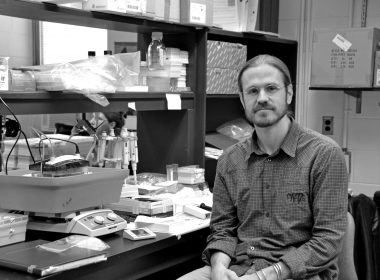
Kendra Pomerantz, U3 Environmental Economics and internal manager of the McGill Food Systems Project, is one of those students.
“I think it’s time to get on the bandwagon [with composting],” Pomerantz said. “At one point recycling was super controversial, and now everyone recycles. I think it’s kind of the next big thing and it seems like in 10 years, it’s going to be everywhere.”
(Alessandra Hechanova / McGill Tribune)
It started with students
Nearly nine years ago, a student organization on campus named Gorilla Composting was established with the intention of creating a waste management plan that utilized composting. Initially, when their pilot project began, food waste was not able to be composted on campus and had to be brought to Quinn Farm in Ile-Perrot instead.
But five years after its modest beginnings, Gorilla Composting purchased an industrial bioreactor—dubbed “Big Hanna”—in order to make composting more of a reality on campus.
Big Hanna—a large, stainless steel composter with a capacity of 91.25 tonnes per year—was installed in 2010 below M.H. Wong Building. It was originally thought to be a silver bullet for sustainability.
Oliver de Volpi, the executive chef at McGill, explained that the McGill Food and Dining Services (MFDS) has been heavily involved with Big Hanna from the start.
“[MFDS—and] now Student Housing and Hospitality Services (SHHS)—had been the main partner [for Big Hanna ever] since [it] arrived on campus,” de Volpi said. “We are the biggest producer of compostable material and we set up and paid for the daily pickup service. For us, it was one more step in our sustainability initiatives, so we started [composting] pre-consumer waste from all of our residences.”
For many, such enthusiasm has turned into frustration. Over the last four years, a laundry list of problems has accumulated from issues with cold weather to a lower than expected capacity that the machine can process. As someone deeply involved with food waste in the residences, de Volpi observed these problems firsthand.
“Big Hanna has been the biggest challenge for sure,” de Volpi said. “[Everything from] temperature, volume, [to] quality of the compostable material going in. It has had at least eight weeks every year when it was “down” and that is out of a 36-week year.”
After a flood during the Winter of 2013 rendered the machines temporarily non-functional, de Volpi sought out the assistance of Compost Montreal.
Compost Montreal is a compost transport company which brought waste from McGill to a commercial composting facility run by the Montreal Department of Parks and Horticulture in St. Henri. Once Big Hanna was repaired, the pre-consumer compost from the residences was split between Big Hanna and Compost Montreal, and the limited post-consumer waste went to Compost Montreal.
Taking concrete actions
In 2013, MFDS—with the help of then Project Coordinator and Supervisor Lou-Anne Daoust-Filiatrault and a handful of other interested students—conducted a “Greenhouse Gas Audit.”
“From [the] numbers [generated from the audit], we set up a series of recommendations as to how we could improve [our carbon emissions],” Daoust-Filiatrault said. “One of the recommendations was to create a 401 project—[an environmental course for student research]— that was going to deal specifically with compost.”
Though the audit’s conclusions reflected a need for change, Daoust-Filiatrault explained that such change can come with challenges. Like most matters of sustainability, funding is a major impediment to the implementation of a new compost scheme.
“[With] energy and water [changes], usually you’re reducing costs, whereas [with] waste, you’re paying more to be ‘better,’ which is always the [concern…] with budgets,” Daoust-Filiatrault said.
But funding—though a formidable obstacle—is just the tip of the iceberg.
“Storage and pick up is [also] an issue,” Daoust-Filiatrault said. “Do you have a place to store it? Is there a freezer you can store it in? Who picks it up? Is there parking? How many pickups in a week?”
The 401 course sought to tackle some of these logistical challenges. Under the supervision of Environment professor George McCourt, its goal was to evaluate the current system and set up proposals for a new system.
The project’s final report, written by nine students—including Pomerantz—consists of 66 pages of research. It covers everything from current waste management legislation, to internal and external case studies, to potential solutions and proposed recommendations.
The first stage of the proposals from the 401 course has already been implemented. As of this January, Compost Montreal has increased its involvement with McGill’s compost system, and now runs Big Hanna—a responsibility that used to fall under the department of McGill’s Facilities Operations and Development.
“It’s been good; it’s been a learning curve getting to know the machine […] and how it might be applied to different institutions,” said Cameron Stiff, in charge of development, finance & commercial accounts at Compost Montreal. “We have long been excited about developing our own site and the decomposition process. We are excited about the possibilities and we are actually going to be at Mac [campus] at the end of the month. We’re hoping to use the opportunity to talk to some professors, to develop new partnerships, and [to] expand to McGill.”
Daoust-Filiatrault attributed the composting projects’ achievements thus far to student inquiry and cooperative efforts with staff, faculty, and administration.
“That’s what started it all in the first place—students researching, students talking about it, students asking to do waste audits,” Daoust-Filiatrault said. “Students looking for records, talking to companies, talking to Compost Montreal, [and] examining Big Hanna. It was students who really started it, and staff members were interested and onboard. And it was sort of the collaboration between the two that worked well.”
With the 401 course over, Pomerantz and two other students are continuing the composting initiative in an honours project and two independent studies with the McGill Food Systems Project, which uses student research and community involvement to promote food sustainability on campus.
Other initiatives and resources for interested students
The ongoing composting initiative on campus is just one fraction of the efforts to make McGill more sustainable by students on campus.
Amelia Brinkerhoff, U2 Environmental Science and Student Sustainability Coordinator for SHHS, has had ample experience with students interested in making a difference with sustainability on campus.
“Students interested and curious about environmental issues at McGill are really fortunate, because not only do you have a wonderful set of pathways within the academics [where] you can explore your interests, [but] you [can] take a project and invest your time in your campus,” Brinkerhoff said. “If you kind of research it on your own, it’s not as strong and fruitful as if you worked with a professor in a class.”
Beyond academic courses, Brinkerhoff pointed out that McGill itself has countless options for students looking to make a change. For example, the McGill Office of Sustability (MOOS) oversees research, community engagement, and even funding through its Sustainability Projects Fund (SPF), which anyone in the McGill community can apply for to fund their sustainability initiatives.
“It [can feel] like there [are] a lot of hoops to jump through sometimes,” Brinkerhoff said. “MOOS really shortens that and they make it easier for students to access issues of sustainability. It’s a good office to have. You have faculty that push[es] you to explore. Motivated students can get funding for projects they care about. It’s a good standard for the quality of work they’re doing. The SPF fund allows students to act on their passions and to be rewarded for that, and they make really considerable conclusions.”
With these resources at hand and projects like the ongoing initiative for campus composting finding success after careful research and planning, students should feel confident with taking on sustainability challenges on campus.
“Talk to your staff, talk to your administrators, maintenance people who work there, facilities,” Daoust-Filiatrault said. “Figure out what’s going on. The more research you have, the more you’re able to quantify what you want to do, [and] the easier it is to get it done.”
No matter how well planned or how motivated, a lot of projects won’t succed unless there are people willing to participate. The next challenge is making sustainability matter to the greater McGill community.
Graduating university is scary enough and the need to find a job can be ,daunting. This difficult process can be made less troublesome by remaining positive, realistic, and most importantly, proactive. By following some simple tricks and tips, you’ll be well on your way to your first paycheque.
Do your research
Before beginning to submit applications and interview, narrow down what jobs you might be interested in and research opportunities. Use all available resources for this process.
McGill’s Career Planning Service’s (CaPS) myFuture is a user-friendly McGill University website that can aid in your inquiries. The website provides students with an extensive list of currently available jobs categorized by position type and projected growth. The website also provides articles that guide students on how to properly format supporting documents and information on other relevant tasks that go along with job searching.
In addition, consider attending job fairs and take advantage of networking opportunities. Developing contacts in your field of interest is extremely important in establishing your credentials. Similarly, consider talking to a recruiter who works with companies in your field.
Get your foot in the door
When applying for jobs right out of university, it’s important to remain realistic. You may not get your dream job immediately, but you have to start somewhere. It’s about putting in your time and paying your dues. Even if a position seems below your skill set, it may serve as a starting point to work your way up.
If possible, you may want to consider internships both during your schooling and immediately after graduation. Having experience is a fundamental first step to getting your dream job.
Companies do their research too
Making sure you are the most appealing candidate possible also includes how you conduct yourself in your personal life. While it may seem invasive, potential employers perform background checks that include Internet searches. You should consider cleaning up your social media profiles and think twice before you post a neknomination video.
Additionally, a respectable credit history may help show employers that you are trustworthy and responsible. Employers can access this information through a background check, although they have to give you notice of it. Even drug tests are standard for corporate jobs.
Pay close attention to your CV and résumé
There is a difference between a CV and a résumé. Your CV includes the publications that your name is attached to when you have done significant research, whereas a résumé is used to highlight your skills, work experience, and education history.
Your résumé should be tailored to the specific job you’re applying for, and your cover letter should be customized for each job. Ensure that there aren’t any silly spelling errors by always editing and revising your documents. Remove superfluous information such as your birthday and martial status, as it is irrelevant to your job application. In addition, make sure your email address is appropriate and professional.
The interview is key
First impressions can make or break a job application. Interviews give employers an idea of your decision-making ability and character. Every little thing matters; be early, but not too early, as this can make you look desperate. Always be honest (lying can come back to haunt you), make sure to keep eye contact, shake hands firmly, and speak with confidence.
Appearance is more important than you might think. For example, visible tattoos may be a deterrent to some employers. Also sit up straight and do not fidget, as it can make you appear nervous. If it is hot outside, arrive a little earlier to give yourself time to cool off and prevent sweating through your shirt.
You can demonstrate interest by preparing questions to ask your prospective employer, although it’s best to avoid talking about salary. Finally, remember to thank the interviewer for their time both during the interview and in an email afterwards to further emphasize your gratitude.
If aging were an orchestra, our youth would be a symphony that eventually starts to play out of tune. First the winds and brass would skip a beat, then the strings would lose their tempo and the percussion would fall behind. As time progresses, the beautiful melody unravels to a musical disaster that not even the conductor can salvage. In our bodies, this is the natural process of aging. However, recent research proposes a new method to keep your body’s orchestra in tune.
While some consider anti-aging as supernatural or even sacrilegious, researcher and professor of genetics at Harvard Medical School, David Sinclair, begs to differ. He proposes that just as we are researching therapies to halt natural neurodegenerative diseases like Alzheimer’s, so too should we be investigating compounds that can reverse the effect of aging.
“Not everyone is affected by Alzheimer’s,” said Sinclair in a 2011 TED Talk in Sydney, Australia, “but […] almost everyone is affected by aging.”
The World Health Organization (WHO) recently released a report saying that the effects of aging on society is one of the biggest problems of our generation. Unless we can keep the elderly healthy, the cost of health care for this group of people could pose serious problems for our economic infrastructure.
Sinclair spent years uncovering the science behind why cells age. His PhD thesis focused on determining the cellular mechanism behind aging in yeast cells.
“The idea [of aging] is that as we get older, genes are switched on and off in the wrong way,” said Sinclair in his TED talk. “When we are young, there is a beautiful symphony playing, but as we get older, the instruments—the orchestra—starts to play ‘willy nilly’ and we screw things up.”
Every cell has a set number of genes. However, only a certain percentage of these genes are ‘switched on’ during the cell’s life span. This process differentiates the cell into a specific type. For instance, in a liver cell, the ‘heart’ and ‘brain’—specific genes are silenced, so that only ‘liver’ genes are turned on to give the cell a unique identity.
The problem, as shown by Sinclair’s research, is that once the yeast cells grow old, many rogue genes start to switch on. As a result, you may get a gene telling a cell in the liver to be a ‘brain’ cell, which ultimately compromises the cell’s functionality.
In 1999, Sinclair started a new lab at Harvard to further investigate this theory behind aging. He discovered several longevity genes in our body called sirtuins, which seem to protect our cells against diseases of aging. When researchers put extra copies of these sirtuins into yeast, flies, and nematode worms, these organisms lived longer and stayed in a healthier state.
Sinclair explains in his TED talk that sirtuins are responsible for shutting down the rogue genes that are turned on as our cells start to age.
A human cell’s total DNA measures about three meters in length. This length is significant, considering it is over 100,000 times greater than the diameter of a typical human cell. Fortunately, our bodies have developed a trick to efficiently package all of this genetic material.
DNA is wrapped around proteins called histones, which help condense genetic material into tight coils, allowing the DNA to fit elegantly into a cell’s nucleus. Since the DNA is so tightly coiled, it must be unraveled from its tight conformation into a loose state in order for a gene to be turned on. This permits the cell’s genetic machinery space to come in and express the gene.
However, when a person ages, chemicals stick randomly to the histones coiling the DNA and unravel them. This process loosens the DNA, allowing cellular machinery to turn on genes in the cell that would not normally be expressed. According to Sinclair, these changes to the histones—known as epigenetic changes—are responsible for our cell’s decreased functionality as we age.
Fortunately, epigenetic changes are not irreversible, and this is where sirtuin proteins play a role. Sinclair’s research proposes that these proteins clip off the chemical groups that are unraveling the DNA, thereby reversing the effects of aging.
“We need to figure out ways to tweak [the sirtuins] and make them more active [to] delay all of these [aging-related] diseases as we get older,” said Sinclair.
Currently, Sinclair’s lab is investigating different molecules that enhance the activity of sirtuin proteins. They have been successful in discovering several compounds, including the molecule known as resveratrol that is found in red wine, which binds to sirtuin proteins and enhance their activity. Sinclair hopes that one day researchers can get these sirtuin enhancing molecules into a pill, which people could take with their breakfast to ward off diseases of aging and help keep us healthier for longer.
“I am not talking about living for 500 years, but what I am talking about is living until our 90s or our 100s in a healthy way,” said Sinclair. “We need to do something about the root cause of aging.”
Countries from all over the world have sent athletes to compete in 15 events in the 2014 Sochi Winter Olympic Games. Although there are 88 countries participating in the Olympics, seven of them hold nearly 60 per cent of all total medals awarded so far. This is not new. Historically, specific countries have excelled in niche sports, thus padding their medal counts: Germany, luge; Norway, cross-country skiing; Netherlands, speed skating. Furthermore, there is a clear lack of parity across the sports, with disciplines such as speed skating and cross-country skiing hosting 12 events apiece, compared to sports such as skeleton, ice hockey, and curling represented with a mere two events each at the 2014 Winter Olympics.
With certain countries able to dominate the podium in a specific sport—particularly in disciplines that have multiple events—the medal board at the Olympics has become extremely top-heavy with a drastic drop-off after the first few positions. How can the Winter Olympics be altered for increased parity in the standings?
Introducing a point system
South Korea has had a historical vice-grip on the short-track speed skating circuit, having won 37 of their country’s 45 medals—including 19 gold—in the sport. There are eight short-track speed skating events, with South Korea being the only realistic competitor every time the Winter Olympics roll around.
Although a country’s expertise in a sport should not be penalized, it should also not be disproportionately rewarded. What makes short-track speed skating more valuable than a sport such as skeleton? There are only two medals available for countries that specialize in the latter, compared to the nearly automatic eight awarded to South Korea for short-track speed skating.
I am not advocating for higher-represented sports to be cut down—the more events there are, the more opportunities there are for athletes to compete in the Olympics. I am also not calling for sports such as curling and ice hockey to sprout eight new iterations, and thus potentially cheapen the value of their respective competitions.
However, I do think that the system needs to change if parity is to be achieved. Why not award an appropriately ratioed amount of points for medals in sports such as alpine skiing, relative to a sport with fewer available medals such as bobsledding? Or consider establishing a stock system, in which sports below five events are awarded the full point, sports between five and eight events are awarded 0.50 points, and sports with over eight events awarded 0.25 points per medal.
Beyond establishing more parity in the standings, this would provide incentive for countries to train and excel at less popularized sports, and hopefully provide more exposure for the athletes that compete in lesser-known events.
—Remi Lu
If it ain’t broke, don’t fix it
In an event such as the Winter Olympics, achieving widespread parity across the medal standings is unrealistic for multiple reasons. The concept of a winter competition gives an inherent advantage to countries that experience long winter seasons, making the record-setting 88 nation cohort a misleading statistic.
The fact that different countries are better at different sports highlights the notion of a comparative advantage, and should be considered a good thing. German luging, Dutch speed skating, and Norwegian cross-country skiing are all events that are ingrained in the respective athletic cultures of these nations and are a source of national pride. It just so happens that these sports are more individual-based, which leads to more medals—not the fault of individual national Olympic Committees who have cultivated an athletics culture in a certain sport. Athletes should not be punished if they medal in an event in which their nation is dominant because of efforts to artificially induce parity.
We should not be fixing something that isn’t broken. Country specialization in events should be celebrated as a harbinger of diversity, and should spark more competition, as other nations pour resources into certain events in an effort to try and knock off incumbent powerhouses. The Olympics are supposed to be a venue for the best athletes from countries across the world to showcase their talents. If their efforts are diminished by any sort of table tampering, it would detract from the spirit of the Games.
—Mayaz Alam
Different solutions for different visions
The final medal standings are a bit of an oddity in the Olympics. Despite the spirit of competition throughout the event, the ultimate outcome is actually rather ambiguous. No nation is declared the winner of the Olympics; the closing ceremonies are a celebration rather than a declaration of overall victory.
If we seek to make the final standings more representative, we must first determine what they should be representing. Should the winner be the country that is the most dominant overall? In that case, give all sports equal weighting in the final standings, or impose diminishing returns on medals won in a single sport. Is it the country with the most dominant individuals? Factor margins of victory from each event into the final standings. Trying to give smaller countries a chance? Divide results by the number of events competed in and rank countries based on the resulting coefficient.
Perhaps the answer is to have multiple calculations, declaring a winner in different categories. Maybe we should award smaller countries a handicap in the standings. Or maybe we should let it be, and let the standings remain an afterthought in these games that are supposedly built around sportsmanship and unity.
With differing climates, budgets, and levels of interest, there will inevitably be disparity between countries. The way we deal with that disparity comes down to how we define an Olympic champion, and ultimately what we feel the Olympics represent.
The release of House of Cards Season 2 last Friday may have been the closest we’ve come as a species to matching the amount of spoiler-induced anxiety that Harry Potter and the Deathly Hallows generated when it first became available. For fans of the show who weren’t able to take in the long anticipated, 13-episode bombshell right after it became viewable on Netflix, every passing conversation or social media outlet doubled as a minefield full of unwanted information that could detonate at any moment. And after the first 60 minutes of Season 2 alone, potential spoiler figures like myself already had plenty of ammunition to work with.
If you’ve seen Season 1 and haven’t yet gotten around to watching the sequel, consider this review a safe haven from any of Season 2’s detrimental plot details: just some gut reactions and extremely broad analysis of what proved to be a mildly disappointing follow-up to a highly acclaimed debut.
With its initial volume of simultaneously released episodes, House of Cards was lauded for being a daring, fast-paced political narrative that takes the notion of corruption in Washington to uncharted territory. Season 2 doesn’t abandon that formula, but at times, it uses a watered-down version of it—one that leaves various episodes prone to stretches of lulled action.
In some ways, that can be attributed to the general plot arc of the season. When we last left Frank Underwood (Kevin Spacey), he had completed his deceptive and improbable rise to vice-presidency, which was fueled after President Walker (Michel Gill) passed him over for Secretary of State. The political snub spurred Underwood and his equally shrewd wife, Claire (Robin Wright), to orchestrate an elaborate revenge plot that centred on Frank seizing power at any cost.
This season, it’s evident that the couple have their sights set on crossing the next frontier—by becoming President and First Lady—but we rarely see them scheme together with the same hunger they displayed in Season 1’s frequent nighttime meetings by the windowsill. Since the steps along the way are less clearly defined, it ends up feeling like more of a leisurely stroll to power than the march it once was.
This isn’t to suggest that Frank has lost his edge—he’s still the same man that’s capable of cold-blooded murder when he has to. As Frank so bluntly puts it in one of his trademark addresses to the viewer, “There are two types of vice-presidents: doormats and matadors. Which do you think I intend to be?” Frank is unquestionably one of the latter, but his newfound vice-presidential duties tend to have him managing crises instead of actively seeking out obstacles to take down—not to mention all the time he has to spend buttering up his uninspiring presidential boss.
In terms of supporting characters, House of Cards keeps a good portion of the group it started with intact, but also makes some key—and unexpected—changes. Of all the newcomers, Jackie Sharp (Molly Parker) makes the most consistent impact, taking over Frank’s role as House Majority Whip after he handpicks her. Otherwise, the writers keep us guessing for most of the season with regards to who will step up in any given episode; there’s a willingness to let presumably minor characters suddenly take on bigger roles, and for old faces to unexpectedly resurface.
That approach has mixed results: sometimes it creates intriguing supplementary storylines, and at other times, it leads to dead ends. However, the caveat with the latter scenario is that those moments may be laying the foundation for something bigger down the road. One of the show’s signature tactics is to bring its characters’ recent pasts into the open—as it does prominently with Claire this season—so it makes sense that its writers would already be thinking ahead to Season 3.
While Season 2 of House of Cards may not have been the dynamic force that its predecessor was, it still delivers a steady stream of absorbing content that justifies a 13-hour binge-watch. It also features a handful of “OH MY GOD, DID THAT JUST HAPPEN?” moments, the most startling of which happens in the season’s first hour and will—quite literally—leave you frozen in your tracks. By the time it’s all over, the main storyline continues to grow as the show’s title suggests it will, into an intricate structure whose grandeur is matched only by its vulnerability.
FIGURE SKATING —We may have had ridiculous expectations, but come on, it was Canada’s golden boy—no, not Sidney Crosby. Patrick Chan took the silver medal, missing out on the gold by less than five points in the men’s free program on Saturday. This was a disappointing result for some as Chan is the three-time defending world champion. But let’s be real, 19-year-old Japanese gold medalist Yuzuru Hanyu is a magician. He should have to wear hockey skates. In all seriousness, this might have been Chan’s last chance at an Olympic gold—he will be 27 years old in 2018—which is honestly devastating. No matter what happens, you will always be in our hearts, PChiddy.
SPEED SKATING—We all love our unlikely heroes, and Canada has found one in Sochi. Denny Morrison won his second medal of the Games on Saturday, earning a bronze medal in the 1500m race at Adler Arena. The 28-year-old wasn’t expected to do much damage in Sochi, considering there were questions about whether he would even qualify for the Canadian team at the time trials in January. Having added to his silver medal in the 1000m earlier in the week, Morrison has tied Gaétan Boucher as the most decorated Canadian male long track speed skater in history with four Olympic medals. He will inevitably break Boucher’s record when he participates in the team pursuit beginning on Feb. 21, because Canada’s skater is always open for business and a grand slam is within his reach.
ALPINE SKIING—Did you know Canada was in the middle of a 20-year Olympic medal drought in men’s alpine skiing? Not anymore as Jan Hudec snapped the streak on Sunday, tying for bronze in the men’s Super-G event. Hudec’s 1:18.67 time was identical to that of popular American skier Bode Miller. Speaking of unlikely heroes, Hudec’s previous top result at an Olympic event was 21st place in the downhill. What I’m trying to say is that anyone who had money on Hudec should buy a lottery ticket immediately.
SNOWBOARD CROSS—Every four years the Winter Olympics brings with it a multitude of obscure sports, but snowboard cross is definitely the most intense. Dominique Maltais—who finished 20th in the event at the Vancouver Games—bounced back by claiming a silver medal on Sunday—the second Olympic medal of her career. She beat out American favourite Lindsey Jacobellis in a wild semifinal, after Jacobellis crashed while in the lead. Maltais cruised in the finals, finishing behind Eva Samkova of the Czech Republic. Somehow, Maltais is still tearing up snowboard cross circuits at age 33, adding the silver medal to her three consecutive Crystal Globes as World Cup champion. I hope someone will give me a medal for just being able to stand on a snowboard when I’m 33.
Originating in Halifax, The Wayo is a young band charting its path with a mixture of ‘antique’ and modern sounds. Consisting of four songs, their first extended play (EP), titled The Wandering, utilizes eclectic instrumentation in order to hold true to the roots of R&B while also appealing to younger listeners. The Wandering is a breath of fresh air for those who appreciate the fusion of musical genres; this EP allows alto saxophones, groovy basslines, and an electronic drum machine to combine for a wholly unique sound.
Charlotte Day Wilson’s vocals immediately stand out. Her tone is smooth and raw, clearly drawing inspiration from the female Motown singers of the ‘60s. She also doubles as the band’s saxophonist. The third track, “Undone,” features both of her talents, while an exceptional rhythm section backs her up.
One of the band’s specific techniques is guitarist Mike Fong’s use of FX, which provides an intriguing echo to his guitar chords. “Lay It Down” is the best exemplar of this effect, giving this song a funky groove and sexual tone—a recurring theme in the EP.
Despite the refreshing sound it brings to a student culture plagued by house and electronic music, The Wandering is still slightly monotonous. But this isn’t uncommon criticism for a band’s debut EP, and it’s one that The Wayo will likely shed as they further develop their musical capabilities.
This also doesn’t change the fact that The Wayo have produced four songs that are easy to dance to and pay excellent tribute to the R&B sounds of the ‘60s and ‘70s. The Wandering is a positive stepping-stone in their career and I’m excited to hear whatever—“smooth ass R&B” is the phrasing on their Bandcamp page—they release next.
At the end of each year, dozens of houses and apartments spanning University to St. Famille change hands from one groups of students to the next in a long-standing, customary sort of way.
What students tend to forget is that the Milton-Parc area has a long history that precedes the current state of student-heavy housing. Hélène Brisson, a representative of the Milton-Parc Citizens’ Committee, describes the area as, first and foremost, a residential one that was not initially intended for student use.
“[Milton-Parc] was built for people who worked at the university or downtown or at Royal Victoria [Hospital]; it was built for people who had families,” she said. “It was never meant as a transient area, but now [many students liver there] because of proximity. All of those older houses were turned into rooming houses.”
When merging two very different demographics into one neighbourhood, many issues can make for a tenuous relationship between the two.
“What makes it difficult is the fact that young people living in the neighbourhood tend to forget that it’s not their area, but an area that they share with long-term residents,” Brisson noted.
Resentment from long-term residents of the use of the word “ghetto” is one of the most fundamental strains on this relationship.
“Nobody likes that it’s called ‘the McGill ghetto,’” Brisson, said. “To this day, although there is that strong contingent of student population, it’s still a majority of long-term Montreal residents.”
As can be expected, the number of neighbourhood complaints increases exponentially during events like frosh week, Management Carnival, and St. Patrick’s Day. Noise complaints seem to be the most common issue that the Citizens’ Committee comes across on a day-to-day basis.
“It’s a clash of lifestyles,” Brisson said. “Unfortunately, when it’s fuelled by alcohol, it makes problems for all. We remind everyone about [keeping noise levels down], but it hasn’t quite sunk in yet.”
Even with reminders, some students feel that the line of communication isn’t completely open, which can result in a misunderstanding between the two groups.
“We became a scapegoat for the noise problem, and would get complaints from the landlord even when we weren’t having parties,” U3 Arts student Jeremy Schipper said. “What was especially frustrating for us was that we never received complaints from any of the neightbours directly, and would only ever hear from the cops or the landlords.”
The hostility only begand to subside when Schipper and his housemates spoke directly with their landlord.
While the majority of complaints are for mild offenses like noise levels and even garbage pick-up issues, there have also been extreme incidents where people’s possessions—and even their lives—have been put in danger. Dalia Goldberg, a representative of McGill’s Community Ambassadors program and U3 geography student, recalled one incident that stuck out in her mind.
“There was a student who had a party and had a lot of people over,” she said. “Somebody lit a bag of garbage on fire and threw it out the window onto a neighbor’s roof and it set her house on fire. Luckily it wasn’t major and just scared her more than anything.”
Both the Milton-Parc Citizens’ Committee and the McGill Community Ambassadors actively work together to bring the students and long-term residents closer, in the hopes of creating a more unified community.
“Volunteers from the community sit down with students in [McGill] residence that want to practice their French for an hour once a week,” Brisson explained. “It works well, is interesting, and is really appreciated by the volunteers. They really enjoy doing it.”
The Community Ambassadors organize community potlucks and neighbourhood cleanups—not only to allow students and long-term residents to meet each other, but also to show that the student population really does care about the neighbourhood.
Both Goldberg and Brisson agreed that, overall, the long-term residents enjoy having the students around.
“Nobody ever says ‘Let’s get rid of them, they shouldn’t be here,’” Brisson said. “It’s a fact; we live with it, and it’s a stimulating environment living with young people.”