Latest News

a, Basketball, Behind the Bench, Sports

The evolution of the Raptors

When DeMar DeRozan steps onto the court at the New Orleans Arena on Sunday, Feb. 16, it will be the first time in four seasons that the Toronto Raptors will have one of their own players in front of the bright lights on All-Star Sunday. The Raptors—like all other Toronto sports teams since 1993—are a study in disappointment and false hope. This year was supposed to be different. This year we were supposed to be good, yet the squad opened the season with a sluggish 6-12 start.

The wildly inconsistent 18-game stretch was enough to show that the Rudy Gay experiment wasn’t panning out. Masai Ujiri, hired as the Raptors’ general manager this past off-season, took it upon himself to bring change. Cue the night of Dec. 9 when Gay was shipped off to Sacramento, and the Raptors seemed to plunge themselves back into their perpetual state of rebuilding.

At least that’s what they thought. Today, the Raptors are nestled snuggly at the top of the Atlantic Division as the third best team in the Eastern Conference. This hope was glimmering, and it was real. The new-look Raptors are breathing new life into a moribund franchise, and are offering a refreshing brand of basketball that focuses on the simplest of philosophies: ball movement and teamwork. It wasn’t long before the skeptics came out to question whether or not this current group is legitimate, but based on the eye test, this is anything but fool’s gold.

On this team, every player understands his role, and as a unit, the team plays a grind-it-out, unselfish style of basketball. Once under-valued players that came over through the trade are now allowed to play to their strengths and look like solid complementary pieces on a playoff roster. Younger players such as DeRozan and Terrence Ross are taking on more responsibility and are developing without the need to appease Gay’s star cache. Due to their selflessness on offence, the Raptors are trusting each other on the other side of the ball. They are a defensive force that ranks seventh in the league in terms of points allowed per possession—a previously unfathomable achievement.

It may not be a stretch to compare this year’s rendition of Canada’s team to the 2004 NBA Champion Detroit Pistons, but similarities do exist. Neither team had a superstar but still found ways to win by showcasing strong collective play and discipline on both ends of the floor. Point guard Kyle Lowry is the equivalent of 2004’s Chauncey Billups. He’s tough, versatile, clutch, and most importantly has a huge chip on his shoulder after being given up on by so many teams. DeRozan, while not the defender Rip Hamilton was, can create his own shot and has the potential to average 20 points, five rebounds, and five assists a game. Ross has freakish athleticism, which, combined with his length and lateral quickness, can be deployed as a defensive stopper in the mold of Tayshaun Prince. Finally, you have young big men, Amir Johnson and Jonas Valanciunas, both of whom can stretch the floor and are learning to play the same team defence with which Rasheed and Ben Wallace anchored the back line for the Pistons.

The Raptors are structured, focused and poised to make a statement come playoff time. As long as they maintain their potent level of chemistry and play as a team, they should be able to push even the best of teams to seven games. The players are well aware of how they have to continue playing in order to keep the machine running smoothly, but only time will tell if that will happen. As a loyal fan of the franchise since childhood, I certainly hope they can keep it up.

That being said, regardless of where they end up come April, Raptor Nation can finally be proud of the fact that its squad has made significant strides in the right direction. In Year 19, the franchise has finally developed a meaningful identity, and maybe, just maybe, a recipe for long term success.

a, News

EUS pilots equity presentation in mandatory first-year Engineering class

A new presentation on social equity and safe spaces in the Faculty of Engineering piloted last week with guest lectures in a mandatory first-year course on Feb. 6 and 7.

The guest lecture is a result of an idea brought up last November at an open EUS discussion regarding sexism, racism, and other issues within the faculty. FACC 100 was chosen to host the presentation because it is a mandatory first-year course frequented by guest lectures.

“[In this class] there have been guest lectures from all departments of the Faculty to introduce students to all the different disciplines in Engineering,” said Christopher Tegho, the Engineering Undergraduate Society (EUS) Equity Commissioner. “After the EUS Safer Space [meeting], Josh Redel, Carlos (the EUS President), and I met with Professor Jim Nicell, Dean of Engineering, and discussed options to raise awareness about Safer Space, including the idea of giving a presentation in an engineering classroom. Nicell supported all our initiatives.”

The presentations were given by Tegho; Fiona Ross, a recent McGill Arts graduate; and Nampande Lande, a current Concordia student. Ross and Lande both have previous experience giving presentations on social topics.

“We have experience facilitating sexual health workshops; that’s why [Tegho] wanted someone who had experience,” Ross said. “We sat down with him, went through the workshop material, and talked about what was most important to get across and how we should get across it.”

“[This presentation] was made specifically for engineering students,” Lande added.

Approximately 150 people attended the presentations each day. The presentation stressed the importance of having a safe space within the Faculty, and reviewed identity discrimination based on class, sexual orientation, and race. In addition, the presentation also evaluated how to address scenarios of microaggression and discrimination.

Professor Joseph Matt Kinsella, who is teaching FACC 100 this year, expressed support for the in-class presentation. He said the social aspect of being a professional engineer is equally important as the academic aspect.

“The concept behind the course is to teach students how to behave professionally as they move out of school,” Kinsella said. “We’re introducing them to how they need to behave as engineering students and as they go out into a career as an engineer.”

Mathilde Marcoux, a U1 Engineering student who attended the class, said that although presentation was entertaining, it could have been more informative.

“The information presented is interesting, but I don’t feel like it’s anything that I wasn’t aware of before,” she said. “It treats very serious subjects, but the presenters aren’t very serious in their comments and manner of presenting. I don’t really see why this workshop is relevant and why it is part of my curriculum as a mechanical engineering student.”

Marcoux also expressed indifference towards the portion of the presentation addressing microaggressions and sexism in the faculty.

“I don’t feel like [being female] affects me in any way; most of the time I actually feel like it’s an advantage,” Marcoux said. “I receive a lot of encouragement from my peers and professors. When I’m experiencing difficulties in a class […] my classmates are happy to help me. They don’t make fun of me or discriminate because I’m a girl.”

For the future, Kinsella mentioned the possibility of expanding guest lectures to FACC 400, the upper-year professional practice course.

“It’s always good to hear things twice [….] Whereas this presentation was catered towards being a student, [one for] the workplace, I think, would be possibly helpful,” Kinsella said.

Next year, organizing these presentations will be the responsibility of the Equity Comissioner.

While Tegho was satisfied with how the presentation went, he said there is still room for improvement in the future.

“I would like to have more examples relevant to the experiences engineering students would live,” Tegho said. “This would require to have a committee work on the workshop. This time, due to time limitations, I could not reach to other people in the EUS or in Engineering to help me with the project. After the presentations, multiple people expressed their interest to join the committee.”

a, News

Justin Trudeau calls for youth engagement in politics

Justin Trudeau, leader of the Liberal Party of Canada, answered McGill students’ questions about Canadian politics, his leadership style, and issues facing the next generation of voters on Feb. 6.

Hosted by Liberal McGill, the event was part of Trudeau’s 2014 Campus Tour, which has brought Trudeau to universities across the country to speak with students. He spoke at Concordia University and Université de Montréal on the same day. Approximately 250 people at McGill turned out to hear Trudeau speak.

“Getting young people […] interested and involved in the political process isn’t just about getting a few more people to come out and vote against the current prime minister,” he said. “We need to start thinking about getting young people to speak up, to be involved, to make your voices heard, [and] to become powerful agents of change.”

Trudeau criticized the nature of present-day Canadian politics, arguing that parties have been less open to compromise and more interested in playing off of differences in opinion. He stressed the importance of finding answers that work for everyone and listening to all points of view.

“Politics has become about division; it’s become about obtaining power, about finding the right wedge issues, about contrasting yourself with your opponents,” he said. “It’s supposed to be about a group of us […] coming together in Ottawa to try and figure out the best way forward.”

One attendee, who could not be identified, inquired about the state of Indigenous affairs in Canada.

“If I’m looking at the Canadian system, one of the groups that is throughout the system not represented fairly is Aboriginal Canadians, and I know a lot of this is because of systemic oppression,” the student said. “When you are prime minister, how will you address this issue?”

Trudeau stressed the importance of education in improving conditions for the country’s Indigenous peoples, citing the sharp decline in suicide rates in communities where education systems have been improved.

“The fact that the dollar spent per student in First Nations communities is far below the dollar spent per student in all other areas of education in other provinces and places across the country just makes no sense when you look at the challenges these communities are going through,” he said.

Trudeau also expressed opposition to tax increases.

“I am certainly in agreement with simplifying the tax code significantly,” Trudeau said. “The tax code [is] much more complex and inefficient than it needs to be [….] But I do not believe that we need to increase taxes anyway, anywhere. The government takes in plenty of money from Canadians; we just need to be a lot smarter about how we spend it.”

According to Nadia Kadri, president of Liberal McGill, Trudeau’s prior experience in connecting with students has been beneficial for this event.

“We know that from his tours across Canada, he has collected a lot of information from students,” Kadri said. “He’s really been able to tailor a message that captures and engages the student body.”

Iain Childerhose, U2 Arts, praised Trudeau’s sincerity in responding to questions.

“Obviously his strength is his charismatic speaking ability, and that showed today; I really enjoyed what he said,” Childerhouse said. “He definitely tried to come from a non-partisan standpoint and encourage political engagement in youth, which is something I think is extremely important.”

a, Men's Varsity, Sports

Basketball: Dufort dominates in Redmen rout of UQAM

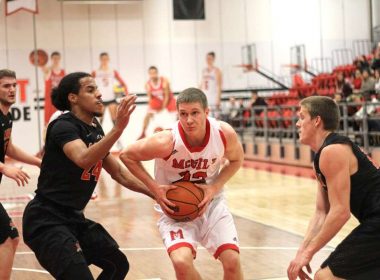
After clinching a playoff berth with back-to-back wins against the Bishop’s Gaiters last week, the CIS no. 8 ranked McGill Redmen (9-2) returned home with control of first place in the conference to face the struggling UQAM Citadins. McGill jumped out to an early 18-point lead in the first-quarter, but a questionable substitution pattern left the door open for the desperate Citadins who brought it back to a five-point game in the fourth. UQAM—playing the part of the pesky underdog—refused to back down all game, but the Redmen hit crucial shots down the stretch and never relinquished the lead en route to a 90-72 victory.

The Redmen offence was sizzling hot from the field, shooting a new season-high of 59 per cent. Veteran forward Vincent Dufort had a tall task in front of him trying to compete with the reigning scoring champion of the RSEQ, UQAM forward Alexandre Bernard. While Bernard topped Dufort in scoring with a game-high 30 points, Dufort put on a shooting clinic, making three of every four shots—including two from behind the arc en route to a team high 24 points. Dufort was everywhere for the Redmen, as he recorded his fifth double-double of the season with a team-high 11 boards.

“I’ve been working on my shot and I was fortunate enough that it was dropping tonight,” Dufort said. “I just tried to find what advantage I had, whether it was in the post or on the perimeter.”

Strong shooting from the perimeter has been a trend for the Redmen all season. Sharpshooter Thomas Lacy came off the bench to tally an efficient 10 points in limited playing time, while freshman Michael Peterkin’s strong defensive play was accompanied with an equally efficient 11 points in just 18 minutes.

The Redmen dealt with foul trouble all game as they tried to stop Bernard and point guard Richard Addai as the two combined for 53 of the visitors’ 72 points.

“Our scouts say they only have three guys that can score,” said Head Coach David DeAveiro. “Our job is to shut those guys down, and we didn’t do a very good job of that today.”

McGill has struggled to put together four complete quarters of basketball this season, and Thursday night’s game was no different.

“I don’t know if there is any other team in the country that dresses seven freshmen every night,” DeAverio said. “These guys have never done it before […] a full 40 [minutes] is going to take some understanding and a high level of concentration.”

On Saturday, the Redmen were forced to put more than 40 minutes of effort in against UQAM in a rematch at the Centre Sportif. McGill clawed out a 78-76 victory in an overtime thriller that saw star point guard Simon Bibeau hit a game-tying three-pointer at the end of regulation. Bibeau stuffed the stat sheet and led the team by example, finishing with 17 points, six rebounds, five assists and three steals.

While the Redmen are now in control of their playoff destiny and are in the running to finish first in the RSEQ, there may be a disadvantage in finishing the regular season on top of the conference. The RSEQ tournament is set to be played in Quebec City, home of an underrated Laval team that handed the Redmen their first loss earlier in the season.

“There’s really no advantage to winning the conference for us because [we] don’t get home court advantage,” DeAverio said. “So at this point we’ve got to […] try some new things [.…] We tried to do some of that today, and unfortunately it didn’t work for us.”

The Redmen have four more games to work out all the kinks before the playoffs start. Look for DeAveiro to mix up the lineup, and for the team’s freshmen to see increased playing time in the next two weeks as the squad gets geared for the madness of March. McGill’s next game will take place on Thursday, Feb. 13 at 8:00 p.m. as the Redmen look to take on the Laval Rouge et Or at Love Competition Hall.

a, Basketball, Football, Hockey, Soccer, Sports

Around the water cooler – Feb. 11

Snowboarding (Men’s Slopestyle) — Only two weeks prior to these Olympics, Mark “Mr. Clutch” McMorris, fractured a rib at the Winter X Games. Presumably fuelled by the power of Canadian wheat, the Regina native made a speedy recovery in time to become Canada’s first medalist of Sochi 2014. In all three rounds, McMorris’ first run was lackluster, but the 20-year-old consistently posted second runs that lived up to his nickname. If only we all got a second chance to make a first impression.

(Ruby Xia / McGill Tribune)

Figure Skating —  In a wild twist of events that reminded the Olympic world of a colder time marked by détente, a French media outlet reported judge vote-fixing by the Russians and Americans. As it turns out, all the superpowers needed to get along was the impending threat of Canadian supremacy in the ice dancing event; allegedly, the Cold War rivals were colluding to ensure that the American ice dancing pair finished before Canuck skaters Tessa Virtue and Scott Moir. In return, all the Russians wanted out of the backroom dealing was a gold medal in the overall team trophy. Eerily enough the Canadian figure skating team won a silver medal—placing behind the Russian team, while Virtue and Moir finished second behind none other than our southern neighbours.

Speed Skating (1500m short track) — “It’s not my best distance,” Quebec native Charles Hamelin explained following his gold in the 1500m short track. The medal, Hamelin’s fourth of his Olympics career, puts him second on the list of most decorated Canadian male Winter Olympic athletes. The Olympics were a family outing for the Hamelins; Charles’ father, Yves, is the Canadian speed skating national team director while his brother François, finished second in the B-final earlier that night. François probably apologized for bringing dishonour to his family by not medalling; the only thing more Canadian than a humblebrag is an apology

Freestyle Skiing (Moguls) — Justine Dufour-Lapointe became Canada’s first gold medalist of the 2014 Winter Olympics when she posted a score of 22.44. Fans in Sochi began seeing double-trouble when Chloe Dufour-Lapointe—Justine’s older sister—took home the silver medal in the same event. Two days later in the men’s event, Vancouver 2010 gold medalist Alexandre Bilodeau proved to be more than a one-hit-wonder, while Mikael Kingsbury, came in as the runner-up. All four athletes hail from La Belle Province, giving the nation of Quebec three golds and two silvers, good for third best at Sochi 2014.

a, Editorial, Opinion

Equity policy needs more clarity, transparency

The Students’ Society of McGill University’s (SSMU) Equity Policy has come under sustained criticism from both students and members of SSMU Council in the wake of its application against SSMU VP Internal Brian Farnan, resulting in a public apology. As was reported Feb. 4, changes to the policy—some of which had been in the works before this controversy—are on the way. As various proposals are considered, the priority must be to make the policy clearer and more accessible to students.

One of the major issues regarding the equity policy arose this past Wednesday at the Winter General Assembly (GA). The final resolution debated that night was on the “Guarantee on the Freedom of Dress in the SSMU Building,” which proved mostly to be a stalking horse for settling a longstanding dispute between the Plumbers’ Philharmonic  Orchestra (PPO) and SSMU. Based on an executive decision, the signature lab coats of the PPO had been banned from the SSMU building on grounds derived from the equity policy.

One of the many issues that were debated was the extent to which the SSMU Equity Policy even has jurisdiction on the matter. The current policy specifies applications to staff, executives, and clubs that are of, or funded by SSMU, plus activities and events hosted by SSMU and affiliated clubs and services, as well as any events, activities and promotions in the SSMU building itself.

Those clauses left the PPO lab coats in a sort of jurisdictional no-man’s land. As a non-SSMU organization, it was not directly accountable to the Equity Policy. However, the coats were deemed by members of the SSMU executive to contain writings that were in contravention of the Equity Policy, leading to both their ban in the building, and a host of other sanctions against the group as a whole, such as prohibition from booking rooms in the SSMU building. One change to the Equity Policy that would improve its application in these kinds of situations is to clarify how it can be used in relation to a student group that is not actually under the umbrella of SSMU.

In addition to jurisdictional issues, the Equity Policy also suffers from a general inaccessibility to students. The actual policy­­—at most recent revision—weighs in at 22 pages. While that may be a necessary level of detail to include in a full-form document, there is currently no simpler way for a student to become acquainted with the policy. The landing page on the SSMU website that discusses Equity lists “Read the SSMU Equity Policy” as the first step to resolving an equity-related situation. Though the page contains a bare-bones outline of situations that could be equity-related, a better service to students would be an “executive summary” of the policy. This­—in a page or two at maximum—would outline both what the policy can remedy and what it prohibits in a form that allows a student to easily decide whether their situation falls within the policy.

In addition, a complaint cited by several SSMU Councillors in the wake of the Farnan situation was the inability for council to suggest changes to the recommendation once it is brought to their attention. The take-it-or-leave-it nature of the remedy presented can cause issues in which the original incident is deserving of a resolution different from that which is suggested by the Equity Commissioner.

The last, and perhaps trickier question that should be asked in reevaluating the equity policy is what even constitutes an equity violation. There is a possible tension between resolving a wider scope of situations  using the policy, and having a definition and scope of the policy that is actually taken seriously by the student body. More to the point, much of the backlash that emerged from the Farnan apology focused on the seemingly insignificant nature of the complaint itself. Continued application of the policy in such a way might make a mockery of the policy, defeating its purpose of educating students, and detracting from cases in which it is truly needed.

The SSMU Equity Policy, while imperfect, is a necessary part of fulfilling the association’s obligations to the student body. However, as recent events have shown, substantial changes are needed to allow it to adapt to the current realities on campus and keep it relevant to students.

Erratum:  A previous version of this editorial contained several factual errors regarding the SSMU Equity Policy. These errors were caused by our reference to a previous (March 2012) version of the policy. The Section 11.5 to which we had referred exists in the new document as Section 9.4, and has been updated to address the concerns we had raised regarding abstentions. It is also worth clarifying that the Equity Policy itself is 11 and a half pages long; the editorial’s previous quote of 22 pages includes appendices and represented the total document length of the previous policy. The Tribune regrets these errors.

Click here to read a statement on the matter.

a, Arts & Entertainment, Music

Kara-Lis Coverdale talks MTL music scene, working with Tim Hecker

If you hear of a 20-something-year-old musician who hasn’t yet had a radio hit, the first thing that likely comes to mind is the ‘struggling young artist’ trope—lots of work with little payoff and growing frustration—but that’s not the case for Kara-Lis Coverdale. Walking into her little Plateau home studio surrounded by an array of pianos, keyboards, computer screens, plenty of electronic equipment, and an enveloping ambient sound that feels like a fixture of the household, there isn’t a trace of desperation in the air.

Coverdale began studying piano at a young age in rural Ontario, and by the age of 14 she was an organist and composing music director at a local church. Coverdale completed a master’s degree in music at Western University and wrote an interdisciplinary thesis on timbral rhetoric and constructions of realism in recorded sound. After completing her studies, she made a somewhat spontaneous move to Montreal.

“There was nothing stopping me from doing whatever I wanted, and I knew Montreal was the place I wanted to do it,” says Coverdale. “In London, the scene was pretty low-key, which can be a great thing to develop a practice and focus on your craft. However, there comes a time when you’re ready to share and collaborate. Here in the city, I feel pretty spoiled—it’s an incredibly inspiring and imaginative idea pool to be a part of.”

Coming to a big city without prior connections is a daunting prospect, and Coverdale explains that the Internet was a huge help in getting the ball rolling.

“I imagine getting settled in a completely new city would have taken eons before the Internet. When I first arrived I didn’t know anyone at all and I didn’t have anything set-up,” she says. “But shortly after I got here, I landed a position as an organist at St. John’s NDG and did an internship at Vice Magazine, a special experience which really helped me meet people directly involved in the cultural scene of the city [….] The editor there put me touch with Tim.”

The Tim she refers to is none other than the Montreal-based sound artist Tim Hecker, a well-established figure in the world of ambient music. The two hit it off immediately and he asked Coverdale to play the keys on his latest album, Virgins, a hauntingly beautiful soundscape that was rated a top ten album of 2013 by The Wire, NPR, and SPIN. The partnership seems like it was meant to be, as working with Hecker provided the perfect venue for Coverdale to develop her own personal sound.

“In terms of my mindset I’m kind of a technologist,” she tells me. “In school, this was one of my huge frustrations with the academy. They never encouraged that type of out-of-the-box thinking [….] So it was up to me to learn the tools and equipment I needed to put the ideas I had about the modern world around me into actual music.”

Her growth as a musician is evident when you compare her first release—a three track EP of self-composed solo piano pieces titled Triptych—to her latest endeavors, which are considerably denser arrangements, full of polymorphous sounds with the occasional resurfacing of processed piano.

“Solo piano pieces are a different beast,” says Coverdale. “I don’t know if I’ll ever make anything like that again. Maybe. I enjoy them, but for right now they aren’t fulfilling. They don’t say what I want to say. When I look back on that work, it feels like a shadow of something else.”

As her music continues to evolve, I have high hopes for whatever Coverdale has in store for us. Her current project, a collaboration with New Jersey-based experimental electronic musician/internet archivist LVX, centres on themes of disembodiment and digitalized aggression.

“We began to explore disembodied violence and virtual reality, and realized these forms of aggression don’t really involve blood at all,” she says. “We wanted to design, from scratch, a soundscape for the distinct pleasure and ecstasy that lies in this safe nook of disembodied experience.”

Keep an eye out for Coverdale in the Montreal music scene in the coming months. She’s clearly a musician with a vision, and won’t hesitate to see it to fruition.

a, News, SSMU

Winter referendum period to see questions on LICM fee increase, first year fund

A fee increase for the Legal Information Clinic at McGill and the creation of a fund for First-Year Council were two of the referendum questions students will be voted on in the Winter referendum period, which will take place March 10th to 21st.  The motions were approved at a meeting of SSMU Council.

Existence and fee increase for Legal Information Clinic

Council approved two questions related to the Legal Information Clinic at McGill (LICM)—one that asks students to support LICM’s existence with its current non-optoutable student fee, and another to increase this fee from $3.25 to $4.50 per semester.

LICM was established in 1973 to provide free legal information to McGill students and the Montreal community. According to the motion, the fee has not been adjusted in 13 years, despite additional costs such as rent increases and computer maintenance.

“LICM would be unable to operate at its current capacity without increased revenue, and would need to decrease services if the LICM fee remains at its current 2001 level,” the motion reads.

First-year fund

Another question would create a new optoutable fee of $0.50 to go towards a fund managed by SSMU’s First-Year Council. The fund is designed help the representation of first year students through new student forums, town halls, community outreach programs, and greater interfaculty collaborations among first year students, according to the motion.

“First-Year Council now is very underfunded; its target group is 7,000 first year students, so that means exchange students, transfer students, and any other first years,” Élie Lubendo, Services Representative and one of the movers of the motion, said. “A first year fund will engage students in first year to be more involved in school, but [also] create more collaborations between first-year groups.’’

Science Councillor Devin Bissky Dziadyk acknowledged the financial issues facing the First-Year Council, but said charging a fee for all SSMU constituents was not appropriate.

“Is that fair to anyone beyond first year that is being forced to pay this fee?” he said. “Although it may not be a significant sum of money, I think it sets a poor precedent when we’re imposing a fee on something that, to the best of my understanding, is for a specific group of people and we are charging everyone for it.’’

Motion on Gerts

SSMU Council also passed a motion that would task the SSMU Vice-President Finance and Operations with the responsibility of ensuring greater transparency for the booking procedure for charity events at Gerts.

According to the motion, the VP Finance must post the procedure for bookings on the SSMU website. The form is currently downloadable online. Furthermore, the comptroller, general manager, bar manager, and VP Finance must meet with charity groups to discuss ways to make the process for booking and hosting events at Gerts more understandable.

Issues regarding transparency were brought forth to SSMU, after the student-run bar raised its retention of profits from 30 per cent to 50 per cent in November 2013.

The motion initially aimed to establish a new fee policy, under which charitable organizations would be eligible to keep 100 per cent of cover and coat check fees  from attendees depending on bar sales and sufficient evidence of advertising. Currently, Gerts charges 50 per cent of cover and coat check charges to charitable organizations hosting events in the bar.

“Student groups holding charitable events at Gerts Bar entice patrons to utilize the student service and augment food and beverages sales,” the motion reads. “Montreal bars and clubs often welcome charity events for free.”

However, Vice-President Finance Tyler Hofmeister voiced concern over the financial implications of the original motion for Gerts.

“The math that has been done doesn’t really account for the cost of goods sold, the cost of security, [and] the cost of staffing, which eats our sales to the point where we are literally paying to have certain events in the bar some nights,” Hofmeister said.

The motion was amended to its current form before it passed.

Notice of Motions

Other fee-related referendum questions include Organic Campus fee creation and University Centre Building fee creation questions; as well as renewals of the Access Bursary Fund, Ambassador Fund, Campus Life Fund, and the Library Improvement Fund. Students will be able to vote on the motions between March 14 and 21.

a, Student Life, Student of the Week

Student of the week: Laura Faulkner

Topics that may seem sensitive or taboo are no problem for Laura Faulkner. The U3 anatomy and cell biology student is a peer health educator for Healthy McGill, a student group that promotes healthy lifestyles for students on and off campus.

Healthy McGill provides resources and support to students, in addition to organizing events and campaigns revolving around five key aspects of health: sexual health, drugs and alcohol, nutrition, active living, and mental health.

“Sexual health is a sensitive topic, but also very important in one’s overall health,” Faulkner says. “Students at McGill come from such diverse background and with that comes many different ideas about what sexual health is.”

Last week, Faulkner worked on Healthy McGill’s “Get Tested Campaign,” which aimed to inform students about sexually transmitted infections (STIs), locations for testing, and why they should get tested. Faulkner’s team tabled around campus to provide information, brochures, and free condoms.

“We always ask people what they think the most common symptom of STIs are,” Faulkner says. “Usually they say bumps or a rash, but the most common symptom of STIs is actually no symptom at all.”

This February, Faulkner will also run Healthy McGill’s #selfcarechallenge campaign. Starting this week, each of Healthy McGill’s teams will have a different self-care challenge that students can complete every day. Some of the challenges include replacing a coffee with tea, or doing squats while brushing your teeth. Specific to sexual health are challenges like enjoying a bubble bath or talking to your partner about protection.

Faulkner will be tabling with information, games, and prizes to promote the campaign throughout the week. The group will also provide Valentine’s Day cards where people can write things that they like about themselves.

“We’ll be encouraging people to say ‘I love myself’ to themselves,” she says. “February is usually associated with Valentine’s Day and loving other people. It’s important to look at yourself and take care of yourself first. Valentine’s Day should appeal to everyone and not be [for those in relationships] only.”

Faulkner’s passion for helping others is also evident from her participation in the Student Life Ambassador Program. The program involves matching a McGill student with an incoming student to help them with the switch from high school to university. She communicates via email regularly with incoming students, offering advice and support.

“I wanted to use what I had learned through my own transition from high school to help new students transition smoothly. I guess I wish I had had someone who knew McGill to help me through my transition,” Faulkner says.

Graduating this spring, Faulkner aspires to pursue a degree in medical school where she can promote healthy living and work with others who are passionate about public health advocacy. Through her work, Faulkner hopes to reach out to her peers and make sexual health just as common a topic as nutrition or exercise.

“It’s a hard subject to talk about and is often met with much resistance,” she says. “But if you can speak about it without being awkward, it will get rid of the stigma around it.”

McGill Tribune: If you could live in any fantasy world, which one would you live in?

Laura Faulkner: Harry Potter seems pretty cool, if I could get to wear an invisibility cloak.


MT: What was your first job?

LF: I worked at Burger King.


MT: What would be on your ideal pizza?

LF: Just plain cheese.


MT: If you could be stuck overnight in any store, which one would you choose?

LF: Wal-Mart—there would be so much to do!


MT: If you were a kitchen appliance, which one would you be?

LF: I would be a blender…because I like to mix things up.

a, News

New management concentrations developed by two students

Starting in Fall 2014, students in the Faculty of Management will be able to major in Strategic Management. Comprised of two concentrations—Global Strategy and Social Business and Enterprise—the major has been developed as a collaborative project between students, staff, and faculty since January 2013.

“Social Business is a type of company that runs just as a normal business—selling a product, earning revenue—but whose ultimate goal is to solve a social problem­ as opposed to maximizing profit, like many companies aim to do,” explained Joanna Klimczak, U3 Management, one of the two students who started the project. “The company must still earn an attractive profit to sustain itself, though profit is not the reason why the company exists […] creating social value is why it exists.”

Professor Robert David, coordinator for the strategy and organization area of the faculty, explained that the two concentrations would provide an option for students to pursue such a line of studies.

“Our two concentrations are excellent complements to other areas of study, precisely because they provide a big picture perspective to more specialized subjects,” he said “Our new major allows students to go more in depth and encourages them to combine foundational topics in strategy with important social challenges.”

Additionally, the new major will allow students to take courses outside of the faculty to complement specific interests, such as agriculture, anthropology, economics, and international development studies.

The idea initially started as two separate projects. Two students, Klimczak and former McGill students Mariana Botero had begun to develop a Social Business Minor in response to a lack of courses on social business at McGill

“I did a lot of not-for-profit abroad and volunteer trips [that] gave me much more of a global mind-set and I noticed how much power businesses had in the world,” Klimczak said. “I noticed McGill wasn’t really teaching social business [….  However], there was a demand from students and a general interest.”

Meanwhile, the strategy and organization area of the faculty—equivalent to a department within other faculties—had been discussing revisions to their concentrations and considered developing a completely new major.

David said the decision to combine the two developments into a single new major was made when he learned of the students’ initiative.

David said that further development of the major involved more consultation with professors and students through

“[The subcommittee] developed proposals for a new Major in Strategic Management and changes [to] the two concentrations,” David said. “I believe that this was a model of student-faculty cooperation, and that program development should always have strong student involvement.”

The developed proposals required approval from the Undergraduate Program Committee, Academic Council, Faculty Council, Academic Policy Committee’s Subcommittee on Courses and Teaching Programs, and finally, the Senate, which gave their approval on October 31, 2013.

“Putting new programs on the books takes at least 18 months, and must go through many committees,” David said. “Because our programs include courses from other [faculties], these other faculties had to give their approval. We also had to demonstrate to the university that these programs would be of value to students [….] There were a lot of factors that had to be considered and a lot of questions that had to be answered.”

Enrolment for the program is available for Fall 2014 to students in all years. Reception towards the major has been positive so far, according to David.

“I have had many inquiries from students about these programs,” he said. “I think there is a lot of demand and excitement about these programs, as they respond to the needs of students and changes in society.”

Chelsea Zelko, U1 Management, said she would consider enrolling in the new major.

“I think this new major is a good idea,” she said. “It offers students the opportunity to specialize in something out of the box but still pertaining to management. More importantly […] being familiarized about the connection between all aspects that are management—social, global, ethics, professionalism, etc.—gives McGill students an advantage against others who will be applying to the same job as them outside of university.”

Botero said she hopes students of the program in its first year will spark interest for future students.

“This program combines the best of business and the social sector,” Botero said. “Hopefully those driven, adventurous, first movers into the program will have such a great experience that by the following semester we’ll have a spike in student interest. This would be great, as so many jobs are being created in this area, and they can move right into them.”

Read the latest issue

Read the latest issue