Latest News

a, Art, Arts & Entertainment

No Foreign Lands finds a home in Montreal

Even with the advent of film, photography, and digital imagery, painting remains a vital and powerful art form, a fact I was reminded of when I visited Peter Doig’s exhibition No Foreign Lands at Montreal’s Musée des beaux-arts last weekend. Doig’s art immediately recalls the legendary Canadian Group of Seven, but his influences also include great pioneers of Modernism such as Edvard Munch, Paul Gauguin, Henri Matisse, and Pierre Bonnard.

Moving about the hardwood floors of the museum, I immediately noticed the scale of Doig’s paintings, and how his use of rich, bright colour stood out with warmth against the vast white walls; his paintings appear as if they were meant for display in a grandiose museum setting.

Author David Byrne writes how musicians and artists, “work backwards, either consciously or unconsciously, creating work that fits the venue available.” Byrne essentially thinks the space, the platform, and the software makes the art. This is exemplified in Doig’s work, as a tangible joie de vivre leaps from his smaller studio film posters, while larger displays remove any sense of reality. Doig propels the viewer to enter a dreamlike, theatrical scene like the ones depicted in Grande Riviere (2002) and Gasthofsur Muldentalsperre (2002).

Doig’s series of paintings of oil on paper, recognizable for stylistic simplicity, are intentionally displayed close together in a corner of the gallery. One feels a childlike spark from each of these paintings, which evolved organically as posters for weekly repertory cinema showings run by Doig and Che Lovelace, a Trinidadian artist. Doig makes a poster for nearly every one of the screenings, shown from his studio in the Caribbean Contemporary Arts cultural center located in a former rum distillery in Trinidad.

Doig was born in Edinburgh, Scotland in 1959 but moved to Trinidad with his parents when he was a child. Another move led Doig to grow into adulthood in Montreal. He attended art school in London and painted during the days throughout his twenties by working odd jobs in nightclubs. He has remarked on remaining independent of the trends of his peers when contemporary artists feared sharing gallery space.

“I never understood what was so conceptual about Conceptual Art anyway—all painting, pretty much, is conceptual,” says Doig in his book, which shares the same name as his current exhibit. “I mean every painting is an idea. Every painting is a result of process.” To Doig, conceptual art just removes the “pleasures” of looking. Since his success, he has returned permanently to Trinidad and also works and teaches in both London and New York.

“There are no foreign lands. It is the traveller only who is foreign.” These words from Robert Louis Stevenson are visible upon arrival to the exhibit, and carry the viewer through the scenes of Doig’s present life in Trinidad, while also weaving the memory of his Canadian home. This is exemplified through Doig’s work, 100 Years Ago (2001), where a man, seemingly adrift in a canoe in the ocean, reveals a backdrop of Carrera, the prison island off the coast of Trinidad. The subject looks to the viewer, as if asking whether a painter can free himself from pictorial memory in his apprehension of the real. Doig begun this work in Europe and finished shortly after his arrival in Port of Spain, Trinidad.

His working method draws on an ever increasing archival collection of personal photographs, as the book describes.

“I use photography simply as a way of imaging memory,” he writes. “The photograph acts as a starting point. It is in the actual act of making a painting that invention takes over.” Doig is noted for how he constantly reprocesses and transforms original images in painting sketches into a mythical, spiritual abstraction of reality. His process is visible throughout the exhibition, even as he admits, an “artist is only ever capable of painting one painting, again and again, in a single lifetime.”

Painting, in effect, is an artist’s own life, and through this exhibit you have the chance to glimpse into the vision of Doig’s own experience.

No Foreign Lands runs until May 4 at Musee des beaux-arts de Montreal (1380 Rue Sherbrooke Ouest). Tickets are $10.44 plus taxes and fees.

a, Arts & Entertainment, Music

Dum Dum Girls—Too True

The Dum Dum Girls’ new album Too True was meant to be the band’s official transition into the world of high-label girl group Rock ‘n’ Roll fame. However, it clearly flows from the same vein as their previous work, making for an ethereal-sounding album that directly harkens back to girl group greats of the ’60s and post-punk beats of the ’80s.

While it may not have been the transformative album the group was hoping for, Too True still holds its own in today’s pop-rock genre. Sleek guitar riffs meld smoothly with lead singer Dee Dee Penny’s eerily calm vocals and poetic lyrics. The standout track of the album is “Rimbaud Eyes,” directly inspired by French poet Arthur Rimbaud, which displays the bands signature fast beat tracks on metaphor-laden lyrics with a gloomy overcast.

The beauty of the album is Penny’s ability to address somber lyrical themes like heartache, betrayal, and death in a calm, steady manner. The near-title track “Too True To Be Good” expresses this concept perfectly as Dee Dee breathlessly moans “I’ve tried to remind myself it’s gonna be fine/[…]/ it’s hard to outrun/ the devil from behind” over a sugar-sweet drum beat.

The album contains a form of micro-variety—while the same narcotic fuzz and Dee Dee’s eerie vocal inflections link each song, clear distinctions form from track to track. For instance, a new wave momentum drives “Little Minx” while “Under These Hands” contains a folk-rock foundation. Heavily influenced by past sounds while still maintaining a fresh punk vibe, Too True is just daring enough to reel you in and mesmerizing enough to keep you listening.

a, Student Life

A celebration of art and friendship

As art made its way into the hands of proud new owners, members of the McGill community dropped cash for a worthy cause at McGill Students for Best Buddies’ third-annual art auction on Jan. 25.

Best Buddies is an international non-profit organization that promotes the inclusiveness of communities to people with intellectual disabilities. They are partnered with the Miriam Home, a Quebec organization with goals that align with Best Buddies and which provides rehabilitation services to children and adults with Autism Spectrum Disorders. Students involved with Best Buddies build one-to-one friendships with adults in the community with intellectual disabilities.

“[The Best Buddies program] makes the connection between two groups that wouldn’t otherwise necessarily meet,” Kirsty Coulter, co-director of McGill students for Best Buddies, said. “Students and the population of adults with intellectual disabilities are really separated […. The program] gives you an idea of the challenges facing the population that you wouldn’t necessarily think of, and also [gives you] a friend.”

The auction, which took place in the SSMU Ballroom, is Best Buddies’ largest fundraiser, raising approximately $1,400 this year. The proceeds funnel directly back to the organization and help fund other events for the buddies.

“We wanted to do a fundraiser, but we wanted to do something to promote inclusion in the community,” Coulter said.

While most events are tailored for the buddies, the auction is one of the program’s few events that are open to the public. The artwork up for auction was either created or donated by students, buddies, or other members of the Montreal community, including several pieces from students’ grandparents’ collections.

Among the artists was Alivia Dlugopiat, a long-time buddy who has regularly participated in art classes at the Young Men’s-Young Women’s Hebrew Association (YM-YWHA) Jewish Community Centre. Dlugopiat expressed that she was proud to show her work at the auction, and was eager to have those attending bid on her creative piece, titled “Pop Art.”

Jason Goldsmith was another donor for the auction. Goldsmith paints designs inspired by his son Ellis’ drawings onto framed pieces of glass. Goldsmith started the Big Blue Hug project, which took off when he discovered that he was best able to communicate with Ellis, who has autism, through drawings. Beyond being a family business, the project serves as a means of educating others on using ‘picture talking’ to aid communication.

The staggering diversity of art—from cartoons and greeting cards to oil-painted landscapes and more abstract pieces—embodied the inclusion that Best Buddies hopes to foster.

“[Art] is something anyone can do and you can express yourself in your own way,” Best Buddies Co-Director Micah Flavin said. “With my buddy, we’ll sit down and draw, or just write. It’s something that really has this therapeutic effect [….] It’s a nice event because it has all sorts of threads coming in together and you can see the different styles of art. ”

The event has come a long way since 2012, with the number of pieces in the auction doubling since last year. There were other additions to the event this year as well; to keep the crowd entertained, two craft tables were situated in the middle of the room.

Music also accompanied the afternoon event, including performances by a quartet of McGill music students  and the glee club from the Gold Centre, an organization funded by the Miriam home.

“[The art auction] has grown exponentially the past two years, so it’s really exciting to see what it’s turned into,” Coulter said. “It’s a good display of work done by us, done by our buddies, and our community members.”

a, Basketball, Football, Hockey, Soccer, Sports

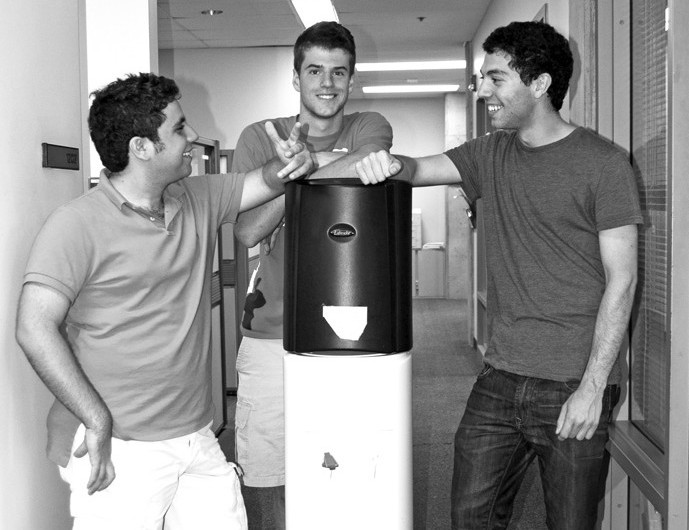
Around the water cooler – Feb. 4

In case you stopped watching after the first play, here’s what you missed in Super Bowl XLVIII…

THE WEATHER

The hype surrounding the inclement weather amounted to absolutely nothing as the temperature in the Meadowlands held up at around 10ºC all night with little wind and no snow. With the weather having virtually no effect on the game, some are already saying that cold weather cities could be added to the regular Super Bowl rotation. Roger Goodell is salivating at the thought of tapping into large markets such as Washington and Chicago. So how about Buffalo in 2018?! No one? Cool.


THE GAME

We should have seen it coming. A game that started with a botched Denver snap ended in complete Seattle domination. The Seahawks controlled all three phases of the game on Sunday, defeating the Denver Broncos 43-8 in Super Bowl XLVIII—the third largest Super Bowl victory margin in NFL history. Despite the anticipation for Denver’s top ranked offence to meet Seattle’s no. 1 ranked defence, the game never lived up to the hype—the Broncos’ prolific attack was shut down from the moment Joe Namath and his thrift shop coat came onto the field. Russell Wilson evaded rushers and converted on some key third downs; the defensive line controlled the line of scrimmage and forced Peyton Manning into some errant throws; and oft-injured Percy Harvin even had an impact, returning the opening second half kick for a touchdown. In other words, the game was never close—Seattle looked bigger, faster, and meaner. Macklemore must be so thrilled.


THE MVP

Don’t be ashamed. We all predicted this one wrong. Outside linebacker Malcolm Smith—a relatively unknown player outside of Seattle—took home the Super Bowl MVP honours, becoming just the sixth defensive player to win the award. Smith recorded nine tackles, a fumble recovery, and most importantly, returned an interception for a touchdown leading the way for Seattle’s destruction. Some other key notes about Smith: he played for Seattle Head Coach Pete Carroll at USC. He picked off the pass that Richard Sherman tipped to clinch the NFC championship. He was awarded a 2014 Chevy Silverado for winning MVP. Not bad for a former seventh-round pick. Macklemore would be proud.


THE HALFTIME SHOW

Bruno Mars was probably the most exciting part of the Super Bowl. He killed it. His performance will likely go down as one of the best Super Bowl halftime spectacles ever. The Red Hot Chili Peppers also showed up without shirts on to play “Give It Away,” which was pretty cool too, except for the part where I could name 40 other Pepper songs that I would rather hear. Just please, no Macklemore next year. Please.

a, Martlets, Men's Varsity, Sports

Sports briefs – Feb. 4

Martlet Hockey

On Saturday, the no.1 CIS ranked McGill Martlets thoroughly dominated the Concordia Stingers en route to a 5-1 victory, extending their winning streak against their cross-town rivals to 54 straight victories. Fourth-year industrial relations major Katia Clement-Heydra was instrumental in McGill’s first four goals. Clement-Heydra set up Gabrielle Davidson and Chelsea Saunders for the opening two goals respectively, before adding one of her own and then assisting Leslie Oles on the fourth.

Sunday saw no halt in the Martlets’ excellence, as the team breezed past the Ottawa Gee Gees with a score of 5-2. Davidson scored twice, breaking the former RSEQ scoring record of 24 goals in only 17 games. McGill out-shot the Gee Gees 45-22 and goaltender Andrea Weckmen recorded a 20-save game as the Martlets extended their RSEQ winning streak to 43 games. Now McGill awaits the season results of Ottawa, Concordia, and Carleton to see who they will encounter in the first round of the conference playoffs.

a, McGill, News

Deregulation of programs results in tuition increases for international students

The upcoming school year will mark the first during which tuition  will be deregulated in the Faculties of Management, Science, Engineering, and Law for international students.

As a result, student in applicable criteria will be charged upwards of $35,000 in tuition for the upcoming 2014-2015 academic year, an increase from the approximate $15,000 charged in the 2007-2008 year.

The costs of all programs at McGill are based on a set fee for Quebec-resident tuition, which is then supplemented by out-of-province and international student fees. In regulated programs, such as Arts, all supplemental international tuition fees are directed to the Quebec government, which then redistributes these fees across Quebec universities based on university-student population ratios.

For deregulated programs, the provincial government gives McGill the jurisdiction to determine the amount of supplemental tuition charged and allows the university to keep the additional money from this tuition.

Vice-Principal (Communications and External Relations) Olivier Marcil said the model for deregulated programs of distribution has disadvantaged the university, as McGill has the largest international student population in Quebec. Since regulated fees are redistributed based on overall student population, most of the supplemental fees paid by McGill international students are portioned to other Quebec universities.

“This is problematic because it means this money doesn’t go toward our students [for regulated programs], but to the education of students in other Quebec universities,” Marcil said. “McGill does not get to keep that extra tuition.”

The decision to deregulate certain university programs was made in 2008 following a compromise by members of the Conference of Rectors and Principals of Quebec Universities (CREPUQ), who advocated for it on the behalf of its member universities to the provincial government. The decision was followed by a multi-year transition period during which the university gradually retained a greater proportion of the supplemental tuition.

“In years one to five, the university will retain an incremental 20 per cent per year of the supplement, so that after five years, 100 per cent of the supplement paid will be retained,” the 2012-2013 Annual Report on the Financial State of the University reads.

Since 2008, this deregulation has enabled McGill to charge more than the previously regulated supplemental tuition amounts, which have resulted in the tuition increases that international students in those programs have faced over the past few years.

The Post-Graduate Students’ Society (PGSS) Secretary-General Jonathan Mooney said that due to deregulation, there is a concern that tuition increases could result in a skewed student population.

“Students’ primary concern is that increased tuition […] reduce[s] accessibility to education,” Mooney said. “Increasing tuition leads to a drop in enrolment for students from lower socioeconomic backgrounds.”

Mooney, along with Students’ Society of McGill University (SSMU) Vice-President University Affairs Joey Shea, raised the concern through a question at the November 2013 Senate meeting.

In response, Provost Anthony Masi said these tuition increases are offset by increased financial aid for students.

“Our need assessment parameters consider each student’s tuition costs in their program of study, so international students in de-regulated programs who demonstrate financial need receive the highest offers of aid,” Masi said.

According to Marcil, many resources will be available for students requiring financial aid, despite deregulation.

“McGill currently allocates 30 per cent of net new tuition revenues directly to McGill’s own internal student aid program,” Marcil said. “At the time of admission, all students, regardless of geographic origin, are invited to apply for entrance financial aid.”

Although future plans to deregulate more programs are unknown, according to Marcil, the provincial government is conducting further research on changes to tuition.

“There is currently a Chantier—a government-appointed committee created following last year’s summit on higher education—investigating the future of international students’ tuition, including deregulation,” he said.

Principal Suzanne Fortier echoed the sentiment in a recent e-mail to the McGill Tribune.

“Some decisions from the government are expected towards the end of the year, and we do not yet know if a decision regarding deregulation will be brought forth at that time,” she said.

a, Features

Does proximity yield progress?

While the Quartier de l’innovation (QI) has generated considerable interest since its announcement in January 2012, the concept of the innovation district is far from new. From Silicon Valley to 22@Barcelona, cities and governments today are investing billions of dollars in urban redevelopment projects that bring people and businesses together into one physical location.

What many don’t realize is that fostering innovation through physical proximity is not a new concept to Montreal. In 1998, the Quebec government launched a development project in an old industrial area just across the highway from the QI’s location in Griffintown. Called the Cité du multimédia, the venture was initially proposed as a  way to facilitate collaboration in Montreal’s growing multimedia sector. However, it has since faced criticism for turning the district into a mere extension of the downtown’s corporate offices.

So where exactly did this demand for innovation districts come from? And why do some fail, while others succeed?

The history of the innovation district:

While creating better solutions and products has been a recurring industrial goal throughout history, the foundation of physical districts to do so is a much more recent phenomenon.

According to Richard Shearmur, a professor from McGill’s School of Urban Planning, a policy emphasis on “innovation” has evolved over the last 30 years, after developing countries began producing large-scale, cheap goods for western markets in the ‘70s.

“How do you unblock saturated markets to get western people to carry on consuming? By innovating, by finding new things for them to spend their money on,” Shearmur said. “If you emphasize actually trying to produce better products than developing countries, that’s a way of maintaining your [economic] position.”

In the ‘80s, sociologists began to observe that some of the most successful industrial areas throughout history were locations that facilitated collaboration between many small, specialized companies.

“[For example], a lot of gun makers were in a district in [19th century] Birmingham,” Shearmur said. “You had the barrel manufacturers, the firing-pin manufacturers—they were all different companies but they came together to make guns. And their guns were particularly good because there was a lot of knowledge and a lot of specialization.”

This same concept has since expanded beyond manufacturers to encompass all types of innovation and entrepreneurship—from technology and science to cultural and urban development.

“The idea is if you have a group of economic agents who are grouped together geographically, and provided that there is a culture of openness and exchange, these geographic districts will lead to innovative solutions because there’s a lot of information exchange [and] a lot of collaboration between people,” Shearmur said.

McGill and the Quartier de L’innovation:

The QI follows this concept of developing a geographical space that encourages innovation, using an area in Southwest Montreal that includes Griffintown, Pointe Saint-Charles, Saint-Henri, and Petite Bourgogne. Launched in May 2013, the QI is led by both McGill and L’École de technologie supérieure (ÉTS), an engineering school located in the area.

“If you look at different universities in the U.S. or even in Europe, you see that [they] are engaging more and more with their communities,” McGill QI Project Director Isabelle Péan said. “For McGill, the objective is really to develop a hub—a living lab—where students can get specific experience [and] develop specific projects.”

The initial stage of the QI was funded in 2012 by several stakeholders: the government of Quebec, the Economic Development Agency of Canada, and the City of Montreal contributed $350,000 each, while ÉTS and McGill contributed $370,000 each.

According to Péan, once this money has been used, the QI will be driven by a non-profit organization that will find funding for its projects, and which will be overseen by the QI’s Board of Directors.

“We want the QI to be led by the community, by people involved with the project,” she said.

Part of this community involvement will come from students, according to Justin Leung, U1 Arts student and member of both the McGill QI Student Working Group and the McGill QI Steering Committee.

“There are incubators, entrepreneurial hubs, [and] start-up houses all over the world, and they’re all trying to recruit the best students,” he said. “We’re trying to build a project with McGill [from] the start, and then provide those resources to the students who need help or need the support.”

Less than one year after the project’s official launch, there has not been a substantial amount of change in the district. However, that may not be surprising given the nature of the project, according to McGill Director of Internal Communications Doug Sweet.

“MaRS [Discovery District in Toronto] has been around since the beginning of the 2000s and it has taken them a decade to get bigger, draw more funding, and produce more projects,” Sweet said. “[The QI is] like a garden being cultivated right now, and more seeds will be planted. [Nothing] has grown up yet because it’s too early.”

Branding, the Cité du Multimédia, and gentrification:

Though the QI is a relatively new project, it is not the first urban redevelopment venture in Montreal to aim to foster innovation and collaboration.

The Cité du multimédia from 1998 aimed to create a central location for the city’s multimedia sector to create jobs and revitalize the Faubourg des Récollets district. The project involved demolishing some of the old industrial buildings in the neighbourhood and constructing new office buildings, which were rented out with salary subsidies for newly created jobs.

However, 15 years later, the Cité du multimédia has faced criticism for failing to realize the goal that the project initially promoted. Due to factors such as expensive rent and conditions on leases, the anticipated small multimedia companies and start-ups never moved into the space, which was instead filled by larger companies.

Shearmur called the Cité du multimédia project an “abuse of branding.”

“[The government] used this branding to get the community on board [and] to get people to accept that they were going to knock down old buildings [and] kick out artists, because [they were] going to have this creative industry in place,” he said. “The Cité du multimédia basically turned out to be an empty slogan for redeveloping a neighbourhood.”

According to Péan, the QI is different from the Cité de multimédia due to the diversity of its stakeholders.

“The idea to bring people from the multimedia sector in one place with tax credits is not so bad,” she said. “But the problem is that if you do nothing to bring different kinds of partners (i.e. not only industry, but academics and people from the community) and try to connect people, no interesting interactions and collaborations will happen.”

However, Claire Poitras, director of the Urbanisation Culture Société Research Centre of the National Institute for Scientific Research, said the problem of branding persists in modern urban redevelopment projects like the QI.

“If you want to attract people to a specific place nowadays, you have to […] brand an area with a specific identity because people are going to move to a place that has special features, that is a distinctive place,” she said. “You have to sell the area as you would be selling a product.”

Instead of branding urban areas, Poitras said public decision makers should encourage ways for people to learn more about the urban history of areas—for example, through heritage tours. Otherwise, a brand could lead to harmful consequences, such as gentrification.

“We saw that in SoHo [New York] about 30 to 40 years ago,” she said. “Artists were attracted to it because it was cheap. Once they were there, other people wanted to be there as well, [but] gentrification occurred and the artists had to leave.”

Although other urban redevelopment projects have been criticized for gentrification, Sweet said the QI’s emphasis on urban planning sets the program apart.

“Urban planning is not part of MaRS at all; they’re not there to develop the neighbourhood—they’re there to develop business,” he said. “[The QI is about] trying to improve and help people stay [where they are], and not get forced out by gentrification as has happened in other neighbourhoods.”

For example, one QI project is to create a “laboratory of urban culture” in St. Joseph Church. Instead of allowing the land to be demolished and developed with condominiums, this project aims to repurpose the historic building as a space to preserve and encourage the artistic and cultural communities.

However, former McGill student senator Matthew Crawford, who voiced concerns about gentrification when the QI was announced in 2012, said he still believes the project will have negative effects on affordable housing in the area.

“Neither McGill nor the City of Montreal has demonstrated that it will move forward with this project with the necessary level of planning to make the project socially sustainable,” he said. “There are those who laud gentrification for its ability to rejuvenate neighbourhoods, [but] if the poor are simply swept away to the outskirts, then the process is not truly a rejuvenation, but an attempt to hide the problem.”

According to Poitras, the QI’s impact on the community will depend on how its various stakeholders interact.

“If there’s a good conversation between these types of actors, it should be fine,” she said. “They have to be sensitive to certain social demands they might have from community groups of the area. Some people might not want things to change that much.”

 An outdated concept?:

Although innovation districts like Silicon Valley have received considerable attention for their successes, the technological advances of the last decade have led some sceptics to question their relevance.

“All of the observers up to the 1990s were functioning in an era where, if you were going to collaborate closely with people, you did probably need to be quite close to them because telephone calls were expensive,” Shearmur said.

The proliferation of the Internet, however, has changed the way businesses communicate.

“It’s far more straightforward and easy now for collaborations to occur which have nothing to do with geography,” he said. “So this fact that you actually need to be close together geographically to have these meaningful collaborations to lead to innovation—is that an idea [that] is decreasingly relevant today?”

However, Péan emphasized the continued importance of physical proximity in innovation districts such as the QI.

“Physical proximity is really important; […] crucial interactions are still face-to-face,” she said. “[With] two major universities engaged in developing concrete projects in technological, social and cultural innovation with their students and professors, it really becomes an attractive space. We need a critical mass for people to interact.”

The future of the QI:

Less than a year after its launch, the QI is still in the early phases of development. Despite the uncertainty of the changing way innovation occurs, Péan said the QI could help redefine the innovation district and its place in the city.

“At the QI, we want to develop entrepreneurship of course […] but we are also here to help non-profit organizations, to bring our students within those non-profit organizations, [and] to create links between the community and the university,” she said.

One way of fostering these links is through student engagement. According to Leung, the most important way for the QI to move forward is for students to contribute to discussions that aim to create more opportunities for involvement in the QI by joining groups such as the Student Working Group.

“We want to get the ball rolling,” Leung said. “We want students to know what the project is, [and] we want more and more students who are passionate about the project to join us.”

One goal for student involvement in the QI is through internships. According to Péan, 16 students were placed in internships or research programs relating to the QI in 2013, including four internships in urban planning and five internships in social enterprises.

However, others have expressed dissatisfaction with the way students will be able to engage in the district.

“Structurally, the QI involves applied learning facilities in close proximity to corporate partners,” Crawford said. “By placing ‘resources’ and ‘products’ closer to their ‘buyers,’ McGill emulates the structure of an industry, rather than an institution of education. In doing so, they serve private interests before the public needs of the city.”

Because the Internet now facilitates so much communication, Shearmur said the QI could be more effective if it serves less as an innovation district, and more as a way of showcasing innovative urban planning and social practices.

“These are lines that are quite different from the traditional view of the innovation district as a group of firms, companies, actors, who, through their social connections, are leading to innovation,” he said. “We’ve got to be careful that the Quartier de l’innovation is looking forward and not looking back at these ideas.”

As the district develops, Péan said only time will tell what will come from the QI.

“We really want to increase collaborations and partnerships with local partners in order to create opportunities for enriching our students experience and be engaged as a university,” Péan said. “The project is new, but I’m confident that we will have concrete outcomes in the next few years.”

Correction appended Feb. 4:
A previous version of this article included a quotation that incorrectly stated that there were no internships available in the QI. In fact, there were 16 internships offered last year. The Tribune regrets the error. 

 

a, Men's Varsity, Sports

Basketball: Redmen sweep Gaiters to move into first in RSEQ

The no. 8 ranked McGill Redmen (8-2) stormed Love Competition Hall Thursday evening, coasting to a 80-67 win over the Bishop’s Gaiters (6-4). In a battle for first place in the RSEQ division, the Redmen emerged on top; Bishop’s intensity level was nowhere close to McGill’s as the home squad’s stifling man-to-man defence and red-hot offence from beyond the arc were the keys to a decisive victory.

The Redmen came out with a bang in the first quarter, setting the tone early with their crisp ball movement and suffocating defence. The home team managed to spread the floor well without forcing any shots. McGill tallied up a 20-4 score midway through the first quarter—which included five three-pointers in transition. However, the more impressive feat was keeping Bishop’s to seven points in the quarter and merely 20 points total by the half.

Yet the second half was a very different story for both squads. The Redmen came out flat, and the Gaiters retaliated with a run of their own as they made appropriate adjustments on defence. Bishop’s outscored McGill by 12 points in the second half and showed some life, but the Gaiters’ comeback run had come too late in the game.

“[Bishop’s] are a very good team,” Head Coach David DeAveiro said. “We happened to shoot the ball extremely well and got up big. You can’t judge them by one half of play. [In] the second half, they kicked our butts. Their coach made a couple of adjustments that were some good ones, and [the team] played with more intensity. They took away some of the things we liked to do, and we didn’t handle it well.”

Along with launching McGill into the  top spot in the RSEQ, the game also marked the first time Redmen senior guard and co-captain Simon Bibeau has scored 20 points or more in a game since October. Bibeau was key to McGill’s victory, leading all scorers with 21 points—including three three-pointers in the first quarter. Rookie guards Dele Ogundokun and Michael Peterkin were also spectacular as they chipped in 17 points apiece in the contest.

However, the journey for first place in the RSEQ didn’t stop Thursday evening, as the team played a rematch against Bishop’s at Lennoxville, Quebec on Saturday, where the Gaiters had previously been undefeated in season play.

“We are going to look at the tape, and [will be watching] the second half [of Thursday’s game,]” DeAveiro said. “We are going to figure out how to beat [Bishop’s] tough defence and learn some lessons [to be] ready to play Saturday.”

McGill was more than ready to play in their second contest of the week as they defended their newly acquired first place position with a 55-48 victory over the Gaiters in front of a raucous Carnival crowd. Co-captains Bibeau and Vincent Dufort led the way for the team, with Bibeau recording 15 points and Dufort posting a double-double with 11 points and 10 rebounds.

“It was a huge thing to win back-to-back against Bishop’s,” Bibeau said. “We know that they’re a tough team. We were in the run for first place. We were able to confirm our [first-place position] this weekend.”

McGill will look to continue their three-game winning streak against UQAM at 8:00 p.m. on Feb. 2 at Love Competition Hall.

a, Student Life

The ins and outs of the McGill residence system

Often glorified in movies, living in residence is generally considered a rite of passage for all college students.  The idea behind residence systems, however, is to provide a supportive micro-environment within a larger campus to aid in the drastic transition upon entering university.

At McGill, not only do the different types of residences cater to students’ needs and personalities, but hall directors and floor fellows also work hard to make the year-long experience unforgettable.

“It’s a cool environment where you get all of the college experience at once: the studying, the partying, the no sleeping […] and everyone’s in the same situation,” U0 Music student Céleste Pagniello said.

McGill’s residence system is already well-developed to meet the needs of students according to Janice Johnson, Managing Director of Residences and Student Housing.

“There are some schools in Quebec that do a lot of programming, have floor fellows, and hall councils that do some of the stuff that we do, but we do it on a pretty significant scale,” she said.

Currently, each residence has one director, except for MORE housing, which has one hall director for the group of houses. Each building is also home to floor fellows—non first-year students who plan activities and, perhaps most critically, are there for students in times of crisis.

Several changes to this system have been planned for Fall 2014. The modified system will have full-time hall directors who are employed by Student Housing Hospitality Services, and who will be responsible for several halls. There will also be faculty members or other administration that live in halls with students.

This decision has been met with criticism from some members of the residence community concerning the accessibility of the hall directors and a lack of consultation in implementing these changes. Despite the uncertainy surrounding how this system will function at McGill, full-time hall directors are common at other academic institutions across Canada and the United States.

For example, Queen’s University has a Manager of Residence Life, an Assistant Manager, and live-in full-time professional Residence Life Coordinators who are responsible for groups of buildings. Their floor-fellow counterparts, called “dons,” are also upper-year students—even graduate students—who support new students in the transition to university life. These dons and staff live in the residences, in a similar manner to the proposed McGill system.

Similarly, the residence system at the University of Chicago focuses on providing support to their students in residence. Their system includes Resident Assistants (RAs), who are third- or fourth-year students; Resident Heads, who are advanced graduate students or administrative staff; and Resident Masters, senior university faculty members who are there to provide a large, connected support system.

One of the main differences between McGill and other universities is that McGill guarantees residence only for a student’s first year of studies. For example, not only does the University of Chicago guarantee housing for all four years of undergraduate school, it also requires that all first-year students live in residences.

However, Pagniello said she supports McGill’s decision to guarantee residence to only first-year students.

“It’s a good experience for a year, but I think it’s going to be good to move out and really live on our own,” Pagniello said.

At the end of the day, university residences are all about providing the support students need to make a smooth transition from living in a residence to living in an apartment.

“[Residence] allows students to become independent and develop new strengths in a new family-type support system,” first-year Education student Jasmine Segal said. “I feel like I’m more prepared for living on my own next year.”

a, News, SSMU

GA to vote on student academic rights, early access to course info

On Feb. 5, the Students’ Society of McGill University (SSMU) will be hosting its Winter semester General Assembly (GA). Five motions are scheduled for voting by all SSMU members. The GA needs 100 people present to reach quorum and pass binding resolutions.

Motion Regarding the Guarantee of Freedom of Dress in the SSMU Building

This motion seeks to remove limitations on dress within the SSMU Building and its facilities, limited only by instances where another student’s right to safe space is infringed upon, as determined by the Equity Policy.

“We learned that there [is] no place in the SSMU bylaws that guaranteed freedom of dress,” Morgan Grobin, a U2 Engineering student who started the petition for this motion, said. “Having the opportunity to express oneself through choice of clothing is an extremely important part of individual development.”

According to Joey Shea, SSMU Vice-President University Affairs, the motion is a response to a previous incident involving lab coats worn by members of the Plumbers’ Philharmonic Orchestra (PPO), an engineering student group. Members of the group wear lab coats that sometimes displays drawings that are considered offensive by students. The lab coats are currently banned from the SSMU building.

“There was an equity complaint last year against the PPO Coats; they just have [inappropriate] things drawn on them,” Shea said. “There’s a complaint saying they’re racist and sexist. So the decision of last year’s exec was to ban them.”

The motion also seeks to remove all current bans on any student groups’ choice of dress, including the ban on the PPO.

Motion Regarding Inclusion of Academic Assessment Rights on Course Outlines

This motion seeks to ensure that all professors and faculties adhere to the University Student Assessment Policy, which has been occasionally ignored according to some students.

Some of the rights within the Academic Assessment Policy include the right to submit work in English or French, and the inability for any final exam to account for more than 75 per cent of a course grade.

In order to enforce the policy, the motion urges the university to make these rights more accessible to students.

“The SSMU support[s] the inclusion of an abbreviated outline of student academic rights […] of the University Student Assessment Policy on course outlines,” the motion reads.

Although academic matters are typically dealt with at McGill’s Senate, Shea said she wanted the motion to go through the GA because of the broader basis for student consultation.

“I think the power coming from a GA motion will sort of propel [the motion] and really give us that much more legitimacy in terms of lobbying McGill,” Shea said.

Motion Regarding Sustainability at the SSMU

In Fall 2013, the SSMU removed its mandated Sustainability Coordinator position, which previously oversaw sustainability projects for the society. Instead, Council established an ad-hoc committee on Sustainability.

This GA motion attempts to ensure that a mandate be presented by the Executive to the SSMU’s legislative Council on the future of sustainability by the end of Winter 2014.

According to Shea, a mover of the motion, since the ad-hoc committee has yet to show signs of progress, the motion is intended to reinforce the significance of sustainability at SSMU.

“Not a lot of people ended up showing up at those committee meetings, so this [is] just to further solidify the need for sustainability at SSMU,” Shea said.

Motion Regarding the Timely Distribution of Course Information

In an effort to allow students to properly plan out their semester prior to registering for a class, this motion advocates that online material, such as course syllabi, are available to students prior to the first day of classes either by a university-wide academic policy or by professors.

“Students not currently registered in a class have no consistent way to access this information, as they cannot view online course material for a course they have not yet registered for,” the motion reads.

According to Shea, who developed this motion within the Senate caucus, the SSMU Office of University Affairs will have to negotiate with the McGill administration to see these changes made. Shea said she hopes to see required readings and textbooks, evaluation dates, and course descriptions online before the semester begins.  Shea wants to pass this motion within the GA in order to emphasize it’s gravity.

“There will be a lot of debate [and] visioning within the subcommittee of senate caucus, how we’re actually going to implement this,” Shea explained. “Are we going to ask for syllabi to be available one week in advance, before add-drop, two weeks in advance? [.…] Those details are still left to be sorted out.”

Motion Regarding the TPP and CETA

This motion aims to address two trade agreements currently under negotiation by the Canadian government: the Trans-Pacific Partnership (TPP) and a Canadian-European Union free trade agreement (CETA).

According to the motion, the trade agreements will allow for increased patents for medications, which could potentially increase the cost of drugs in Canada.

“The health and/or financial security of students would be negatively affected by an increase in drug costs due to direct increase to the inability of healthcare plans to cover new drugs to cost, or to increased insurance premiums,” the motion reads.

The motion, initiated by Medicine representative David Benrimoh, asks SSMU to take a formal stance against the trade agreements.

If passed, the SSMU will write a letter to the federal government to express their disapproval of the provisions and lack of public consultation.

Read the latest issue

Read the latest issue