


Latest News

a, McGill, News

Delving deeper: McGill’s research partnerships with corporations

Last November, a report by the Canadian Association of University Teachers (CAUT) criticized McGill’s collaboration with Bombardier Inc., a publicly traded aerospace corporation, and eight other partners. The report warned that a lack of protections for academic freedom in collaborative research agreements between universities and industries could affect universities’ integrity. This week, the McGill Tribune takes an in-depth look at McGill’s relationship with the corporation.

The CAUT is an organization that represents 68,000 university teachers, researchers, and general staff throughout Canada. According to Paul Jones, CAUT research and education officer, agreements that do not protect universities’ interests could increase the commercialization of research.

“[Industries are] putting pressure on universities to crank out more commercializable products,” he said. “It means universities turn away from curiosity and vision-driven research [….] Universities can play, or should play, the unique role in society as independent protectors or purveyors of information for the public interest.”

McGill’s involvement with Bombardier comes from their membership in the Consortium for Research and Innovation in Aerospace in Quebec (CRIAQ), which is a collaborative organization of 14 universities, nine research centres, and 52 companies. The consortium was founded in 2002 as a non-profit organization with the goal of increasing competitiveness within the aerospace industry.

“[CRIAQ aims] to develop international collaborative research projects by partnering with Canadian, U.S., European and other programs,” the CRIAQ website reads.

Other members of CRIAQ include Concordia, Université de Sherbrooke, and companies such as GE Aviation and Bell Helicopter.

As of 2012, CRIAQ had enabled 142 research projects, which received $124 million in funding. According to CAUT’s report, 25 per cent of project funding is a grant from CRIAQ, 25 per cent is from corporate participants in the project, and 50 per cent is from the Natural Sciences Engineering and Research Council of Canada (NSERC), a federal agency.

Clement Fortin, president and CEO of CRIAQ, said project collaborations with industries give students a unique opportunity to gain practical experience working in the field.

“Collaborative research of this type allows students, researchers, and professors to get experience with the real thing, so the students can find better jobs, and it can be faster for them to enter the workforce,” he said. “Collaborative research also supports a greater number of research students.”

CRIAQ has supported 700 graduate students since its conception in 2012. The projects result in approximately 250 publications per year. In 2013, 253 graduate students were involved in CRIAQ projects.

In their report, CAUT specifically critiqued the collaborative agreement for CRIAQ’s PLM-2 project, which McGill manages with Bombardier Inc. The PLM-2 project is researching ways to improve information-sharing and information management for a product throughout its life-cycle.

“The agreement compromises the university’s institutional autonomy by allowing the industrial partner to compel the university to patent university-owned intellectual property,” the CAUT report read on the collaboration.

Jones said patents can have a negative effect on academic research.

“The point [of academic tradition] is to make the world a better place by developing new knowledge and insuring that it’s disseminated as widely as possible,” Jones said. “The problem is when there is pressure, either implicit or explicit, indirect or direct, for faculties to turn their knowledge into patents.”

McGill’s Associate Director of Research Contracts and Agreements Nathan Currier stressed that, for instances where research is patented, the university can still own the intellectual property.

“It’s infrequent that [McGill] develops something which belongs to us by the nature of the agreement, and we decide not to pursue it, so we give it to the [industry],” Currier said. “We can give [industries] the option to try and acquire the intellectual property we’ve developed if we’re not interested in using it [….] In our agreements, we insist that researchers and students will always have the right to utilize intellectual property for academic and research purposes.”

The report reviewed 12 collaborations between universities and industries throughout Canada. Seven out of the 12 agreements reviewed did not include specific protections for academic freedom; 10 out of the 12 agreements did not explicitly stipulate against university participants having a financial interest in the collaboration; and none of the agreements included a framework for the creation of a publicly accessible review of the collaboration.

The principles that the report outlined for improving the quality of the collaborative agreements included protecting academic freedom and institutional autonomy regarding teaching, research, hiring practices, and the publication of information; having protections against conflicts of interest; and encouraging transparency.

Jones added that increased public funding of universities by the provinces is key to protecting academic freedoms.

“I think that universities have to be refunded, that the cutbacks have to be ended and proper funding restored,” he said. “There has to be instead a focus on basic research—the kind of fundamental research that results in long term breakthroughs.”

a, News, SSMU

Council votes against taking stance on Leacock restructuring

Members of the Students’ Society of McGill University’s (SSMU) legislative Council voted against taking a stance on the People, Processes & Partnerships (PPP) plan last Thursday.

Introduced in November 2012, the PPP plans to consolidate the administrative staff of departments within the Faculty of Arts into six hubs, which would consist of many departments under shared staff. The plan was developed as a response to staff reduction through the voluntary retirement program.

“There is a worrying lack of evidence presented to stakeholders to suggest the viability of this plan, whether in terms of documented cost-savings, demonstrable efficiencies, or student, staff, and faculty satisfaction with such arrangements at universities comparable to McGill,” the motion reads.

The motion faced criticism from both councillors and non-councillors. Justin Fletcher, president of the Arts Undergraduate Society (AUS), argued that the PPP is an Arts-related matter, and therefore not a suitable subject for SSMU to discuss.

“This is a motion that is very specific to the Faculty of Arts, and I believe that the AUS is the most representative body to discuss such an issue,” Fletcher said. “So I do not believe that this really is SSMU’s place to take a stance [….] I ask that representatives of the SSMU legislative Council respect the AUS’s autonomy in making decisions specific to policies in our faculty.”

However, Medicine councillor David Benrimoh argued all students of the AUS are still represented by SSMU.

“Arts students are SSMU members, as well,” he said. “We have a responsibility to advocate for their interests [….] I think we do have a place to speak about it.”

Arts councillor Ben Reedijk responded that despite such arguments, many councillors of SSMU were not acquainted enough with the PPP to take a sound stance on it.

“The PPP has been drastically changed since last year,” Reedijk said. “If you had been to one of the many student consultations that have happened since, you would probably know that [….] So I think it’s really depressing that we’re going to be passing a motion on an issue, but not actually show up to the consultation for it.”

The motion failed.

Council endorses creation of Family Resources Coordinator

Council endorsed an application submitted by the Senate Subcommittee on Women that, if approved, would create a Family Resources Coordinator position funded by $88,000 over two years by the Sustainability Projects Fund (SPF).

The fund application, made up of fees from students and matched by the administration, will be reviewed by a working group in the Office of Sustainability.

The project would aim to connect student parents with resources available to them and to advocate for greater support for student families.

Sara Deslisle spoke on the development and necessity of the project.

“At the moment, there is no dedicated resource for either students, faculty, or staff dealing with family-care issues,” she said. “What we’re basically looking at for the first year of the pilot project is to look at childcare issues in particular. At the moment, there is a shortage of childcare resources on campus. For instance, the McGill Childcare Centre currently has a 740-persons waiting list for 106 subsidized spots.”

Reedijk expressed concern regarding the usage of the fund to create a project, as opposed to funding more daycare spots.

“How many actual additional daycare spots can we create in lieu of hiring a coordinator revolving around the issue of daycare spots?” Reedijk said. “Why not actually just go directly to the source and fund more daycare spots for our students?”

Deslisle emphasized the importance of evaluating the situation before allotting funding.

“At the moment, there is no assessment as to what is needed,” Deslisle said. We’re doing a needs assessment, first of all, trying to figure out who needs [things and] what’s needed.”

The motion passed.

a, News

Faculty voice concerns about administrative restructuring at AUS Town Hall

Last Wednesday, the Arts Undergraduate Society (AUS) hosted a Town Hall for faculty members to voice concerns about the plan to restructure the administrative staff within the Faculty of Arts.

Called People, Processes, and Partnerships (PPP), the plan was initiated by Dean of Arts Christopher Manfredi in Nov. 2012 in response to staff reductions and financial constraints. Since then, the plan has undergone numerous changes in response to criticism by staff, students, and faculty, the latest of which was presented at AUS Council on Nov. 13, 2013.

According to AUS Vice-President Academic Jacob Greenspon, other meetings about the PPP have mainly addressed its impact on Arts students.

“It seems like there is [already] some discussion on that, but this [Town Hall] was more about how [the PPP] is going to affect the staff and not the students,” he said.

Currently, each department in the Faculty of Arts has its own specialized administrative staff. At some times in the year, several of these administrative units are served by as few as two people. The PPP will bring all the staff together to create six support units that will each cater to several of the faculty’s 16 departments.

“The idea since September has been to think whether we can consolidate [our administrative staff] into a set of larger groupings that would mitigate some of the risks of having academic units only served by only one or two or three administrative or support staff,” Manfredi said. “As well, it would allow us to equalize the workload.”

However, some faculty members were critical of the outcomes of the PPP. Philosophy Professor Alison Laywine expressed concern about the potential loss of administrative expertise.

“We have people who have specialized knowledge about the culture and life and administration of our departments,” Laywine said. “I’m guessing that this specialized knowledge is going to get lost and lead to a situation of chaos.”

Manfredi said he would provide training for staff to prevent this problem.

“I actually think [our staff] are quite capable of transmitting to each other their specialized knowledge of their departments,” he said.

The implementation of the PPP will create a single administrative hub for the departments of art history and communication studies, French language and literature, English, and the French Language Center. The PPP will also group the departments of political science, economics, and philosophy together on the fourth floor of Leacock Building. The Anthropology, Sociology, History, Classical Studies, and Jewish Studies departments will be located on the seventh floor. This new structure frees rooms for use as student space.

These groupings were determined on the basis of the number of faculty members in each department, the number of students in each department, and the number of students in classes offered by each department.

Manfredi added that there will be an academic benefit to this restructuring, noting that interdisciplinary programs similar to the philosophy, politics, and economics grouping are already offered in many universities.

“Now that these three departments are going to be sharing administrative services, [they] are going to have to know enough about the other programs that perhaps allow [them] to develop some relationship between [department staff] to allow for some interesting intellectual collaboration,” Manfredi said. “When people work together, they’ll find interesting ways of taking advantage of that.”

Professor Darin Barney from the department of art history and communication studies said he doubted the effects of relocating administrative staff.

“[This restructuring] can seriously alter the experience of students and faculty and staff members that have been built up around the integrity of departmental culture and autonomy,” he said. “I find it a concern that such a move is being undertaken without reference to models where similar types of clustering have been successful, that we would then contemplate stepping into this unknown territory.”

The PPP relocation process is scheduled to be complete by Summer 2014.

“It’s also a good idea for us to go back once [the PPP] has been going for a term and ask the students what their experience has been and how they’ve been impacted,” Manfredi said.

a, Arts & Entertainment, Music

Against Me!—Transgender Dysphoria Blues

The Florida-based punk rock band Against Me! formed in 1997 and firmly established itself in the punk world with the release of five albums between 2002 and 2012. In 2012, lead singer of the band, Laura Jane Grace—formerly Tom Gabel—announced that she was a transgender woman. Following this admission, the band began work on their sixth album, Transgender Dysphoria Blues, a concept album following the life of a transgender prostitute.

Transgender Dysphoria Blues has already set itself up to be one of this year’s most iconic albums in the punk rock scene. Intensely personal, heartfelt, and relentlessly unapologetic, this album incorporates classic punk concepts with a new type of awareness not typically associated with a genre that has been largely limited to white, heterosexual males.

The album is musically and lyrically well rounded; from the anti-authoritarian “Osama Bin Laden as the Crucified Christ,” to the longing lone-song “Two Coffins,” to the metaphor-filled upbeat anthem “Paralytic States.”

While Grace’s personal anguish fuels the lyrical fire of this album, the compilaion is made even more stirring by the fact that—having just begun her transition—Grace still has a very deep voice, the same one that’s defined her career from the beginning. The impact is particularly felt in the title track when Grace belts out “You want them to see you/ like they see any other girl/ they just see a faggot.”

Laden in punk beats, lyrically heavy, and overwhelmingly inspiring, Transgender Dysphoria Blues is an incredible album with an even more incredible message.


a, Student Life

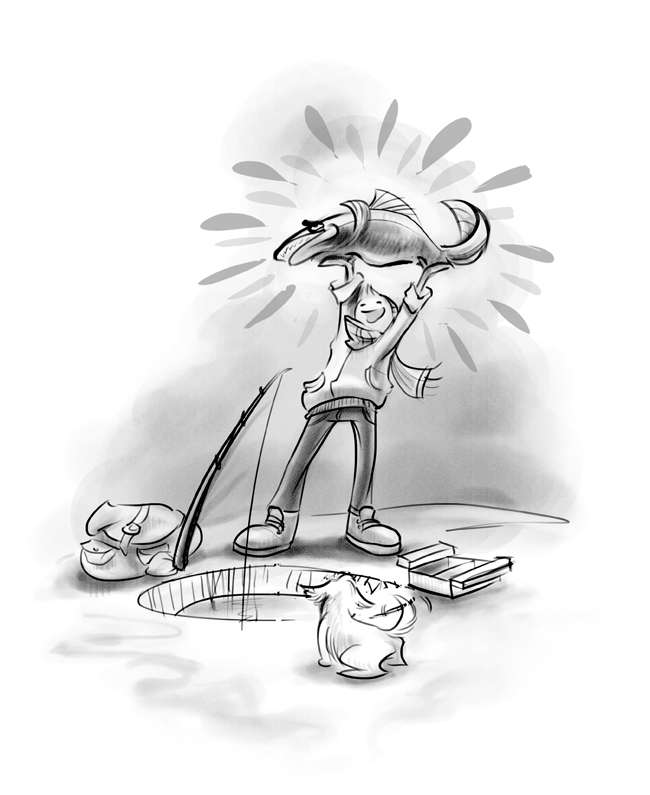
Gone fishing

What I expected to be a boring afternoon, freezing in a claustrophobic hut, turned out to be an anomalous but pleasant way to spend four hours on a Sunday.

The possibility of going ice fishing first came to my attention when I stumbled upon the organization Pêche Blanche, located in the Old Port. The notion of doing an activity I associated with a bunch of plaid-clad men and pristine lakes surrounded by snow-covered white pines, in the midst of bustling downtown Montreal caught me off guard. When a friend proposed the idea, there was no way I was going to pass up the opportunity.

The fishing village is located off the docks of the Montreal Yacht Club. The setup was comfortable and convenient; the basic wood structure could easily seat about eight people and was equipped with two space heaters to keep us warm all afternoon. Openings cut into the floor exposed the holes in the ice below. The rods were placed so that we only had to check them occasionally.

An employee instructed us on how to fish—from attaching bait to reeling in—only to be interrupted by the jerking of one of the rods. We were giddy and eager to reel in the fish, but were more shocked that there were fish actually biting at our rods. Up until that moment, we had doubts that it would be possible to catch anything so close to home. The fish didn’t hook, but we were stricken with high hopes of an action-packed afternoon.

Within five minutes of settling in, we were questioning why we hadn’t brought a deck of cards, or at least downloaded the app Heads Up on one of our iPhones. We passed the time naming the minnows in our bait bucket, snacking, and talking about television. We waited impatiently like children on Christmas morning. Over the course of the afternoon, there was only a handful of nibbles; each time we immediately fell silent until the fish inevitably swam away.

Finally, after three and and half hours, a fish finally caught on the hook. As we reeled in, the fish became visible in the hole; its bulging eyes and gaping mouth emerged from the water. In a true reflection of our generation’s attachment to social media, five of us whipped out our phones and huddled around the hole snapping photos of the floundering fish below. We may have been more excited to capture the perfect Kodak moment than to have caught the fish.

The line snagged and we couldn’t pull the fish any further. In a panic we reached for whatever long pole was available in the hut and tried to release whatever was caught. Like a fish out of water we were hopeless and required expert assistance; a deft employee unhooked the fish within the hole and then freed the hook from the ice.

His enthusiasm for our fish—a Sauger, the largest catch of the day—and for amateur photography matched our own; we were taken outside for a photo shoot with our fish, which was promptly uploaded to Pêche Blanche’s Facebook page.

Despite concerns about the contaminants in the fish from the shores of a polluted urban metropolis, the most surreal part of the experience was finally eating our catch. With live fish in hand, we hopped in a cab back home and used YouTube to guide the gutting process. As far as local food goes, this was about as local as it could get; it’s rare to know where your food comes from, nevermind being the one to actually catch it.

With the whole afternoon costing around $40 each for fishing licenses and rental fees, it was the freshest and most expensive fish I’ve ever eaten. The once-in-a-lifetime, oddly commercialized, back-to-nature experience was nonetheless priceless.

a, Science & Technology

Science from science fiction: invisibility cloaks

Whether it’s used as a plot device or simply as a cool effect to amuse spectators, invisibility is and has been part of science fiction for almost as long as the genre has existed. One early example is H.G.Wells’ The Invisible Man—a novella about a former medical student who invents a serum to render himself invisible. Today, scientists all around the world have been developing different experimental techniques in attempt to make objects invisible.

H.G. Wells’ idea of achieving invisibility was to change the body’s refractive index to that of air so that you would become invisible to the naked eye. The refractive index is the property of a substance that determines how light is bent when entering a material. While this index can be modified for a substance given the right conditions, altering the index of the human body directly is a much bigger project involving more challenges.

Most research in this area focuses on different materials that bend light away in a manner that could then be used to cover a body, similar to the invisibility cloak from Harry Potter. These materials range from carbon nanotubes, which simulate mirages, to optical camouflage, which—in simple terms—consists of projecting what’s behind you to create the impression that nothing is there.

The mirage effect is the same that causes shimmering on roads on hot sunny days. The temperature difference in between the asphalt and air causes the light to bend, or refract, away from the road. Researchers at the University of Texas at Dallas NanoTech Institute took advantage of this phenomenon through the use of carbon nanotube rig in 2011.

Carbon nanotubes are, as their name suggests, sheets of carbon wrapped up into cylindrical tubes. They are extremely strong and have many other interesting qualities, one of which is an extraordinary capacity to conduct heat. This makes them excellent producers of mirages. To achieve this, sheets of the tubes were submerged in a petri dish of water and electrically heated. This method has its limitations, as a large-scale model is difficult to reproduce and the great discharge of heat would make for a poor invisibility cloak.

The optical camouflage is a simple enough idea that is relatively hard to produce. It involves using technology to create a garment that will adapt to  the wearer’s surroundings, turning him or her invisible. Yet, in 2012, Susumu Tachi, the principal investigator of the research team at the University of Tokyo’s Tachi Lab, managed to do just that. Essentially, a computer scans background imagery and projects the picture onto a cloak made of very reflective material, similar to what’s used for stop signs.

The most recent attempt at invisibility is an interesting approach pioneered by professor George Eleftheriades and PhD candidate Michael Selvanayagam from the University of Toronto. Their idea is to surround an object with antennas that would cancel outgoing radiation from an object, rendering it invisible to whichever light spectrum is being targeted.

Light is not simply constrained to what we can see—it has a wide variety of spectrums including microwaves, radio, infrared, and ultraviolet. Our visible spectrum is a minute fraction to the possible wavelengths of light. When light strikes an object, it reflects back and our eyes capture that outgoing wave. It is these types of light spectrums that the antennas would target.

The antennas covering an object can emit their own electromagnetic fields—another word for light. Therefore, when these antennas are attached to an object, the fields emitted cancel out the light that is usually reflected from the object. As a result, there is no light bouncing off of the object for our eyes to perceive—rendering it invisible.

The theory is that this method could cloak an object from the visible spectrum; however, doing this would require antennas tens of hundreds of nanometres in size. Eleftheriades’ and Selvanayagam’s method only works for microwave and radiowave detectors so far.

Although actual cloaking has yet to be perfected, this new development shows great potential for additional research on the topic. Further efforts may, in the future, result in the development of an active invisibility cloak.

a, McGill, News

Food for thought: exploring the limitations of your meal plan

Many McGill students are all too familiar with having their meal plan cards turned down at certain vendors on campus.

While accepting meal plans may seem like an obvious choice to the student, the system behind the service is much more complicated. This week, the McGill Tribune takes a look at the meal plan program and the factors that determine where you can use it on campus.

The meal plan program is managed by McGill Food and Dining Services (MFDS)—a subunit of Student Housing and Hospitality Services (SHHS). Students can use the meal plan to purchase food at both in-residence dining halls, as well as various other food vendors on campus, including Subway, Sinfully Asian, and Presse Café on the downtown campus, as well as Faberge Café and Vihn’s Café on Macdonald campus.

The main food service provider for McGill is Aramark, which manages numerous food service locations on campus on the behalf of MFDS, including two residential dining halls—Carrefour Sherbrooke and New Residence Hall, McConnell Engineering Caf, and Redpath Caf.

Monique Lauzon, MFDS marketing and nutritional advisor, said different providers enter into different contractual agreements with the meal plan program.

“Aramark was selected as McGill’s main food service provider following a public bid process four years ago […] against major companies like Compass and Sodexo,” Lauzon said.

The process is different for third-party vendors, such as Subway, Second Cup, and Sinfully Asian.

“[The companies] approach us and we look at how we could incorporate them into the meal plan, so that is more on a one-to-one basis,” Lauzon said. “[Then] a contractual agreement is negotiated [….] Costs are based on different criteria—[such as] your location and what you’re offering.”

Although vendors accepting the meal plan can be found around campus, some students express frustration with the lack of such vendors in the SSMU Building.

“I’ve worked in SSMU before as an executive and it’s one of the top comments that vendors get,” Josh Redel, manager of the Student-Run Café Le Nest in SSMU, said. “It’s the number one thing people ask for.”

Jonathan Taylor, a Liquid Nutrition franchisee and a tenant of the SSMU Building, said accepting meal plan at his business is “not feasible” because it is too expensive.

“The meal plan costs $10,000 to have a new point-of-sales device, so we had to run two separate inventories, two separate cash systems, two separate everything for the people who don’t use meal plans,” he said. “McGill also holds your funds for a month before giving back to you and as a small business, they can’t withhold a month worth of my sales.”

SHHS Senior Director Mathieu Laperle said that, since MFDS is a self-funded unit, the university does not subsidize its costs, which makes the meal plan costly to implement.

“We do have to generate a revenue to pay all the different costs,” he said.

According to Lauzon, these costs arise from a variety of factors.

“We pay our employees, facility fees, rent, we have to be able to self-finance our operations,” Lauzon said. “If we didn’t charge vendors to accept the meal plan, we would have to assume the costs of operating [at] the location, which includes IT support and administrative support that we provide to run the [meal plan].”

Laperle said the choice to join the meal plan is ultimately the decision of the tenants.

“Being a part of the meal plan is not mandatory, but of course, we believe it’s a potential of revenue—there are over 8,000 students on the meal plan,” Laperle said. “Should a vendor approach us and express interest in joining the meal plan, we certainly welcome that. However, it is a contractual agreement and has to work for both parties.”

a, Martlets, Sports

Hockey: Martlets stand up to aggressive Gee-Gees

With nine minutes left in the second period, McGill forward Pamela Psihogios lost her balance with the puck at hand. Undeterred, she passed to an open teammate and then sprung to her feet to support her fellow Martlets as the aggressive Ottawa Gee-Gees initiated a small scuffle. Despite the combative nature of their opponents, the Martlets managed to win against Ottawa 2-0 on Friday evening, maintaining their composure in the face of the Gee-Gees’ aggressive play.

“At Ottawa it’s always a tough game; they play a very physical kind of game,” Head Coach Peter Smith said. “I wouldn’t say that we are the most physical team but they play a physical game, and I thought we did a really good job.”

Shortly after the scuffle, senior forward Katia Clement-Heydra converted Chelsea Saunder’s assist to finally break the deadlock. The Martlets were clearly the dominant team thanks to a disciplined defence and an excellent shutout performance from netminder Andrea Weckman. Third-year chemical engineering major Stefanie Pohlod topped off the Martlets’ play in the third period with McGill’s second goal of the night.

The Martlets’ ability to dictate the pace and generate pressure against a physically larger opponent is a true testament to their adaptability and excellence over the course of the season. The lopsided shot count of 35-22 was further indicative of their control of the rink. Smith voiced his pleasure with his team’s execution over the course of the season and the game.

“I think that we’ve done a good job,” Smith said. “We spend a lot of time doing what we do, practicing hard and a big part of what we do is focusing on our game and not worrying about our opponent.”

Clement-Heydra, who had three of her shots hit the post, echoed this sentiment.

“We did well; we had a good shooting mentality; we were opportunistic,” she said. “You know, sometimes it goes in, sometimes it doesn’t, and today it didn’t want to go in as much as we wanted it to, but we managed to get the win.”

This victory showed the confidence the Martlets had in their game plans and their ability to execute.

“I think our fitness is a high point of our team,” Clement-Heydra explained. “Our practices are high tempo, and we work a lot on cardio so we are able to have a good forecheck and then back check.”

There are now six games remaining before the playoffs and the Martlets are both physically and mentally prepared for the challenges ahead. They have enjoyed their position at the top of the RSEQ standings, and will be looking to take this momentum into the post-season.

“We are confident, but after last year and losing in the finals, we are really hungry and looking for redemption,” Clement-Heydra said. “[We] are looking to go all the way, but we don’t want to be too confident.”

The Martlets will face off against Ottawa once more this Sunday, Feb. 2 at McConnell Arena at 3:00 p.m., where they will play the Gee-Gees for the fifth time this season.

a, Features

A lesson from the students

In the bleakest days of Montreal’s winter, it’s easy to feel weighed down with the stress of school, the grey skies, and the cold that keeps us indoors. This winter, I tried to forget the seasonal gloominess and instead remembered my experience this past summer—one that reminded me about finding a sense of joy in even the dreariest of days.

On my first day in Cambodia, I was greeted with an airport about the size of a typical campus building, 40 degree weather that made it tremendously hard to breathe, and a driver who didn’t speak a word of English.

From day one, the students I taught did not cease to amaze me with their clever games, their spontaneous gifts of flowers and pebbles, their yearning for knowledge, and their laughter. With each day that I spent with them, I couldn’t help but notice how they were so determined to look past any challenges in their day. Now back in Montreal, I realize that as university students, we lead such busy lives that we often ignore the possibility of taking a deep breath and slowing down a little. When they were playing ‘tag,’ I noticed that two little girls were playing it by a different rule: whenever one person became ‘it,’ the other would run remarkably slowly, even turning around and giggling, until she was finally tagged. As they caught up to each other, they would laugh with delight. I think they simply liked playing with each other more than they cared about winning.

After I taught the kids how to play ‘duck, duck, goose,’ it quickly became one of their favourites. I always thought that being able to successfully tag the target was one of the most important parts of this game, but the kids seemed to enjoy the chase in itself so much more. Delight gleamed in their eyes as they got up and raced around the circle. Witnessing those moments showed me how easy it is for us, as college students with big plans for the future, to focus so much on the goal and lose the joy of the process. Running, climbing, falling, stumbling, and reaching are all important stages of a journey that will bring us to our final destination. The children showed me that happiness is about the chase just as much as the ultimate goal.

During one particular recess, I asked the kids what their favourite game to play was. They pulled out a long rope made of rubber bands, and set it up in one corner of the room to play. Thirty minutes later, this game showed no signs of ending.  With so many tasks on my to-do list here at McGill, I often give excuses for not doing certain things because I don’t have the ‘proper resources’, or that the timing is not right, but I know that I might ultimately lose out if I am not willing to grasp those opportunities. These kids could have complained that they didn’t have a real jump rope, or that it hurt when the rubber bands slapped against their bare feet—but they didn’t.

Something else that struck me as I spent more and more time with the kids was how openly and freely they showed their love to one another. They would shower each other with affectionate hugs and kisses, and they did not hesitate to help each other when others were in need. The older kids would carry their younger siblings on their backs to school, or the girls would come to us bearing beautiful flower wreaths. I don’t tend to see these outward expressions of affection too often on campus, but the children I taught made me realize how valuable they can be.

On my last day, the kids pleaded to end class early so they could take us around the old stone ruins of a former temple. They manoeuvred up and over the stones nimbly and laughed as I stumbled before managing to catch up. “Teacher, teacher,” they called, beckoning for me to follow. I could only climb a few levels above the ground, while they were way up high on top of the rocks. The older kids carried the younger ones, the stronger kids pulled the smaller ones along, and they were all able to reach the top. They all wanted to climb to the peak and by holding on to and supporting each other; they arrived at that goal. And that was one of the most prominent observations I made during my time in Cambodia—that even though we each have our own individual aspirations here at McGill, happiness will often come when we help others reach their happiness, too.

My time in Cambodia made me think about the way we perceive happiness in our lives and how we could find it in certain forgotten places. Now that I am back on campus, I make an effort to remember the little lessons I had learned from my experience with these children. After all, they always seemed to know exactly how to unearth happiness wherever they went.

a, Football, Sports

Point counterpoint: Denver vs. Seattle

The Super Bowl XLVIII is set to take place this coming Sunday, Feb. 2 at 6:30 p.m., with the Peyton Manning-led Denver Broncos facing off against the dominant defence of the Seattle Seahawks. In a preview of the championship game, a current sports editor writes against a past sports editor in defence of their respective picks for the Super Bowl.

Denver

Offence —Greatest of all time. When future Hall-of-Famer Peyton Manning steps onto the field in the Meadowlands he will be leading the highest-scoring offensive unit to ever play in the NFL. Manning has a plethora of receivers that will pose a myriad of problems for the Seahawks’ vaunted secondary. The “legion of boom” will have to pick their poison as Demaryius Thomas and crew can win with speed deep or in the short passing game. The passing attack may get all the headlines, but the Broncos have had success running the ball behind an offensive line doing yeoman’s work as a unit. Running back Knowshon Moreno had 10 touchdowns and upwards of 1000 yards during the regular season, and rookie Montee Ball offers a change of pace and has played well in limited action so far. One statistic sums up just how unstoppable this offence is: the Broncos have punted just once in the playoffs so far.

Defence —The less hyped matchup is when the Broncos defence comes into the game to face quarterback Russell Wilson and the Seahawks. The key to stopping Seattle’s offence will be to shut down its running game. Defensive tackle Terrence ‘Pot Roast’ Knighton has been a revelation in the post-season for a patchwork defensive line and completely neutralized the Patriots’ run game in their matchup. If Knighton is able to anchor the defence and mitigate Marshawn Lynch’s impact, Seattle’s ability to use the play-action pass will be severely diminished. The linebacking corps will miss Von Miller’s ability to generate pressure, but Shaun Phillips has had a renaissance this season. On the back end, Denver’s corners will have no trouble shutting down Seattle’s mediocre receivers. No pass-catcher projects as a game-changer—with the exception of recently medically cleared Percy Harvin, but he has only caught four passes in the regular season and post-season combined.

Coaching —John Fox mans the helm for the Broncos’ coaching staff and has helped guide the team to 26 regular season wins in the past two seasons. Fox has played a crucial role in creating a culture of winning, and has guided the team with a steady hand. On the offensive side, Coordinator Adam Gase has taken the league by storm in his first season on the job. Gase’s ability to cultivate a strong relationship with Manning and his creative play-calling have played a key role in the record breaking success. On the other side of the ball, Jack Del Rio has taken a roster riddled with injuries and created a lineup that ranks second in both scoring defence and defence by total yards in the post-season.

X-Factor — The environment will have an enormous impact on the outcome of this game for two reasons: cold weather and the absence of a 12th man. Forecasts are projecting near freezing temperatures with a chance of precipitation, two factors that have hampered Manning’s ability to be successful in the past. However, in his past eight games played in similar conditions, he had a 72.8 per cent completion rating, 2129 yards, and 17 touchdowns—not in line with his career averages but still very good, and likely enough to make the difference. As for the crowd: the team is no longer in Seattle, so the Seahawks won’t be able to recreate the tremendous home field advantage that they have enjoyed in the friendly confines of Century Link Stadium. With this much at stake, all the small factors that result from a raucous crowd could be the difference for which team hoists the Lombardi Trophy.

Score — Denver 31, Seattle 24

—Mayaz Alam

Seattle

Offence — The Seahawks’ offence is often overlooked because of their dominant defensive unit—but it shouldn’t be. Second-year quarterback Russell Wilson has proven to be one of the most dynamic talents in football in just two short seasons. He is incredibly proficient outside of the pocket, making use of his speed to evade the rush and extend plays to find receivers down the field. Though the Seahawks don’t possess many game-breakers on the outside, Wilson undoubtedly elevates their level of play. However, Seattle’s offensive success starts and ends with running back Marshawn Lynch. Expect ‘the Beast’ to receive close to 25 carries to wear down the Denver front line and help set up the play-action passing game.

Defence — Where do you want to start? The defensive line does a great job stopping the run and has a wealth of speed rushers on the edge like Cliff Avril, Michael Bennett, and Chris Clemons that pressure opposing quarterbacks. The linebacker core—led by Bobby Wagner—is a bit more unheralded, but they are all solid tacklers and can close quickly on ball carriers. But the backbone of the Seahawks’ top-ranked defence is their secondary or self-nicknamed “legion of boom.” Richard Sherman is one of the league’s top shutdown corners—a fact he will make sure to let you know—and all-pro safety Earl Thomas is a top-flight ball-hawk. For all they have accomplished this season, however, they have yet to face a passing attack like the one the Broncos boast. There is no doubt that Peyton Manning and his wealth of talented wideouts pose a difficult task, but if there’s one team that can stop them, it’s this Seattle defence.

Coaching — There were a few question marks surrounding the Seattle Seahawks when they named Pete Carroll their new head coach three years ago. Could Carroll—who led the University of Southern California to two national championships—translate his coaching strategy and style back to the NFL? Well, he’s been pretty successful so far. Carroll has reinvigorated a Seattle franchise that was battling mediocrity after reaching the Super Bowl in 2006. The Seahawks have adopted the mantra of their energetic and cocky head coach, and it seems to translate well to the field. Carroll might be the best in the league at getting the most out his players and elevating their play. His staff—led by Offensive Coordinator Darrell bevel and Defensive Coordinator Dan Quinn—also did a great job this season devising game plans to exploit mismatches. Expect them to carry that momentum into the Super Bowl.

X-Factor — We couldn’t have asked for a better matchup. The best offence against the best defence. Most pundits will point to the battle between Denver’s wide receivers and Seattle’s secondary as the key to the game. But the Seahawks’ defensive success will depend on their play up-front, and whether they can generate a pass rush against Manning. We’ve seen the future Hall-of-Famer struggle when his line collapses and is forced to move outside the pocket. If Seattle can frustrate Manning’s timing, they will hoist the Lombardi Trophy when the clock runs out.

Score — Seattle 23, Denver 20

—Steven Lampert

Editors’ pick: Denver Broncos

Most football pundits predicted this matchup before the season began: one of the best offences in the NFL against an unparalleled defensive lineup. While the Seahawks’ “legion of boom” will no doubt push the Broncos to the brink, this is Denver’s game to lose. Manning is quarterbacking the best offence in the league, and with the talented coaching staff behind the Broncos orchestrating plays on both sides of the ball, this will be the year Manning wins his second Super Bowl ring.

Read the latest issue

Read the latest issue