Latest News

a, News, SSMU

Motion to ban “Blurred Lines“ fails at Council

On Oct. 24, the Students’ Society of McGill University (SSMU)’s Legislative Council debated a motion to ban “Blurred Lines” from being played in the SSMU Building, specifically at SSMU’s annual Halloween party “4Floors.”


Banning “Blurred Lines” from SSMU Building

After much debate, a motion to ban playing the song “Blurred Lines” by Robin Thicke in the SSMU Building failed, with seven votes in favour of the ban, eight against, and 11 abstentions.

Science Representative Sarah Southey, a mover of the motion, explained that the song, which is frequently played at SSMU’s student-run bar Gerts, had caused students to complain that its lyrics are “triggering.” The song has been widely criticized for promoting rape culture by trivializing consent to sexual activities.

“A triggering song is when someone who has experienced sexual assault or harassment directly feels a psychological response to that song,” Southey said. “This motion was written with the equity committee, and corresponds to the zero tolerance policy we have at McGill.”

Councillors in support of the motion said that the SSMU Building could not be a true safe space if others were feeling threatened or uncomfortable within the area.

Joey Shea, SSMU Vice-President University Affairs, said that banning the song would determine a clear stance by which SSMU would stand if such cases arose in the future.

“This song has symbolic weight which surrounds it,” Shea said in support of the motion. “I feel like symbolically banning the song would do a lot [….] It shows where we draw a line.”

Other councillors opposed the motion. SSMU Vice-President Internal Brian Farnan said that the ban would set a precedent of censorship.

“This is one of the scariest things I’ve seen in this Council,” Farnan said. “This will set a frightening precedent, when we start to ban artistic content in a student building in a university.”

Farnan added that a unilateral ban on the basis that the song is triggering would necessitate banning a number of other songs based on their lyrics, too.

“Outside of “Blurred Lines,” there are many songs that have equally or more so offensive and triggering lyrics,” Farnan said. “I believe that if you try to do this you have to understand the gravity of what you’re doing, banning a song for its content, and […] you need to ban all songs that have this exact same content.”

Law Representative John Simpson suggested alternative solutions to officially banning the song.

“Others have come up with other solutions that could achieve the same result without the consequences that we’ve been discussing,” he said. “For example, we could ask the Gerts management to just stop playing the song.”

Council did not make an official decision to speak with Gerts management.


McGill Vision 2020

SSMU Sustainability Coordinator David Gray-Donald presented a report on Vision 2020—a project aimed at promoting sustainable initiatives on campus.

Gray-Donald’s presentation was meant to further Council’s understanding of Vision 2020 and to help councillors reach a consensus in the future when choosing which environmental goals to pursue.

He explained that the second phase of Vision 2020, which encompasses the visions and goals for McGill’s sustainability, will include research, education, connectivity, operations, as well as administration and governance.  outlined some of the ideas Vision 2020 is aiming for in each of those categories, including hosting student workshops on sustainability, embedding sustainability into course content, and creating networking events to foster collaborative research.

“There is tremendous power in student government and what resources you provide to students,” Gray-Donald said. “I don’t know if SSMU does all in its power to help students and support sustainability. That’s the sort of question that spawned my position three years ago, and that is the sort of question that we should continue discussing.”

a, Sports

McGill makes a splash at Coupe de Quebec

McGill’s swimmers took to the Memorial Pool this past weekend in the second leg of the Coupe de Quebec. The Redmen and Martlets placed second overall, behind the juggernaut program from Université de Montreal.

Senior Pierre-Alexandre Renaud, a captain for the Redmen, garnered male Swimmer-of-the-Meet honours to follow up on the two gold medals he won at the first leg in Trois-Rivieres. In addition to this, Rhys Johnson and Sami Eid won silver and bronze in the 200m backstroke with times of (2:10.03) and (2:10.70) respectively.

Renaud has been pleased with his campaign so far but realizes that there will be challenges ahead.

“[It’s a] good start for my last year at McGill. It will be a tough year this year because of Université de Montreal and Laval, [as] they both have good teams,” he explained.

The Redmen are navigating a tough season following the loss of last year’s McGill Athlete-of-the-Year and CIS All-Canadian Steven Bielby. Consequently, Renaud has had to assume a new role in and out of the pool.

“Because it’s my last year, I feel a little bit more pressure,” Renaud said. “I feel like I need to set a good example for the rookies so that’s why I’m trying to do my best every race.”

Despite Bielby’s departure, coach Peter Carpenter  says that the team is performing very well and has been buoyed by a strong group of freshmen.

(Jack Neal / McGill Tribune)

“We have a lot of very good rookies in, we’re replacing him by committee,” explained Carpenter. “Ultimately we’re doing just as well provincially without Steven as we did with him last year.”

The Martlet squad is being led once again by reigning RSEQ Swimmer-of-the-Year, Katie Caldwell. The sophomore won two silver medals in the 400m individual medley (4:53.18) and the 800 freestyle (9:02.84,) while also winning gold in the 4x100m Individual Medley relay. Caldwell said she believes that she cannot rest on those laurels and must continue to strive for excellence while highlighting team goals.

“Last year was a good year, and I would like to redo that in some way, [with] either times getting faster or positions getting better […] but there is still a lot of work left to do,” Caldwell said. “I just love being here as a teammate and cheering everyone on […] so as a team if we can improve either at provincials or at the CIS level I think that would be the better accomplishment.”

Caldwell is also dealing an increased role out of the pool, similar to Renaud, and has experienced new expectations as a leader on the team.

“It’s definitely changed this year,” she said. “I didn’t really know anyone on the team last year, [so I’m trying] to  get a really good group of rookies [to be] part of the family [early on]. I love being a leader and taking that [role] and getting the team [ready] for every meet.”

In addition to Caldwell, Valerie DeBroux won silver in the 100m Breastroke (1:13.79). DeBroux, a junior, also worked with Caldwell to earn gold in the team relay. Like the Redmen, the Martlets have been energized by a strong group of first-years who have shown progress in the season so far.

“[Our squad has] a lot of good rookies. Simone Cseplo stepped up today and progressed from the last meet, [and] Fanny Gervais-Cartier also did a really good job today,” Carpenter said. “Our veterans are still getting the job done and I’m really happy [of] where the team is right now.”

Both squads have a busy season ahead, in which they will be doing all they can to get swimmers qualified for the CIS championships. They begin this journey by traveling across town to Université de Montréal for the third leg of the Coupe de Quebec on Nov. 9.

a, Arts & Entertainment

Could be good

BOOK LAUNCH

Not Your Ordinary Wolf Girl

Emily Pohl-Weary, Canadian author and granddaughter of science fiction writers Judith Merril and Frederik Pohl, launches her new novel centred around an indie bass player and her run-in with a wild dog in Central Park.

Wednesday, Oct. 30, 7 p.m., Drawn & Quarterly Bookstore (211 Bernard W). Admission is free.


NIGHTLIFE

Rocky Horror Picture Show Halloween Ball

Cult British comedy/musical classic The Rocky Horror Picture Show is shown for three nights to celebrate Halloween. The screening includes a live cast and interactive experience.

Thursday, Oct. 31 to Saturday, Nov. 2, 8 p.m. and 11 p.m., Cinéma Impérial (1432 Bleury). Tickets are $17.95 in advance and $19.95 at the door, with a $5 discount for students on Halloween.


NIGHTLIFE

POP Montreal’s Halloween Massacre

POP Montreal throws a Halloween party that features WZaaRD, Filthy Haanz, Beatles and Rage Against the Machine cover bands, and DJs Raf Stabbybak and Annie Q.

Friday, Nov. 1, 9 p.m., NOMAD (129 Van Horne, 2nd Floor). Tickets $7 with costume, $10 without.

MUSIC

Lucius

Indie pop rockers Lucius, fresh from the release of their LP Wildewoman, are set to return to Montreal once more. The group has been praised for their “luscious, luminous, lilting lullabies” by The New York Times.

Saturday, Nov. 2, 9 p.m., Divan Orange (4234 St. Laurent). Tickets are $15 in advance.

MUSIC

Ranee Lee

Montrealer and veteran jazz vocalist Ranee Lee returns to the venue where she recorded 2009’s Juno-award-winning Ranee Lee Lives Upstairs.

Saturday, Nov. 2, 7:30 p.m. and 10 p.m., Upstairs Jazz Bar and Grill (1254 Mackay). Admission is $25.


a, Sports

Martlets maul Ravens to open RSEQ season

Another game, another blowout victory for the McGill Martlet ice hockey team. The most consistently successful varsity team at McGill is back to its winning ways following a disappointing finish to last year’s season.

McGill (2-0) thoroughly outplayed Carleton (1-3) in every facet of the game in the contest, winning 5-0. Pick a statistic and it further confirms the ease with which the Martlets were able to rack up goals. The shot total was an astounding 52-9. The penalty battle was won convincingly by a margin of 9-4.

The team was also coming off a 5-2 loss against Harvard University and used a strong week of practice to re-group and prepare for the regular season. Head Coach Peter Smith attributes the turnaround to the squad’s work ethic.

“This team practices hard […] under any circumstance and this past week was no different,” Smith explained. “Our defensive zone coverage wasn’t great against Harvard; we worked on that this week and it showed.”

This was most evident in the shot total, but McGill also employed a very aggressive forecheck that suffocated the Ravens. Carleton struggled to get the puck out of their own zone in the first and third period, the two stanzas in which McGill found the net. The second period, however, showed that although the team is a force to be reckoned with, they still have work to do if they want to reclaim lost glory. The Ravens turned the tables and were able to force the Martlets into uncharacteristic mistakes. When McGill did get shots on net, they were generally poorly placed as the opposing goaltender, Eri Kiribuchi, rarely had to move to stop the puck. Smith attributed the lapse to a deviation from the game plan.

“Our signature is that we want to play with tempo on the ice and a sense of structure,” Smith said. “We wanted to make sure we keep our shifts short [after the second and] we did a much better job moving the puck in the offensive zone in the third period.”

(Luke Orlando / McGill Tribune)

Sophomore forward Gabrielle Davidson was named the first star of the game following a two goal night. She recoded her first goal near the end of the period. Only seconds before the goal line scramble that led to her goal, Davidson sent a wrist shot to the right of a wide open net.  Her second goal came on an assist from forward Katia Clement-Heydra who went end to end with the puck past multiple opposing players before calmly laying it off for Davidson to finish the job.

Clement-Hydra also notched a goal of her own, while Stefanie Pohlod and Adrienne Crampton rounded out the scoring for the night. Pohlod’s goal also came from skating as she shielded the puck from Carleton defencemen on a spin move before finding the back of the net. Davidson believes that the matchup was the perfect opportunity to start the season off on the right note.

“As a team we wanted to send a message […] that we’re going to be a threat the rest of the season and also start strong so we can build on top of it,” said Davidson.

Davidson is also having to adjust to a new role this season following the sabbatical of the reigning CIS Player-of-the-Year Melodie Daoust, who is currently playing with the Canadian national team as it prepares for the 2014 Winter Olympics.

“I think if I step up, other people will be willing to step up, and if everyone steps up we can make up for not having [Daoust],” said Davidson.

McGill was able to cement its status as the best team in Montreal —and in the country— as they defeated Montreal 5-3. The no. 1 ranking in the CIS should soon follow as the squad looks to once again mount an undefeated regular season and return to its winning ways at the national championships. The Martlets travel to the nation’s capital next weekend for games against Ottawa and Carleton on Nov. 2 and Nov. 3.

a, Editorial, Opinion

Dentistry student fee unfairly stiffs future students

Last week it was announced that in order to help fund the Faculty of Dentistry’s $18 million move into new facilities on the corner of McGill College Avenue and Sherbrooke, the Dental Students’ Society (DSS) has voted to impose a $2,500-per-semester annual fee on all future members. Although well-intentioned, this fee is seriously problematic—by applying the fee only to students starting the program in the 2014-15 academic year or later, the DSS ensured that no current voting member would have to pay the fee. This is a decidedly undemocratic decision,

Whether or not it is the role of the students to voluntarily pitch in towards funding university initiatives beyond what’s paid through tuition is a worthwhile discussion—this is the second time in recent memory that this has taken place. Last spring, the Engineering Undergraduate Society (EUS) voted to enact a  two-year “emergency fund” of $40 per semester, which hopes to maintain the faculty’s quality of education amid McGill’s burdened financial situation.

The new dentistry fee differs from the latter scenario in nearly every way—the indefinite timeframe and astronomical cost for students are cause for concern. Most troubling, however, is the decision to exempt current students from paying the fee. While future students were naturally given no voice into this fee which they alone will pay, they will also face an uphill battle if they later attempt to reverse it—it will be two years before even half of the DSS’ membership is paying the fee, making a successful fee reversal by referendum unlikely before then.

With a projected completion date of June 2014 for the faculty’s move, students not currently in their last year will benefit from the new facilities, while deferring financial responsibility to incoming students. A more reasonable approach might have been a graduated fee, decreasing by year. This would ensure that current students do contribute while, still making an effort to minimize any re-budgeting necessary for them to accommodate the fee.

While there is an argument to be made that the fee is relatively insignificant when compared with the earning projections for a dentist, the real issue at play here, however, is one of democratic responsibility. This is no less an imposition on future students than if the McGill administration had opted to unilaterally raise fees. Student associations exist to serve the interests of their membership—in this decision however, the DSS has spectacularly failed its posterity.

a, Features

Catching and releasing the Bitcoin bug

If the virtual currency Bitcoin is still in its infancy today, it was merely an embryo when I first heard of it. After spending last year obsessively researching how Bitcoin worked, periodically watching its price rise and fall, and deliberating over its future, I bought 20 Bitcoins for about 11 dollars each. At the time, people had asked me why I would exchange my hard-earned Canadian money for an intangible, untested currency that could hardly buy anything. The question bothered me enough that I eventually cashed out at around 13 dollars apiece, spending my pleasantly crisp $20 bills during my frosh week at McGill. Unfortunately for me, had I kept my money in Bitcoin form instead of spending it on beer, it would have been enough to pay for a full semester of university at its current market value.

What is Bitcoin?

Bitcoin has been touted by its proponents as an alternative to traditional ‘fiat’—government-declared legal tender—currency, like the Bank of Canada-backed Canadian dollar that we use in our everyday lives. Unlike traditional legal tender, Bitcoin is supported by a cryptographic peer-to-peer network of computers that verify transactions by separately confirming each one in a list of exchanges between  any two parties.

Bitcoin uses ‘public key encryption’ in order to guarantee security. These keys come in mathematically-related pairs—one public and one private—and are made up of unique strings of letters and numbers. Each coin is associated with its owner’s public key. When sending the coin to another party, the transaction is marked by the original owner’s private key as well as the new owner’s public key. This securely and anonymously associates both parties with the transaction and prevents others from changing the transaction once it has been made. Confirmed transactions are added to an encrypted ‘block,’ and when a block is complete, the series of transactions it contains is added to the ‘blockchain’—a public ledger of all transactions. In this way, blocks are analogous to pages in a ledger.

(Alexandra Allaire / McGill Tribune)

New blocks are verified by miners—computational hardware—that track Bitcoin transactions. The miners seek to generate a string of characters called a ‘hash value’  out of the transaction information within a block that meets a target determined by the network. The lower the target, the higher the difficulty of generating a hash value that both meets the target and reflects this information. Once a satisfactory value is found, the owner (or owners) of the miners then receives a Bitcoin bounty, currently 25 Bitcoins per block. The whole process gets increasingly difficult as more computers are added to the network, which increases the security of the blockchain and decreases the rate of Bitcoins generated. The amount of virtual coins will eventually cap out at 21 million.

This brings us back to the question of value: if money can be generated by a computer, what makes it hold value? The answer is simply that the people who own it collectively believe it does—which in fact echoes the green paper of conventional currency. Despite the fact that fewer goods and services are available for their Bitcoins, advocates of the system believe in its long-term viability due to its anonymity, security, and negligible fees for both local and international transactions. This is why, at the time of publication, a single Bitcoin in a pool of nearly 12 million is worth $195 CDN.

The Bitcoin Embassy

While some Bitcoin owners are looking to make a profit by buying in at the right time, others take an almost evangelical stance on it, believing it to be a currency of the future in which widespread adoption could have revolutionary implications. The largest real world embodiment of this dream in Montreal—and perhaps on earth—is the Bitcoin Embassy (Ambassade Bitcoin), a three-floor building at 3485 Blvd. St. Laurent that is still in development. It will consist of a retail space and welcome area, a lounge that serves as a conference and meeting space, and administrative offices.

The biggest realization of the Embassy’s stated goal of public outreach and education about Bitcoin has been its use as a space for monthly meet-ups and free events that gather investors, entrepreneurs, Bitcoin beginners, and other interested parties. A meet-up held earlier this month attracted various Bitcoin enthusiasts, mostly from Montreal and Toronto. Several of those in attendance own companies that enable Bitcoins to be spent, whether through online payment processors similar to PayPal, like Alexandre Bourget’s
“BitCredit” system, Eric Spano’s online bill payment system “Bylls,” or Andrew D’Allesandro’s gift card platform “Bitcarder.” Companies like these attempt

(Alexandra Allaire / McGill Tribune)

to solve one of the current problems with Bitcoin: the fact that a majority of businesses don’t accept it.

“Ideally, the best thing would be for stores to adopt Bitcoin, but I personally don’t see that happening any time soon, just because for it to be used in stores it would have to be bigger than PayPal,” said D’Allesandro, a fourth-year Concordia civil engineering student. “In between then, there needs to be some sort of a bridge, and I find the best way for now would be to use Bitcoins to buy gift cards.”

On the first floor of the embassy, “the idea is to attract pedestrians that walk by, people [who] are just interested in what a Bitcoin is,” said Bitcoin Embassy Founder and Chairman Jean-Marc Jacobson. “A lot of people have a lot of cool items in the Bitcoin world, and they have to have a place to sell it, so we will present [them] in the shop. We will have some information about the legals, the history of Bitcoin, [and] paraphernalia [….] We are also looking […] to rally other merchants […] to start accepting Bitcoins.”

Meanwhile, the open-concept, 3,800 square feet second floor, plays host to the aforementioned monthly Bitcoin meet-ups as well as workshops and lectures. “Usually we try to attract personalities in the Bitcoin industry,” Jacobson said. “They explain their specialty, and anybody can participate and ask questions.”

Finally, the third floor offices, besides containing offices for Bitcoin Embassy employees, will support “those that have good ideas [for businesses] or projects. If we believe in them, we will help them get started, provide them with an office, provide them with all the necessary financing to start working, […] and try to make sure the businesses there are more than the sum of [their] parts.”

Who wants coins?

(Alexandra Allaire / McGill Tribune)

While the Bitcoin Embassy promotes Bitcoin by accelerating projects like D’Allesandro’s, the organization also hopes that their presence encourages local businesses to accept Bitcoin.

“We believe that the Embassy will really convince most businesses around to accept Bitcoin, and therefore will become one of the prime tourist locations for Bitcoiners,” Jacobson said.

Perhaps the largest—and most notorious—business to accept Bitcoin was Silk Road, an online marketplace for buying and selling narcotics—among other products—anonymously. Described as “a sort of eBay for drugs” by The Economist, the site was shut down by the FBI earlier this month, but not before conducting “somewhere between $30 million and $45 million” in annual transaction volume, according to an estimate by Carnegie Mellon computer security professor Nicolas Christin in an interview with The Daily Dot. Immediately after Silk Road was closed—and founder Ross Ulbricht arrested—the price of a Bitcoin lost a fifth of its value, only to rise to a six-month high two weeks later.

“I think what drove the market back up is a lot of people on the fence,” said Bitcoin Embassy meet-up attendee Alexander Izak, a Bitcoin investor who works at a bank in Montreal specializing in mutual funds and currency-based work. “They didn’t like the fact that [Bitcoin] was attached to Silk Road, which is such a big single entity. I think that the idea is with Bitcoin, the more decentralized the markets, the more small businesses [there are, the] more valuable it is.” As if to demonstrate the arbitrariness of the value currency, Izak brought an impressive collection of paper money from around the world, much of which would no longer be accepted today.

Around the same time Silk Road was shut down, another more legitimate player introduced itself to the Bitcoin market. Chinese web services company Baidu, often described as ‘China’s Google,’ now accepts Bitcoin through its security division, Jiasule. In an announcement released on Oct. 14, the company stated that “Jiasule, as the innovator of the internet, has become the first cloud services vendor to support Bitcoin, giving us [more] payment methods and experience.”

At the moment, Bitcoin seems to attract a motley crew of investors looking to get rich, idealists who think the currency will revolutionize commerce, and

(Alexandra Allaire / McGill Tribune)

entrepreneurs who want to take advantage of a growing business opportunity. Only time will tell if Bitcoin will ever become ‘grandma-friendly,’ the goal of Jordan Kelley, CEO of RoboCoin, a manufacturer of ‘Bitcoin ATMs.’ As it happens, one RoboCoin ATM is scheduled to be installed at the Bitcoin Embassy soon, and the first machine in Canada goes live in Vancouver today.

Without a central organization to promote its use, Bitcoin relies on fans who have caught the ‘Bitcoin bug’ to spread the word about the new currency. Judging from the passion of those involved, a day where McGill University e-bills can be paid with e-money may not be far off.

a, Student Life

One less lonely grad student

Coming into a new university can be intimidating, however some students face more challenges making friends than others. While undergraduates often find themselves in frequent contact with other students—in classes and in residence—graduate students sometimes have limited opportunities to socialize due to the high level of independence in their studies.

Recognizing this problem the Post-Graduate Students’ Society (PGSS) has taken it upon themselves to facilitate friendship through an event called ‘speed-friending.’

It follows the same format as speed dating. Participants go one by one, meeting each attendee of the event through short ‘dates’ to identify people with similar interests. Afterwards, attendees can let their new friendships blossom while playing board games like Settlers of Catan, Apples to Apples, and Mousetrap.

According to Elizabeth Cawley, PGSS member services officer, the idea for ‘speed-friending’ came about last year as the result of a survey by PGSS’s Health and Wellness committee. When attendees at one of their events were asked questions like “Do you feel isolated?” and “Do you feel alone in your graduate experience?” 25 per cent of the people who responded said ‘yes.’

“There are lots of issues with people not necessarily knowing how to meet people: where to go when they’re in trouble, how to find information, how to be integrated into the McGill community—it’s a huge problem that we face,” Cawley said.

Cawley attributes the struggle for graduate students to establish relationships in part to the lack of opportunities for them to interact with one another. Graduate students have neither an orientation analogous to Frosh nor consistent chances to meet new people, as they spend most of their time in labs or offices.

“Some weeks you can go without seeing anybody else—even your supervisor,” PGSS Financial Affairs Officer Erik Larson explained, speaking from his personal experience as a grad student. “You might see him once or twice in the hallway without even seeing the outside world. Especially in the winter, it can get depressing sometimes.”

Cawley highlighted the poignancy of this issue for students who are on placement at one of the hospitals, like the Douglas Institute or the Montreal General Hospital, and who choose to live near their workplace for convenience.

“You don’t even feel like you’re a part of McGill,” she said. “You’re far, it’s not downtown, and it’s even harder to run into people.”

Additionally, PGSS members are at very different stages in their lives: a masters student in his or her early twenties may be more interested in partying, whereas a post-doctorate fellow may have a family to go home to after their work day is done.

Cawley said that Internal Affairs Officer Michael Krause has been trying to diversify their events in order to better serve the needs of the community. Just this past month, PGSS has hosted a diverse range of events, including apple picking, a Halloween party, and trivia nights.

Larson mentioned that another way to bring students together is through departmental groups, which were instrumental in his own experience. Individual departments set up events to help foster a sense of community.

“I met some people on my first day here and then once you start building on a small group […] it just snow balled,” he said.

Whether it’s through academic interests, or through speed friending, Larson and Cawley agree that becoming engaged in the McGill student body can provide students with a unique support network that cannot necessarily be attained elsewhere.

“It’s super important to have a McGill community because there’s something about the McGill experience that I find is completely different. I know students at other universities [.…] They can relate, but […] you need that sort of commonality,” Cawley said.

The ultimate aim of speed-friending is to help get past the initial hurtle of creating these fundamental bonds.

The first event last year had an impressive turn out, with people hanging around playing games all night.

“To have 40 people come to an event like that was super shocking,” Cawley said. “It’s just the simplest idea, but people want the opportunity to meet other people.”

Due to last year’s success, PGSS is bringing back speed-friending this semester. Looking for some more grad student friends? Head to Thomson House basement at 7 p.m. on Nov. 21.


a, Sports

Lacrosse National Championships come to McGill

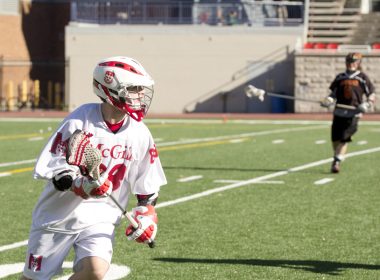
The Redmen have been the best team in the CUFLA this year. Following their Baggataway Cup victory last season, McGill has gone 10-0 against league opponents, winning games by an average margin of 10 points.

The Tribune has prepared an overview of the Redmen lacrosse team in anticipation of this weekend’s National Championships, hosted here at McGill from Nov. 1 to Nov. 3.

Offence

The Redmen have an incredibly strong offensive line, led by player-coach Kevin Donovan. Donovan currently sits in fifth place overall on the scoring leaderboard, with 28 goals and 37 points in eight games played. Other scoring standouts for McGill include third-year Connor Goodwin with 18 goals, co-captain Alex Rohrbach with 15 goals, and with 10 goals apiece, Richie Klares III, Leland de Langley, and Tayler Sipperly.

However, the biggest offensive strength for the Redmen lies in their balanced scoring attack, with no single player required to shoulder the scoring load. As a result, opposing defences cannot focus on stopping any one player and must be wary of numerous offensive threats.

Defence

McGill has a top-notch defence led by goalies Riley McGillis and William Waesche. McGillis has logged 497 minutes in the regular season, and has a Goals Against Average (GAA) statistic of 7.24; Waesche has logged 200 minutes with a GAA of 3.60. Both goalies have been outstanding for the Redmen.

Along with the goaltending, McGill boasts a stout defensive line led by co-captain Ossie Long. Long and second-year defenceman Quinton Bradley were named to the all-conference team in 2012.

Strengths

According to Head Coach Tim Murdoch, the strength of the squad lies not with one or two facets of the game, but rather with the mentality that the entire team has adopted. “[The captains] have been the heart and soul of this team,” he noted. “We have [Long], [Rohrbach], Brandon McLean, and Nolan Prinzen. We’re really lucky to have these four guys. In addition to their roles as captain, they do a lot of things off the field [….] It’s a top-to-bottom thing—captains down to the last man on the roster.”

McGill’s midfield line is also a source of pride for the team, as they boast arguably the most skilled midfield in the CUFLA, in addition to one of the deepest rosters overall. McGill has a balanced lineup, with no player in the league top 10 for minutes played. The squad boasts talented players at every position, allowing Coach Murdoch to minimize injuries and keep his team fresh.

Weaknesses

One key point to look out for are occasional lapses on the defensive end. This was most recently demonstrated in the Oct. 19 game against the NCAA Plattsburgh Hornets, in which the team played sloppy defence in the second stanza. However, the Redmen have the capability to rout their CUFLA opponents when the players stay engaged. The team’s youth belies its composure on the field.

McGill’s only challenge lies in battling complacency, as the Redmen have dominated their opponents so far. “It’s a fine balance [in regards to] complacency,” Long said. “We’ve kind of battled with that.”

”We don’t want to forget that we want to stay mentally and physically ready to go,” Murdoch added

Teams to watch

There are a number of teams that could make a surprise run for the Baggataway Cup this weekend. Brock University will pose the toughest challenge for the Redmen, as the Badgers finished atop their conference. While McGill has swept through its schedule undefeated, Brock’s lone loss came at the hands of the Western Mustangs, the team with the no. 2 position behind the Badgers. The Guelph Regals also have the ability to challenge for a spot in the championship, as they finished with a third seed in the tough Western Conference.

The Bishop’s Gaiters, led by Alex Henderson, pose the biggest obstacle for the Redmen in the East. McGill’s two games against the Gaiters in the regular season yielded narrow victories, in contrast to their clear dominance over other opponents.

While the rest of the CUFLA has made strides to take down McGill, no Canadian team has been able to defeat the Redmen in over a year. Expect the squad to win another Baggataway Cup, further advancing what is rapidly becoming a lacrosse dynasty.


(Cassandra Rogers / McGill Tribune)

#05 Alex Rohrbach

Position: Attacker
Height: 5-11
Weight: 160
Class: Third Year
Hometown: West Windsor, NJ (USA)
High School: West Windsor Plainsboro HS 2011
Academic Major: Finance

McGill Tribune: What was your favourite sport growing up?

Alex Rohrbach: It was definitely lacrosse. I also played football growing up. I did kicking, I was a receiver, and a defensive back—so I was always on the field. But I enjoyed lacrosse the most.

MT: How long have you been playing lacrosse?

AR: Since I was eight years old. My neighbour played lacrosse—lacrosse is very popular in New Jersey. I remember just having a catch with my neighbour, and thinking, ‘Oh, this is cool’, and wanting to check it out. That was right before going into the third grade.

MT: What made you come to McGill?

AR: I was attracted to McGill for a number of reasons, lacrosse probably being the least important. So definitely the high academics, the city of Montreal, the international aspect of McGill and living in Montreal—[those were] big factors. I had been studying French for a number of years—eight years, nine years—and I was definitely interested in improving my French and having a place to practice it. And lacrosse was my last factor.

MT: What’s your favourite sports team?

AR: I’ll probably go with the Philadelphia Eagles. New Jersey, it’s weird. You’ve got the Giants, the Eagles, and the Jets. I chose the Eagles.

MT: What are your plans for the future?

AR: Career-wise: exploring the world of finance and getting into central banking in the public sector. Possibly doing something with the Federal Reserve in the United States. That’s really intriguing to me.

#27 Nolan Prinzen

(Cassandra Rogers / McGill Tribune)

Position: Midfielder
Height: 6-0
Weight: 190
Class: Second Year
Hometown: Summit, NJ (USA)
High School: Summit Senior HS 2010
Academic Major: Economics

McGill Tribune: What was your favourite sport growing up?

Nolan Prinzen: My favourite sport growing up was definitely hockey, and it’s still my favourite sport today even though [I’m playing] lacrosse here. I was born in Canada, and moved to the U.S. when I was 10 years old. I played hockey growing up in Canada, but when I moved to New Jersey there was no Rec League hockey so I wasn’t able to play. But if I could have I definitely would have.

MT: How long have you been playing lacrosse?

NP: I’ve been playing since I was in grade six, so I’ve been playing for 10 years.

MT: What made you come to McGill?

NP: I came for the academic reputation. I knew that since I went to high school in the U.S that I wanted to come to Canada for [university]. I knew I wanted to play lacrosse in university so I came to McGill since it was one of the top tier teams.

MT: What has been your proudest moment on the field?

NP: [That] game against Guelph. We were down by two goals, we scored two to even it, and we scored the last one to win it with seven seconds left. No one expected us to win it in regular [time]; everyone expected it to go to overtime for sure.

MT: What’s the biggest challenge you’ve overcome?

NP: I think it was getting that National Championship off our back. Because we’ve had a good team for a while now, and we finally came together as one unit last year [….] [In the] semifinals, we were down and we came back. And the finals went to overtime and we had to try and trust each other that we were still going to pull off the win. With our backs against the wall, we came through.

MT: What’s your favourite sports team?

NP: The Toronto Maple Leafs.

MT: Who is your role model?

NP: My Dad. He was a really competitive athlete in his younger years. He played professional football. I always wanted to work my hardest, because I knew he did.

MT: What are your plans for the future?

NP: I’m looking to go [into] finance. I’m an Econ major. This summer I interned in wealth management with RBC in Toronto, so I’m looking to go a similar road as Rohrbach, but the wealth management side.


(Cassandra Rogers / McGill Tribune)

#02 Osburn (Ossie) Long

Position: Defender
Height: 6-0
Weight: 180
Class: Fourth Year
Hometown: Sarnia, ON
High School: Northern Collegiate 2009
Academic Major: Physical and Health Education

McGill Tribune: What was your favourite sport growing up?

Ossie Long: Box lacrosse.

MT: How long have you been playing lacrosse?

OL: I started playing when I was eight, so about 16 years.

MT: What made you come to McGill?

OL: It was just the last school that accepted me. I was psyched. I applied to some dusty schools, and I got into McGill so I was just like I’m jumping on this for sure. It was kind of spur of the moment [….] Didn’t know anybody that was coming here, just went for it. No regrets whatsoever. Five years baby.

MT: What has been your proudest moment on the field?

OL: Probably just coming back from a two-goal deficit with a minute-and-a-half last year in the [semifinals] against Guelph. That was definitely triumphant. I liked that a lot.

MT: What’s the biggest challenge you’ve overcome?

OL: [On the National Championship]: It’s a fine balance [in regards to] complacency. We’ve kind of battled with that. At the start of the year, everyone was like, ‘Oh, we’re the champs,’. It’s been a good season, but the real challenge lies ahead now.

MT: What’s your favourite sports team?

OL: I’m not a huge sports fan, I just like playing sports. So I’d probably say our team, the Redmen [and] my box [lacrosse] team in the summer. I don’t really watch sports so I’m more of a fan of the teams that I play on.

MT: Who is your role model?

OL: My younger brother always pushes me because he’s got an unreal work ethic, and I’m really competitive with him. So we always push each other in that way.

MT: What are your plans for the future?

OL: Scoping into this season, I want to be the first team in the East to defend the National Championship [….]  Cause Bishop’s [was] the first team in the East to win the title, so we have to be the first team in the East to defend it. And at home—that’s a sick opportunity.

I’m studying Phys. Ed., but I don’t know if I’ll teach right off the hop. I think I’m going to start a carpentry apprenticeship and just get some practical hands-on skills.


Tickets are $5 for students and $10 for guests. A tournament pass is $10 for students and $20 for guests.

a, Arts & Entertainment, Music

Overshadowed, but not overmatched

When I bring up Shad in conversation, I find that the number of people familiar with him is still frustratingly low. Many will shake their heads to indicate they have no idea who I’m talking about, but when someone is familiar with the emcee from London, ON, I can expect a wide grin to emerge onto their face—because they know. They know about the commanding flow, the exceedingly clever rhymes, and the endearing style that make Shad arguably the best Canadian rapper in the game.

Drake is the headline-grabbing icon in Canadian hip-hop, but it was Shad’s TSOL and not Drake’s Thank Me Later that took home the 2011 Juno Award for Rap Recording of the Year. Not long after that upset, Shad was honoured for another momentous achievement: a Master’s degree in Liberal Studies from Simon Fraser University (SFU).

“Basically, we’d do the canon of western literature and then take a range of classes from there,” Shad explains. “I kind of kept it as broad as possible. That was really my intention in going back—learning for its own sake.”

With the complexities of the English language at his disposal, rapping is a way for the self-proclaimed “nerdy jock” to take pleasure in his linguistic gift.

“I think the first thing I gravitated towards with rapping was just the fun aspect of it. It was fun to entertain, fun to make my friends laugh, and just kind of the joy of playing with language,” Shad explains.

Rap is a bona fide form of poetry, but Shad has gotten feedback from fans who are only interested in his music for its poetic elements. On “Stylin,” a single from his Oct. 15 release Flying Colours, Shad takes a bit of a shot at those who say things like “Oh hey Shad, I hate rap but I like you.”

“It’s not a big issue,” says Shad when I reference that line. “I think I address it in a bit of a playful way [….] but it is something that fans might not be aware of: how they’re heard, how they’re understood when they make that kind of remark, which is quite prominent for myself and an artist of my vein [….] I do think it’s worth pointing out.”

For Shad, the canon of rap carries the same weight as the canon of western literature. Take “Fam Jam” for example, a Flying Colours track that borrows the line “Not bad, huh, for some immigrants?” from the Kanye West and Jay-Z collaboration “Otis,” and makes it the chorus hook. He tells me about completing “Fam Jam,” a groovy tribute to the immigrant family and friends he grew up with in London after relocating from Kenya at a young age.

“That was a special one for sure [….] a song like “Fam Jam” is one of those [songs] where I’m trying to be a little more pointed and literally trying to describe a specific experience or situation; in particular a nuanced experience like that one, that really takes time to put into words and to put into music.”

Flying Colours’ “Progress (Part 1: American Pie, Part 2: The Future is Here)” shows off the flip side of Shad’s creative process. He starts off with a vague vision that leads to a seven-minute dystopian critique of ‘American’ identity and culture.

“I think I am talking about America more in the sense of an idea,” he says. “It’s a big song—it’s almost bigger than what I can put into words.”

He explains that the catalyst for the song was a parallel he drew between the premature deaths of Ritchie Valens and Buddy Holly, which are discussed in Don McLean’s “American Pie,” and those of rappers 2Pac and Biggie Smalls.

“And then that got my imagination going and it started spinning off into these cascading images [….] I think really it describes some underlying anxiety around some subconscious feelings about a new age that we’re entering. I think that’s kind of the centre of it.”

Despite occasionally rapping about America, Shad’s current tour takes him almost exclusively through Canada. He’s a fan of the domestic touring experience, especially some of the lesser-known stops.

“There’s little places that people might not know; cities like Guelph or Nelson or Victoria, that are very cool music cities, people are very interested in music and really down for an experience when they come to shows [….] People might not know these kinds of things unless they tour.”

Next week, Shad will be performing in St. Henri, a small district of its own within the greater Montreal city, before heading west and covering the rest of Canada. Not bad, huh, for an immigrant?

Shad performs at the Corona Theatre (2490 Notre-Dame West) at 8 p.m. on Nov. 6. Tickets are $30.65 online.

a, Sports

Season preview

Atlantic division

Brooklyn Nets 

The league’s newest big market franchise is looking scarier than ever. The Nets have acquired essential pieces in building their championship team this season with the additions of Kevin Garnett, Paul Pierce, and Andrea Kirieinko. Deron Williams can now relax and simply focus on distributing the ball. The only variable in the equation is new Head Coach Jason Kidd. It is too early to say if Kidd will be able to manage the minutes and personalities of this deep roster. The Nets should finish near the top of the Eastern Conference and make some real noise in the playoffs.

New York Knicks

The Knicks have been dethroned by the Nets for the title of best team in New York. This may be a surprise to many, but the Knicks do not have a roster that can contend for an NBA championship. Carmelo Anthony, Amare Stoudemire, and Tyson Chandler give the squad recognizable names, but this team must still figure out how to play cohesively. New York’s weaknesses will be exposed by a superior team in the playoffs. The Knicks have added a little bit more depth with Andrea Bargnani and Metta World Peace, but this won’t stop New York from finishing below the top spots in the East.

Toronto Raptors

The Raptors have made some big moves this year. They acquired Tyler Hansborough, Steve Novak, and even added Drake as a global ambassador in the off-season. Canada’s team is really starting to find its way after Bryan Colangelo’s resignation and the hiring of Masai Ujiri. The new nucleus for Toronto consists of Demar Derozan, Terrence Ross, and Jonas Valanciunas after trading Andrea Bargnani to the Knicks. Look for the Raps to finish around ninth or 10th in the East as the growing pains continue for the Raptors.

Boston Celtics 

The reset button has been pushed for one of the greatest franchises in NBA history. In the off-season, the Celtics traded away Kevin Garnett and Paul Pierce, two of the most important players to ever don Celtic green. This year, Boston is going to rely on mainly unproven talent while waiting for All-Star Rajon Rondo to recover from injury. Also, the Celtics introduced the precocious Brad Stevens as their new head coach.   the Celtics will just miss out on the playoffs.

Philadelphia 76ers 

It is safe to say that the 76ers will be the worst team in the NBA this year after falling victim to the promise that Andrew Bynum once had. Their first round draft picks—Nerlens Noel and Michael Carter-Williams—have multiple flaws. Noel is recovering from a knee injury and may not play this season while Carter-Williams can’t shoot, or play defense. Expect to see the Sixers at the top of every mock draft from now until Andrew Wiggins stands on stage to shake Adam Silver’s hand.


Central Division 

Chicago Bulls

Derrick Rose is back! NBA fans spent the entire 2012-2013 season wondering when the former MVP would return to the basketball court, and the time has finally arrived. With a starting lineup featuring the elite defensive play of Joakim Noah and Luol Deng, this team is  a defensive juggernaut. Jimmy Butler is the x-factor and needs to take the next step in his game and relieve some of the offensive pressure off of Rose. If Carlos Boozer is dealt away and the team receives adequate compensation, Chicago will be in the conversation to win an NBA Championship.

Indiana Pacers

Last season NBA fans saw Paul George mature into a legitmate NBA All-Star and lead the Indiana Pacers to within one game of the NBA Finals. This time around, the Pacers regain the scoring abilities of Danny Granger, who will complement the imposing defence of Roy Hibbert. The team struggled with awful bench-play all season, forcing rehired General Manager Larry Bird to bring in the veteran role players C.J. Watson and Luis Scola to help anchor the back-end of the rotation. With added depth and the return of Granger, this team is set to compete with the top of the East.

Detroit Pistons

If the Pistons are clicking on all cylinders, Motor City might be getting revved up to make some noise in this year’s NBA playoffs. Unfortunately, this won’t be the case. The Pistons had a video game-like off-season, bringing in the talents of Brandon Jennings and Josh Smith, but these skill sets come with glaring flaws. Both love to take ill-advised jump shots, and with only one ball to go around, it will be tough to see these players meshing. Detroit will easily make the playoffs as the sixth seed in an Eastern Conference that lacks depth.

Cleveland Cavaliers

The Cavaliers shocked the world this off-season by taking Anthony Bennett with the first pick in the 2013 NBA draft. They followed this up by adding sixth man of the year candidate Jarrett Jack along with the carcass of Andrew Bynum. The team will depend on the elite scoring and playmaking abilities of point guard Kyrie Irving and the development of Dion Waiters and Tristan Thompson to find success this year. If Bynum can’t make it onto the court this year, it could be another lottery-pick season for the Cavs in the post-LeBron era.

Milwaukee Bucks

The Milwaukee Bucks gave up on the inefficient and overrated offensive duo of Brandon Jennings and Monta Ellis and recplaced them with Brandon Knight and O.J. Mayo. The Bucks are built around a solid group of young role players, a plan that does not lead to success in the NBA. Look for them to try to acquire an All-Star calibre small forward to complement the defensive prowess of Larry Sanders. Unfortunately, the Bucks seem bound for another season stuck in middling purgatory. Milwaukee isn’t good enough to win a playoff series and isn’t bad enough to get a top five draft pick.


Southeast division 

Miami Heat

The Miami Heat enter the 2013-2014 campaign with no shortage of confidence, and why shouldn’t they? They have retained the core of their previous championships squads, led by the Big 3. After amnestying Mike Miller, the Heat took a considerable risk in signing the perpetually injured former no. 1 overall pick, Greg Oden. If he can withstand the demanding regular season and playoff schedule, he will provide a vital inside threat offensively and defensively.  The Heat are heavily favoured to become the newest NBA dynasty with a third consecutive championship.

Atlanta Hawks

The Hawks attempted to plug the sizable void left by losing franchise cornerstone Josh Smith with the talented and under-appreciated Paul Millsap. Although he may lack Smith’s athleticism, Millsap is a jack-of-all-trades forward who will contribute consistently while bringing a blue collar mindset. In the backcourt, Jeff Teague will have his hands full for the time being, while Lou Williams recovers from a torn ACL. The lack of perimeter options will limit Atlanta’s progress this season and may keep them out of the post-season for the first time in seven years.

Washington Wizards

The Washington Wizards have a lot to be excited about this season, which has not been the case since the departure of Gilbert Arenas. John Wall is poised to break out as a bona fide superstar, while Bradley Beal looks to build on his impressive rookie season. In recent trade activity, the Wizards acquired Marcin Gortat, who is one of the better defensive centres in the game.  It’s been a long time coming for Washington, but the team appears to be ready for their first playoff berth since 2008.

Orlando Magic

Ever since Dwight Howard’s departure, the Magic have been without an all-star calibre player. If his summer league and pre-season success are any indication, rookie Victor Oladipo may be that player somewhere down the road. Look for the athletic guard to contend for Rookie-of-the-Year honours. Third-year centre Nikola Vucevic gobbles up rebounds at a rate that has made fans forget about his predecessor, while Arron Afflalo and Jameer Nelson provide scoring support. The Magic are taking steps in the right direction but are not quite ready to be in the playoff mix.

Charlotte Bobcats

It feels as if the Bobcats have been in the rebuilding stage for years now. Bringing in Al Jefferson will provide Charlotte with a proven scorer for whom opposing defences will have to account on a nightly basis. The team’s best future assets are also their greatest current liabilities, as second-year small forward Michael Kidd-Gilchrist and rookie Cody Zeller are being thrust into the spotlight with very high expectations. A time will surely come when the potential talent of the Bobcats will come to fruition, but that time is not in the near future.


Pacific division

LA Clippers

After winning the Pacific Division for the first time in franchise history last season, the Los Angeles Clippers were knocked out of the playoffs in the first round.  This year’s team will be much improved after a busy off-season that saw the departure of Eric Bledsoe and Caron Butler, and the addition of Darren Collison, Jared Dudley and JJ Redick. However, the most important off-season change for the Clips has undoubtedly been hiring of Doc Rivers as their head coach.  With a strong core and deep bench, the Clippers will compete again for first place in the division this season.

Golden State Warriors

There was no team more captivating in the NBA last season.  Stephen Curry electrified the league with a breakout year that included topping Ray Allen’s record for three-pointers in a season.  With no significant losses aside from reliable bench pieces Jarrett Jack and Carl Landry, the Warriors are a rising force and will look to make the Finals for the first time since their 1975 championship team.  The acquisition of All-Star defensive menace Andre Iguodala will help the squad’s young nucleus grow. Golden State will now have the capability to fully embrace the role of a dark horse contender.

LA Lakers

Hollywood’s team is in for a long season. Nobody knows how many games Kobe Bryant will play after suffering a serious injury to his Achilles tendon last season. Steve Nash is nowhere near his prime, and Pau Gasol is at the centre of constant trade rumours. The starting five includes the likes of small forward Wesley Johnson and power forward Jordan Hill.  Coach Mike D’Antoni has little to work with, as the only significant newcomers are Nick Young and Chris Kaman.  It would be a surprise if D’Antoni makes it through the season before getting a pink slip.

Sacramento Kings 

The Kings are rolling the dice on the enigmatic DeMarcus Cousins, giving the talented but troubled big man a max level extension.  The move was probably co-owner Shaquille O’Neal’s idea, and although the genie’s wisdom can’t be doubted (see: Kazaam), this move is not going to push Sacramento above mediocrity.  Neither is the signing of breakout guard Greivis Vazquez or the play of rookie shooting guard Ben McLemore.  However, this is a promising young team that will definitely build on last season with the promises of a new era following a new owner, general manager, and head coach.

Phoenix Suns

This will be an interesting season in Phoenix as we watch how the Eric Bledsoe trade works out.  The team has impressive salary flexibility due to the departure of numerous veterans. Under first-year Head Coach Jeff Hornacek, the revamped Suns’ biggest obstacle will be finding cohesion among a group of fresh players.  Phoenix has shown a willingness to create a long term plan that involves mortgaging the present, and such intent will land them at the top of the lottery come draft time.


Northwest division

Oklahoma City Thunder

Even though the Thunder are clearly the class of the Northwest division, there are glaring flaws with the roster as it is currently built. Superstar forward Kevin Durant will have to shoulder a larger scoring load until Russell Westbrook returns. There are several question marks on this roster aside from the dynamic duo. Once known for its trio of young stars, the Thunder had to let go of All-Star guard James Harden to stay under the luxury tax—with minimal returns from the trade. If they are to succeed next May, the team will need consistent bench production from either Jeremy Lamb or Reggie Jackson.

Minnesota Timberwolves

For the past few seasons, the Wolves have been fighting the injury bug and the ineptitude of recently jettisoned General Manager David Kahn. If healthy, this year’s pack is a good bet to return the franchise to the playoffs for the first time since 2004. Presently, the team arguably possesses the league’s best power forward, Kevin Love. Look for him to lead a dominant offence with Ricky Rubio, and the newly acquired Kevin Martin. Defence will be a glaring liability at times, but if coach Rick Adelman can squeeze some passable defence out of his team, be prepared to pencil them in for a low playoff seed.

Denver Nuggets

It’s hard to be optimistic about the 2013-2014 Nuggets. Ty Lawson will put together dazzling fast breaks, Kenneth “The Manimal” Faried will hustle his way to rebounds he has no business snagging, and Nate Robinson will probably get hot off the bench and go for 50 points one night—but it’s fool’s gold to think that any of it will be enough to make the squad a lock for an 11th straight post-season appearance. This year’s group could be a pleasant surprise, but don’t expect the Nuggets to emerge out of a loaded Western Conference.

Portland Trail Blazers

Rip City spent the first half of last season in the thick of the playoff race thanks to another impressive year from LaMarcus Aldridge and the outstanding play of Rookie-of-the-Year Damian Lillard. Portland has a nice collection of pieces moving forward with C.J. McCollum, Thomas Robinson, and Meyers Leonard playing behind solid starters Nicholas Batum and Robin Lopez. While they brought in more young talent and addressed their once-laughable bench, the Trail Blazers are still a long shot to leapfrog fringe playoff teams in a deep Northwest Division.

Utah Jazz

By letting go of two established big men who helped them compete for the eighth seed the past two years, Utah cleared the front court for two developing big men who may play integral roles on a Jazz contender one day. Derrick Favors and Enes Kanter will fill the void left by Paul Millsap and Al Jefferson in the starting lineup, Gordon Hayward will log heavy minutes on the wing, and the young backcourt of Trey Burke and Alec Burks will aim to provi de perimeter support. If anyone in the Northwest is ‘Riggin for Wiggins,’ it’s Utah.


Southwest division

San Antonio Spurs

The Spurs came within one play of hoisting the Larry O’Brien trophy last season. Despite an aging core, San Antonio remains the favourite to win the division. While playoffs and a high seed are essentially a guarantee, there will be questions as to whether the team has the energy to make another deep playoff run. Coach Greg Popovich will likely employ the same tactic of limiting minutes for his ancient Big 3 during the season, in order to have enough in the tank come playoff time. With another year of experience under his belt, Kawhi Leonard’s role should also grow.

Memphis Grizzlies

This off-season featured a number of odd coaching changes. Former Grizzlies coach Lionel Hollins is among a number of coaches who were fired despite leading their team to success. Former assistant Dave Joerger will replace him, taking over a team that is hoping to improve on a 2012-2013 campaign that saw them make the conference finals before being swept by San Antonio. With very few changes in the roster, the Grizzlies are hoping that a change in tempo will lead to improvements.

Houston Rockets

The Rockets made the biggest splash this off-season, signing Dwight Howard to a four-year max level deal. The chemistry between Howard and superstar guard James Harden makes sense on paper, but is unproven on the court. Elsewhere, Houston must figure out whether Jeremy Lin is the answer at the point guard spot and whether center Omer Asik can capably mesh with Howard. The move to acquire Howard makes the Rockets a serious contender in a tough Western Conference, but the team lacks the depth that is needed for a long playoff run.

Dallas Mavericks

It wasn’t all that long ago that the Mavericks were crowned NBA champions, but it certainly feels that way. Since that season, Dallas has endured two seasons of mediocrity. The team added guards Monta Ellis, Devin Harris, and Jose Calderon in the off-season for slight improvements. The Mavs are in a difficult position: they aren’t close to being a contender, but are too good to bottom out. With very little salary on the books for 2014-2015, it seems that the Mavs could slide into a low playoff seed before what should be a very busy off-season.

New Orleans Pelicans

The Pelicans (formerly the Hornets) are often overlooked. In perhaps the toughest division in basketball, the Pelicans are sitting at the bottom looking up. The centrepiece of the ongoing rebuild is  Anthony Davis. The ‘Brow is a special talent, but the Pelicans gave him little to work with last season. This off-season they traded for young guards Tyreke Evans and Jrue Holiday. The two of them join Eric Gordon in a backcourt that should fill up the stat sheet. The Pelicans have young talent on its roster but the team will need more experience before it can get back to the playoffs.

Read the latest issue

Read the latest issue