



Scientists have studied the expansion of the universe since the 1920s, when the field was pioneered using Albert Einstein’s field equations and theory of general relativity. This work posits that a universe filled with matter and energy cannot remain static: The space between galaxies is dynamically stretched over time.
On the exterior of individual galaxies is the circumgalactic medium (CGM)—an atmosphere of low-density gas that exists around and between cosmic systems. The CGM contributes to star formation and regulates cosmic expansion through the absorption and cooling of star-forming material.
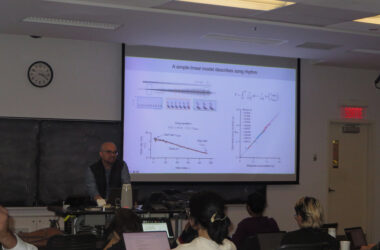
In a seminar with the Trottier Space Institute at McGill on Oct. 27, Chris Carr, a presidential fellow and researcher at Princeton University’s Department of Astrophysical Sciences, discussed the CGM-galaxy connection, how matter and energy cycle in and out of galaxies, and how this contributes to the self-regulation of galactic growth.
This process begins when baryons—heavy subatomic particles—accrete into dark matter potential wells and pull on exterior gases, causing them to accelerate inward and settle into a halo-like structure. This movement creates a shock radius of high temperatures, and ultimately produces the CGM.
“Material that’s accelerated due to the potential wells eventually hits supersonic speeds, and crashes into material that’s already there. This process forms a virial shock […], and through this rapid compression, kinetic energy that was already there thermalizes […], transition[ing] [into] what we call the shock radius,” Carr said.
Afterwards, this thermal energy begins to leave a halo, and as the gas cools, it condenses inward, where it builds galaxies. In experiments simulating this process, researchers have found that rapid acceleration followed by cooling leads to the formation of overly massive galaxies that are far larger than what exists in the real universe. This effect has become known as the overcooling problem.
Carr’s research looks beyond how the CGM is involved in supermassive galaxies, and investigates how low-mass galaxies regulate star formation. Galaxies with less mass act differently because they have much weaker gravitational fields that cannot retain the star-forming cold gas and thermal energy that more massive galaxies can.
“[There are multi-phase] winds [coming from supernovas],” Carr stated. “You have gas at very low densities and high temperatures moving at fast velocities, [with] dense clumps of gas at lower temperatures being wafted up by this hot wind.”
Essentially, supernovas occurring in the interstellar medium (ISM) bring energy and mass into the CGM in the form of hot galactic wind. This heat expels cold gas, thereby preventing formation of the cool, dense clouds that serve as fuel for new stars. When running simulations to approximate energy, mass, and metal quantities, researchers applied loading factors to assess how these components contribute to the function modelling star formation.
“People in the past have adapted gas regulator models where you can think of the CGM, the stars, and the ISM as […] reservoirs, which exchange [mass, energy], and metals at different rates within some growing halo that’s accreting material from the surrounding ISM,” Carr said.
Carr’s lab has been able to independently track these flows of mass, energy, and metal in order to demonstrate their impacts on galactic properties.
“One of the key insights of [our] work […] was that [the] final stellar mass calculation was pretty insensitive to [the] choice of mass loading factor,” Carr said. “While the cell mass actually seemed remarkably sensitive to [the] choice of energy loading, as you increase the energy loading, you are driving more energy out of the halo.”
This finding was significant, as it demonstrated that by pressurizing the CGM, you are more effectively driving material out of it, thereby limiting its galaxy’s growth by cutting off fresh material that helps with formation.
While Carr is still in the early stages of his research, he has already established that the CGM-galaxy connection is critical for understanding the dynamics of our universe. With regard to low-mass galaxies specifically, Carr has discovered more effective mechanisms of measurement, and contributed to the furthering of smaller-scale galactic regulation. He hopes to continue this line of inquiry, and look for more answers on how our universal plane of existence unfolds in the cosmos.