
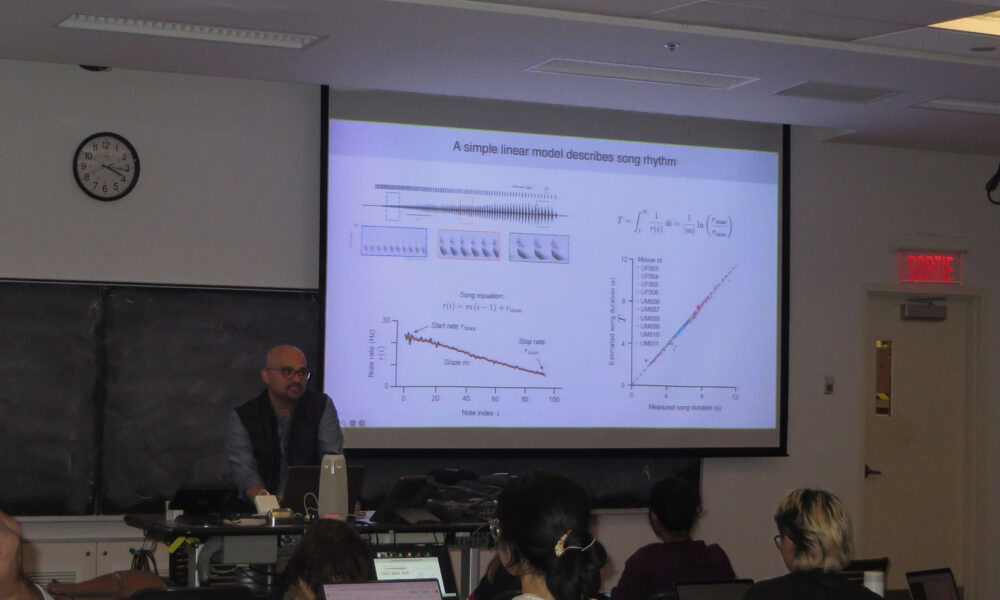

Picture this: A 15-gram mouse climbs onto a rock, tilts its head back, and belts out a song. While this may sound like a fairy tale, singing mice are real, and are helping scientists discover new ground in evolutionary neurobiology. In last week’s edition of McGill’s Neurobiology and Behaviour seminar series, Associate Professor at Cold Spring Harbor Laboratory Arkarup Banerjee discussed his research on how evolutionary changes in neural circuits can give rise to new behaviours, modeled by Alston’s singing mice.
The talk, which took place on Oct. 30 in the Stewart Biology Building, opened with the children’s stories that inspired Banerjee’s focus on these mice.
“Maybe some of you have read the Just-So Stories written by Rudyard Kipling. He was exploring ideas like, how does the camel get its hump, […] or how does the elephant get a trunk?” Banerjee began. “In our lab, we work with these highly vocal Costa Rican singing mice that have evolved the ability to sing, [which is] a unique trait in rodents. And just like Kipling, I’m interested in how the singing mouse got its song. But unlike Kipling, who frankly just made up his explanations, hopefully what I’ll tell you is actually true.”
Alston’s singing mice, from the cloud forests of Central America, produce a loud, high-pitched, highly structured song hundreds of times per day. One song consists of about 100 rapid notes over seven seconds, starting fast and quiet and getting louder and slower. These mice also love a duet, and when one hears another, it will answer within about a fifth of a second. Banerjee further described a more variable, softer kind of “voice”—called ultrasonic vocalizations (USVs)—that these mice exhibit when in close quarters to one another.
Scientists call these kinds of habits behavioural innovations, and Banerjee aims to discover what has to change in the brain for such an innovation to appear.
The study looks into whether songs and USVs operate under the same mechanism, and whether that mechanism works like a vibrating guitar string or a whistling recorder. To determine this, Banerjee and his colleagues had the singing mice inhale helium, which would make their voices higher only if their sounds were created through a whistle mechanism. They discovered that while the mice’s songs and USVs sound completely different, they are made the same physical way: by whistling air through the voice box. Since the instrument is the same for USVs and songs, the difference has to lie in the brain controlling these sounds.
So, Banerjee moved to the mind. His team compared the brains of singing mice and ordinary lab mice; while Banerjee said he expected these organs to look quite different, he found they were almost identical.
If a singing mouse’s brain looks the same as a lab mouse’s, then why do only some mice sing? Banerjee next moved to studying individual brain cells. His team gave each brain cell in the motor cortex—the movement and planning area of the brain—its own unique DNA barcode tag, allowing researchers to trace where each cell sends connections.
After tagging approximately 76,000 cells across the two species, Banerjee’s team found that more cells made certain connections in singing mice compared to in lab mice. Two destinations stood out, each roughly three times more likely to receive a connection in singing mice than lab mice: the periaqueductal gray (PAG), a midbrain region that works as an on-switch for vocalization, and the auditory cortex, the brain’s hearing area.
To test whether this boosted connection actually drives song, Banerjee and his colleagues used a toxin to gradually shut off the cells in mice PAGs that receive signals from the motor cortex. They then recorded songs over 12 days. On Day 4, the opening of the mice’s songs got choppy, and through Day 8 and 12, the songs got quieter and lost their rhythm.
“By the end of 12 days, it actually does not [sound] like [a] song at all,” Banerjee said.
Finally, the team had found their answer: Singing mice did not evolve a new part of the brain, they just turned up the volume on a connection in the PAG that all mice already have.
“My null model when I started doing this project was that drastic changes in behaviour [require] drastic changes in neural circuits,” Banerjee said. “I now find many examples where there are quantitative changes in pre-existing circuits […] that may be a widespread mechanism for rapid behavioural evolution.”