
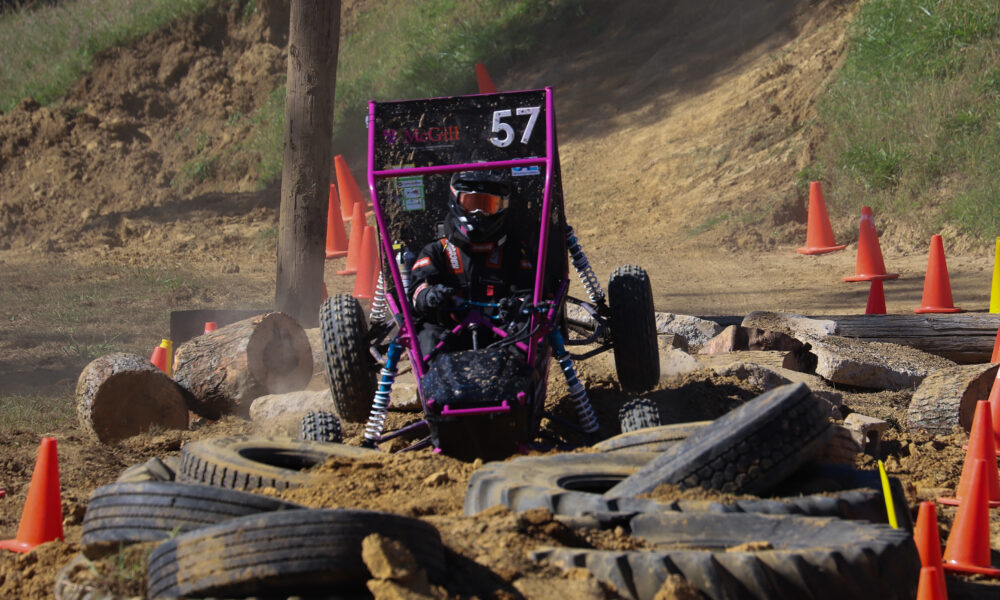



For most people, a car flipping sounds like a tragedy. But for McGill Baja Racing (Baja), it’s a routine part of their intense off-roading competitions. Every year, Baja, one of McGill’s Faculty of Engineering design teams, models and manufactures a new single-seat off-road vehicle. This off-roader is then raced in international competitions hosted by the Society of Automotive Engineers (SAE).
In an interview with The Tribune, Elsa Edwards, U4 Mechanical Engineering and Baja archive, events, and SAE lead, spoke about Baja’s design process and what competitions are like.
“The whole fall [semester] is dedicated to design because it’s a really long process, and you have to work with the [team’s] previous car to understand what you want to improve [and] why you want to improve it, [which] requires a lot of time and testing,” Edwards said. “[Design] happens through research and development, data collection from the old car, and [the creation of] a computer-aided design.”
Once the design phase is finished, the team moves onto manufacturing. SAE gives teams a model specification for a single, standard engine; the rest of the offroader, the team must figure out on their own. Much of their manufacturing is done by students in-house, while some of the more complicated work is sent to McGill machinists.
“Not only do we have machines [in the workshop] that we [as students] can use, like a mill and a lathe to turn metal stock into whatever form we desire, but we also have professional machinists in the shop downstairs who take care of more complicated […] parts. We are really lucky to have them, and they produce what we need,” Edwards said.
Along with more common machine technologies, Baja boasts a welding station. Their chassis—the skeleton of their off-roader—is made of steel tubes welded together by members of the team. Becoming a welder is quite an undertaking. Students are required to undergo a number of additional safety and procedural training courses to use this machinery.
“Access to the [welding] shop requires Workplace Hazardous Materials Information System [(WHMIS)] training and an in-person safety training, but you can become a welder on the car after a year of welding training,” Edwards explained. “We have a dedicated team of welders that are always there to answer questions.”
Once the off-roader’s chassis is built, each subsystem is attached to the car’s frame using welded brackets. From here, the team begins troubleshooting and testing until the off-roader is ready for competition.
Held in the summer, SAE competitions include both dynamic and static events. The car is assessed on everything from its traction control and maneuverability to business-style presentations about its design cycle. Dynamic events are time-based, where cars compete to achieve the fastest time in a race, or the greatest number of laps in a set period.
“Endurance is our biggest challenge. It’s the [dynamic event] that’s worth the most points in our final scoring, and it’s four hours of continuous racing, and you have to do as many laps as you can,” Edwards said. “So it challenges your speed, and it challenges your car’s reliability, because the track also has challenges. Sometimes there are inclines, sometimes there are big bumps that challenge your suspension and traction [….] It’s really looking for your car to be reliable, and oftentimes, parts of [the] cars will break. And then you take it off [the track], you pit it, [and] you fix the [issue] as quickly as you can.”
This year, Baja’s first competition falls in early May—a much earlier date than the competition’s typical June start. Edwards explained that leads and general members will have to be extra conscious of their time as a result. But despite the closer deadline, Edwards maintained that this competition will be the highlight of the Baja program’s year.
“Going to competition and seeing [the off-roader] run is a really rewarding experience, and you get to be there with all the people that worked on it with you,” Edwards said. “It’s a big bonding time for the team.”