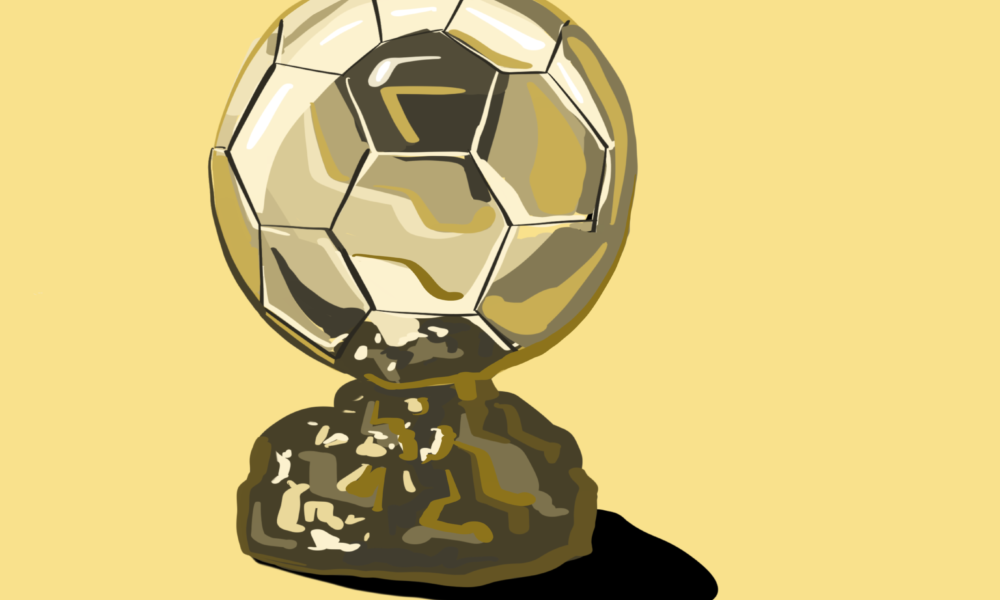



Football forward Harry Kane was cut from Arsenal Football Club’s academy when he was eight years old for not being athletic enough. Yet on Oct. 26 of this year, at the London Palladium, he lifted the Ballon d’Or, an award honouring the best-performing football players over the course of the previous season. He is the first Englishman to win the trophy since Michael Owen in 2001.
The road between those two moments was long. When Kane finally made it to the big leagues, Tottenham Hotspur FC loaned him to Leyton Orient FC, Millwall FC, Norwich City FC, and Leicester City FC before he became Tottenham’s all-time top scorer. Now playing for Germany’s Bayern Munich FC, in the 2025-2026 season, Kane scored 73 goals in 65 games, won the Bundesliga and the DFB-Pokal, and helped England earn third place at the 2026 Fédération Internationale de Football Association (FIFA) World Cup.
Kane did not have the night to himself. Spanish athletes took over the show, with superstar Alexia Putellas winning the women’s award for a third time and Lamine Yamal taking home the Kopa Trophy for the best young player once again.
Kane’s Ballon D’Or win was far from certain. Vincent Garcia, editor-in-chief of France Football, told L’Équipe that Kane’s margin of victory over Kylian Mbappé was smaller than the 41 points that separated Rodri and Vinícius Júnior in the 2024 ceremony. The final tally showed just how close the race was: Kane earned 1,055 points, only 28 more than Mbappé’s 1,027. In a vote this tight, the people casting the ballots matter almost as much as the players listed.
Few fans know who these voters are. The panel consists of one specialist journalist from each of the 100 nations at the top of the FIFA national team rankings, evaluating 10 men’s players from a 30-player shortlist. Each journalist chooses their top 10 from the shortlist, and each first place vote awards the player 15 points, down to one point for 10th place. The ranking is based on three criteria: individual performance, collective performance and achievements, and class and fair play.
This year’s podium defied those criteria. Mbappé came second in the Ballon D’Or rankings after a trophyless season with Real Madrid. Meanwhile, 19-year-old Yamal won the World Cup with Spain, yet finished third in the ceremony. Garcia explained that Yamal scored once in the tournament and started injured, and that Rodri, voted the tournament’s best player, took Spanish votes away from him.
The individual ballot voting system raises questions of its own. In 2025, Scotland’s juror, John Greechan of the Edinburgh Evening News, ranked his country’s midfielder Scott McTominay first despite him finishing 18th overall in the Ballon d’Or rankings. One ballot does not prove national loyalty, but this year, when Greechan explained why he voted for Kane—arguing that his six World Cup goals and outstanding season made him impossible to overlook—Greechan directly acknowledged his belief in a Scotland–England rivalry that could bias him towards Scottish players. This case reveals jurors’ potentially skewed judgment.
The Ballon D’Or voting criteria also does not change even when considering drastically different positions on the field. This year’s top 10 rankings consisted of eight attackers and two midfielders, while the highest-ranked defender, Pau Cubarsí, finished 12th. A centre-back needs an extraordinary season to compete with a striker on the same ballot. France Football has created separate trophies for goalkeepers and top scorers, but they have done little to broaden the awards criteria, which largely favour goalscoring ability, thus prioritizing forwards.
International tournaments add another grey zone to the voting process. Lionel Messi’s 2023 Ballon D’Or win followed Argentina’s 2022 FIFA World Cup title, and Rodri’s 2024 win followed Spain’s European Championship victory the summer before. Yamal’s third place, despite winning the World Cup, suggests that this year’s jurors gave international success less weight than their predecessors. It is up to each voter to decide how much a month-long tournament should weigh against a 10-month club season when casting their ballot.
The soccer calendar blurs the picture further: Ballon d’Or voting closed on Sept. 28, weeks into a new club season that began at the end of August, while jurors were meant to exclusively judge the season before it.
The process behind Ballon d’Or wins like Kane’s deserves the same scrutiny players often receive. Though France Football has published every ballot that determined the results of the Ballon D’Or ceremony, fans should be able to ask each juror to justify their top choices moving forward: letting fans properly evaluate the judges for their votes.